
Wednesday
May 14, 2025
Spring · 7 entries
spine is also as part of the
and let the pelvis kindof
1. Why resistance bands work for end-range strength
Resistance bands provide what’s called variable resistance: the further you stretch them, the more resistance they provide. This makes them perfect for training end-range strength—that’s the strength required when your muscles are either fully lengthened or fully shortened. Think of the top of a backbend, the deepest point in Supta Kurmasana, or holding your leg behind your head: these are all end-range positions.
Unlike free weights, bands make it harder as you move deeper into the range, which is the opposite of most real-life strength patterns (where you tend to be weakest at the extremes). So by training at those extremes with resistance bands, you’re preparing your muscles and joints to be strong, stable, and supported in yoga’s most demanding positions.
2. Why that’s good for Ashtanga yoga
In Ashtanga, especially the Intermediate Series and beyond, we are constantly exploring the limits of flexibility and control. But:
• Flexibility without strength is like stretching a rubber band with no tension—it’ll snap or sag.
• End-range strength helps prevent injury by supporting joints in vulnerable positions—like Kapotasana or Karandavasana.
• It also helps balance the nervous system’s stretch reflex. If your nervous system doesn’t trust you to be strong at end-range, it will limit your flexibility. But when it feels you’re strong and stable, it lets you go deeper—safely.
3. Systems Thinking
From a systems view, resistance bands act as an elegant feedback mechanism. They amplify the demand precisely when the system (your body) is most vulnerable—end-range. By strengthening the feedback loop between mobility, control, and proprioception, bands help shift the whole system (your practice) toward resilient adaptability—aka fewer injuries and deeper poses with less drama.
They are really great for proprioception and intrinsic stability.

They are really great for proprioception and intrinsic stability.

ashtanganurse
Practicing yoga is a privilege.
So is choosing to vaccinate your kids... more
®
IS YOGA JUST A
PERSOI '.
PRACTICE?
know what you're thinking.
4 likes • 1 reply
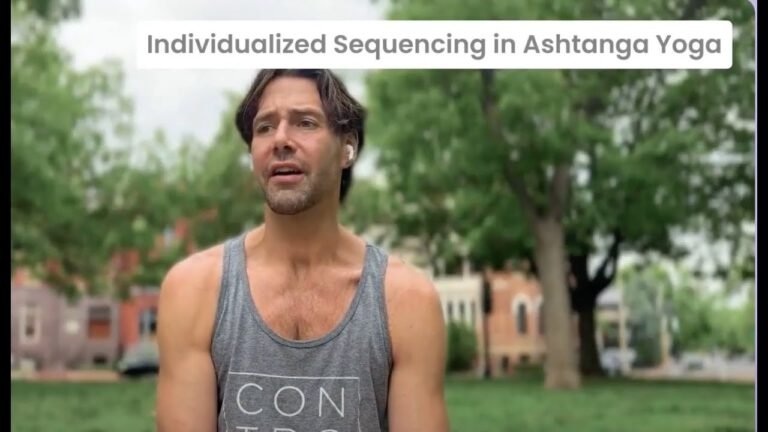
Individualized Sequencing in Ashtanga Yoga
Individualized Sequencing in Ashtanga Yoga --- **Introduction** Hello! Michael Joel Hall here, diving into the world of individualized sequencing in Ashtanga Yoga. While Ashtanga is known as a structured system, it's crucial to realize that adaptability is its core strength. Without it, the practice becomes fragile. The traditional sequence, developed throughout the late 20th century, is designed to cultivate strength, flexibility, and resilience through its progressive and intentional design. But what happens when the system faces the individual realities of injuries, physical limitations, and unique biomechanics? --- **Understanding Challenges and Adaptations** Ashtanga Yoga, like any practice, meets unique individual challenges. When faced with pain, limitations in breath stability, or when a posture aggravates an existing injury, adjustments become essential. It’s vital to adapt intelligently without compromising the essence of the practice. Obstacles such as existing injuries or unique physical structures can sometimes act as barriers that cannot be overcome by sheer determination or force. --- **Integrating Therapeutic Adaptations and Vinyasa Flow** Therapeutic adaptations can be integrated smoothly without breaking the vinyasa count, by maintaining the rhythm of breath and incorporating regressive movements that facilitate appropriate breathing and motion. The core purpose of Vinyasa is to preserve the continuous flow of energy. As long as substitutions support these core goals rather than disrupt them, why not embrace them? This way, the integrity of the system remains intact. --- **Balancing Tradition with Sustainability** One of the significant challenges in modern Ashtanga Yoga is balancing tradition with the sustainability of practice. As we incorporate our western conditions and lifestyles, rigid adherence can lead to more injuries or create unnecessary exclusion. There’s a misconception that modifying the practice will dismantle its structure, but that only happens if modifications are made without discernment. Understanding why the sequence exists and adapting it with respect and intelligence gives it a long-term vision. For me, this practice extends beyond a single session. It’s an insight practice—a lifelong journey. Don’t you want a practice that offers lifetime insights? --- In conclusion, individualized sequencing in Ashtanga Yoga is about making intelligent adaptations to honor both the tradition and personal needs. This nuance allows for sustainability and inclusivity, ensuring that the practice benefits each practitioner uniquely over their lifetime.
Read the essay →Get MichaelFilter
Enter your email. We'll send a one-tap link to read today's edition free, in your browser — the link works for 24 hours. Membership unlocks every issue, PDFs, and transcripts.
Already a member of theyoga.club or ashtanga.tech? You're already on file — no re-registration. We won't add you to any list.