Friends
12 entries in 2010 · oldest first
Today in CrossFit we worked on a lifting technique that’s familiar to a lot of my friends. Not because they participate in functional training, but because it’s a little like what happens on Friday nights. No, not getting drunk and losing your car. Think dance floor: droppin’ it like its hot. Back Squats, you see, are (at the most basic) lowering your hips with your knees a little out, the back extended, and a bunch of weight resting across the back of your shoulder. You may have seen something like it in a rap video.
This isn’t going to be a post about how to squat– talk to a trainer for that kind of info (seriously: real life is so much different than what a even a good youtube video can prep).
No, today I wanted to talk about being honest with yourself.
If you don’t take your hips lower than your knees in a squat, you’re cheating yourself out of a huge strength gaining opportunity (isn’t that why we lift weights?) and even have the potential to lose some of our range of motion. Why would we allow that to happen? Because going all the way is, without question, harder.
Like many little white lies we tell ourselves, its easier to do just a little less, such as going just shy of breaking parallel in our squat. It makes things easier, you work less hard– but ultimately, whats the point? Wasted energy, and on top of that, a little bit of dishonesty, too.
Dishonesty, it would seem, comes in degrees. I mean, you’ll be able to knock out more squats, but are you actually “doing the work”? When tempted to do less than your best, remind yourself that “this is not useful.”
Then work to cultivate the opposite.
Why?
The yoga sutras say that as truthfulness (satya) is achieved, the fruits of actions naturally result according to the will of the yogi. If you desire to be better, and you really want to get what you want– you know real gains and real improvement– you gotta be honest with yourself.
Eschew the aesthetic or the illusion and go for whats real. Cultivate the opposite of dishonesty, reminding yourself when prompted otherwise that “this is not useful” and let a natural flow of goodness into your life that will also bear fruit.
On the mat, under the bar, or at the bar.
Have you ever sucked in your gut to create that creepy too-big-rib-cage effect? Then odds are good you’ve used a muscle called the Transverse Abdominus. The TA is an important link in the deep kinetic chain of the body that allows for power from the low body to relate and transfer into power for the upper body (and vice versa) via increased stabilization in the pelvic girdle (and how it relates to the shoulder girdle).
As many of you know, I spend a ton of time throwing heavy stuff over my head– like, um, my body. If I want to improve, how do I go about it? Accessing the TA. It’ll seem obvious when I say this, but bear with; the more consolidated the core, the more control we have in all sorts of actions (olympic lifting, handbalancing, keg-standing).
 Think about your core:
What do we have hiding underneath the skin?
First, the obvious:
- The big-sexy-six pack: aka the up-and-down rectus abdominus.
- The Side-abs: the external obliques.
These guys are all associate with torso flexion. They allow the body to “crunch.” Thats all well and good, but it doesn’t neccesarily speak to stablizing during the “crunch” or, heck, any other activity that might require you to not wobble (I think I can think of a few).
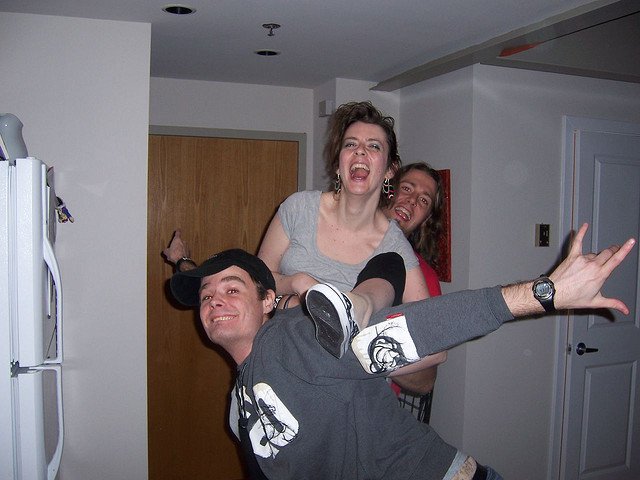
Much like my friendship networks of yore, the stable buddies can sometimes go less noticed in leiu of the louder (erm, less “stable”) friends.
Who handles the stabilization, then? The less obvious nonsuperficial muscle:
- The internal obliques: You can think of them as Patrick Swayze’s hands on Baby’s torso during the lift scenes. They function like that, cradling and lifting. The fibers of this muscle run perpendicular to their external brethren.
- The multifidus: Weaves along each disk of the back, and works to stabilize the joints at each segmental level. The stiffness and stability makes each vertebra work more effectively, and reduces the degeneration of the joint structures.
- The transverse abdominus: beneath those, we find a corset like muscle going around the bottommost portion of the spine (lumbar) and connecting all the way up to the low ribs.
When you draw the navel in towards the belly, you’re engaging your real core, your inner corset. The transverse abdominus contracts inwardly, bringing everything internal closer together. This is required for consolidated movement and efficient energy usage.
The multifidus is very small, but it has a unique design that lends stability to the spine , as well as working to keep you upright. When the multifidus is put on a stretch, as when you bend forward, it actually gets stronger. This is unlike most muscles which, when lengthened, lose their strength. The multifidus also brings space to the disks of the back, and brings the pelvis into a more powerful alignment for bigger (safer) actions.
The internal obliques are our same-side rotators. . It acts with the external oblique muscle of the opposite side to achieve this torsional movement of the trunk. For example, the right internal oblique and the left external oblique contract as the torso flexes and rotates to bring the left shoulder towards the right hip.
So how do we strengthen these good muscles and program ourselves to engage them regularly?
This method is super easy, but also not the most exciting thing in the world. Truth be told, at any given point, you can contract your transverse abdominus, internal obliques, and work your multifidus.
Egg Timer Method:
Draw in your innermost layer of abdominals without collapsing the chest. Draw up and in with the navel until the ribs splay, and then draw back in. Avoid slumping the shoulders. Imagine a zipper from the low back that goes to the navel, and zip it up, too. This will work the multifidus. Hold this contraction for 30 seconds. Repeat after a brief rest. Do this 5 times. Include one legged standing tilts (such as Warrior III in yoga). Repeat a few times a day. Next week make it 45 seconds. Third week? A minute.
String Method:
While drawing in the TA, tie a string around your midsection along the natural waist. For the rest of the day, every time you notice the belly flesh digging into the string, draw the belly back in. Do this consistently. Full disclosure: I haven’t done this yet.
The Benefits:
- a (dramatically) smaller waist line
- confidence in strength
- good balance
- safety in “big lifts” and “big jumps”
- decrease in low back pain
Here's hoping my friends with kids take heed.
http://www.cnn.com/2010/US/05/18/doll.study.parents/index.html
http://www.washingtonpost.com/wp-dyn/content/article/2010/11/01/AR2010110106050.html


10)
Mat



10)
Mat
Get MichaelFilter
Enter your email. We'll send a one-tap link to read today's edition free, in your browser — the link works for 24 hours. Membership unlocks every issue, PDFs, and transcripts.
Already a member of theyoga.club or ashtanga.tech? You're already on file — no re-registration. We won't add you to any list.