















Similar Posts
Balancing the Scales: Subjectivity versus Objectivity in Ashtanga Yoga Practitioner Development
Introduction There’s a certain push-and-pull that lives at the heart of every serious Ashtanga practice. On one side, there’s the deeply personal, lived experience—the hum of your own breath, the way your body feels in Kapotasana today compared to last Tuesday, the private territory only you can navigate. On the other side, there’s the mirror held up by the outside world—your teacher’s keen eye, the lineage’s standards, the unblinking honesty of a video replay. Neither side holds the whole truth. Our inner compass is essential; it keeps the practice from becoming hollow repetition. At the same time, relying solely on our inner sense can keep us circling our own blind spots. The real magic happens in the meeting place between the two—when our subjective, felt…
What is Ashtanga Vinyasa Yoga? What’s Mysore Style? And More!
Over the last few years, I’ve received all sorts of questions about the type of yoga I practice and teach. Since before my last trip to India, I’ve been teaching Sunday-Friday at Kali Yoga Studio in Columbia Heights in a traditional format called “Mysore Style” Ashtanga Vinyasa Yoga. We call this program “DC Ashtanga.” In my experience of both practicing and teaching, I have come across no system of yoga more effective, exacting, or straight-up powerful as Ashtanga Vinyasa Yoga as it’s taught in Mysore. Right now, we have a $45-two week get-started special that will help new practitioners get their feet off the ground and flying high. Like sugar’s taste, its hard to explain, easy to experience. (and pretty darn sweet) Without further ado:…
Body Diversity in Ashtanga
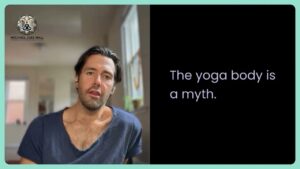
This is a video about Body Diversity in Ashtanga. Visit michaeljoelhall.com/coaching to book a session if you’d like to chat about your practice.
00:00 Body Diversity in Ashtanga
00:23 The Functional System of Ashtanga Yoga
00:42 The Myth of the Yoga Body
00:54 Promoting Inclusivity in Yoga
01:09 Embracing an Embodied Practice
visit michaeljoelhall.com/coaching to book a session.
What Do You Enjoy Doing?
The first twenty minutes go the same way every time. A new client comes in and we inventory the damage. Where it hurts, how long it’s been hurting, what they’ve tried, what failed, what the doctor said. It’s useful information. I need it. But after a while it starts to sound like a case file, and a case file isn’t a person. So I change the subject. “What do you enjoy doing?” I ask. Not what they used to enjoy before the injury. Not what they plan to get back to eventually. What do they do for fun, right now, this week, in their actual life. The question lands strangely. There’s always a pause. Not a polite one — a real pause, the kind that…
Integrating the Physical and the Spiritual
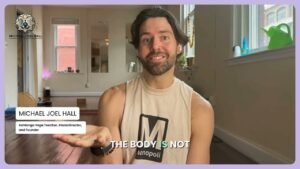
This video features Michael Joel Hall discussing the inherent link between physical mastery and spiritual depth in Ashtanga Yoga. Hall explains the integrative approach of the Tristhana method which combines breath (pranayama), posture (asana), and gaze (drishti) to create a holistic path of transformation. He emphasizes the symbiotic relationship between body and spirit, where physical practice enhances mental clarity and emotional balance, and spiritual engagement infuses intention into movements. Progress in Ashtanga Yoga is measured by how the philosophy is applied to physical postures and further integrated into everyday life.
00:00 Introduction to Ashtanga Yoga
00:18 The Trisana Method: Breath, Posture, and Gaze
00:42 Symbiotic Relationship Between Body and Spirit
01:03 Applying Philosophy to Practice
01:35 Conclusion

how does compression work help you find concavity without fighting your hips?
This is Ashtanga Yoga Tech Support. Real questions from the yoga community, answered. The Question I've been thinking about using compression work with my legs parallel so I can find the concave quality in my stomach while letting my hips move naturally. Does that make sense as a way to work? — from a MJH note Our Response Yes. That’s exactly the direction.Compression work with parallel legs gives you a container. You get to feel what your abdomen does when your hips aren’t externally rotated, when there’s no flinch pattern steering you away from the midline.
—
Read more: https://ashtanga.tech/tech-support/how-does-compression-work-help-you-find-concavity-without-fighting-your-hips/
All content: https://mjh.yoga
#ashtanga #yoga #ashtangayoga #techsupport #ashtangatech
Notes from the field
No notes yet · members & customers welcome
- No notes yet. Be the first to leave one.
Join MichaelFilter
Michael Joel Hall’s daily reading — the field journal, critical-thinking cards, and synthesis — as a membership.
$5.50/month · cancel anytime
Join — $5.50/mo →Secure checkout on theyoga.club. A yearly option ($55) is available there too.