
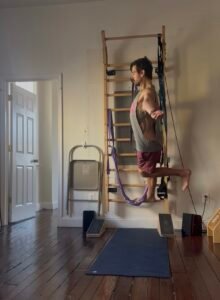
The 40Hz Protocol: Ashtanga Yoga as a Multimodal Gamma Entrainment System

The 40Hz Protocol: Ashtanga Yoga as a Multimodal Gamma Entrainment System

Neuroscientists are designing elaborate protocols to induce gamma oscillations in the human brain — flickering lights, transcranial currents, near-infrared light helmets. A 2024 review in Frontiers in Neuroscience catalogues four distinct stimulation methods to achieve what the brain needs to perceive clearly, move well, and regulate emotion. Reading it, I kept having the same thought: Ashtanga yoga already does all of this. Not metaphorically. Simultaneously, and without a single device


Introduction to Ashtanga Collider Theory

Introduction: When Effects Distort Our Understanding of Causes In 1946, statistician Joseph Berkson noticed something peculiar in hospital patient data: diseases that should have been independent appeared to be negatively correlated. Cancer patients seemed less likely to have diabetes, and vice versa. This observation seemed to contradict everything known about disease independence. The answer to this paradox would eventually reveal one of the most counterintuitive principles in causal reasoning—the collider effect. A collider is a variable that sits at the convergence point of two or more independent causal pathways. The structure looks deceptively simple:Variable X → Collider Z ← Variable Y Two independent causes (X and Y) flow into a common effect (Z). But here’s the paradox: when we condition on the collider—when we only…

Getting Better at Causal Loops and Drawing Inferences

Revisiting Rule 1: Independent Variables Are Not Correlated Restating the Argument In Ashtanga Yoga, not all elements of practice are causally connected. For example, focusing solely on aesthetic performance (e.g., how a posture looks) often leads to false assumptions about progress. Understanding this independence helps practitioners avoid wasting energy on irrelevant or misleading correlations. Detachment (vairagya) serves as a guiding principle for staying grounded in what truly matters. Counterpoints, Holes, and Second Opinions 1. Do Variables Ever Exist in True Independence in Yoga? Counterpoint: Yoga philosophy emphasizes the interconnectedness of all things. The idea that two variables (e.g., strength and flexibility) are completely independent may clash with this holistic worldview. Can independence ever truly exist in a system as integrated as the body-mind connection? Alternative View: Instead…

Causal Inference Rules and How to Use Them

In systems thinking and yoga alike, progress requires recognizing hidden confounders and addressing them directly rather than being misled by surface-level correlations. When practitioners address the root cause, both seemingly related symptoms often resolve harmoniously. Rule 1: Independent Variables Are Not Correlated This rule states that if two variables are causally independent, there will be no observable association between them in the data. For instance, if Variable A does not influence Variable B, their correlation will be zero unless influenced by an external factor. Intersection with Ashtanga Yoga: In Ashtanga Yoga, this can be explored through the principle of detachment (vairagya). The yogic system acknowledges that not all elements in life are interconnected in meaningful ways, and discernment (viveka) is required to understand what truly impacts…

Introduction to Causal Inference

The eight basic rules for causal inference from Peder M. Isager’s blog provide an excellent framework for understanding how causal relationships emerge and interact with observable data. These rules resonate with core principles in both systems thinking and Ashtanga Yoga. Let’s explore this connection. 1. Independent Variables are Not Correlated In systems thinking, an independent variable can be seen as an external input or a system component that does not directly influence other parts. This rule aligns with the yogic principle of detachment (Vairagya) where actions devoid of expectations (causal independence) do not entangle one in their outcomes. 2. Causal Influence Creates Correlation This mirrors the idea in systems thinking that feedback loops (positive or negative) generate observable patterns. In yoga, cause-effect chains are understood…

What Is a Collider? How Ashtanga Practice Teaches Systems Thinking Through the Body

What Is a Collider? In systems thinking, a collider is a variable that sits at the convergence point of two or more independent causal pathways. Unlike a mediator (which transmits influence from one variable to another) or a confounder (which influences multiple variables), a collider is influenced by multiple independent sources—and this seemingly simple distinction creates profound complications in how we understand cause and effect. The mathematical structure looks deceptively simple:Variable X → Collider Z ← Variable Y Two independent causes (X and Y) both flow into a common effect (Z). But here’s where it gets interesting: when we condition on the collider—when we only examine cases where Z occurred—we create an artificial correlation between X and Y that doesn’t exist in the broader system….

Collider: Why Ability Privilege Perpetuates Itself

In systems thinking, a collider is a variable influenced by two or more independent factors—and Ashtanga’s authorization system contains a perfect example that explains why the current model is so resistant to change. Consider the collider: “Becoming an Authorized Teacher” This outcome is influenced by two largely independent variables: In an ideal system, both would be required for authorization. But the current Ashtanga authorization process primarily conditions on X (asana achievement), creating what statisticians call collider bias—a systematic distortion that produces misleading correlations. Here’s how the collider creates dysfunction: The Selection Bias When we only examine people who’ve achieved authorization (conditioning on the collider), we’re looking at a pre-filtered population. Within this group, we might observe that teachers with exceptional asana ability sometimes struggle with…

Peer Support as a Living System: Tending the Roots of Practice

In the ecosystem of Ashtanga Yoga, peer support isn’t a side dish. It’s the mycelium under the forest floor — the network of connection, communication, and shared resilience that keeps the whole thing alive. When done with intention, peer support can shift the dynamics of a practice community from hierarchy to mutual growth, from dependence to interdependence. A Systems View: Feedback, Flow, and Resilience In systems thinking, one of the most powerful leverage points is changing the structure of information flow. Who knows what, and when? In the traditional Mysore model, feedback primarily flows from teacher to student — often delayed, and sometimes filtered through fear, formality, or old-school guru-student dynamics. Peer support disrupts that pattern (gently) by creating new channels for honest reflection, insight,…

Video: Transform Your Yoga Practice with CRM Systems

Video: Transform Your Yoga Practice with CRM Systems

Discover how CRM systems can revolutionize your yoga teaching business with Michael Joel Hall! Learn the power of CRM tools in managing student relationships, automating administrative tasks, and creating a thriving yoga practice.

In this video, we’ll explore:
– How CRM systems build stronger connections with students by personalizing communication and tracking progress.
– The benefits of automating scheduling, invoicing, and financial management for yoga teachers who desire more freedom and efficiency.
– How to use CRM for designing and managing classes, workshops, and retreats smoothly.

Unlock the potential for predictable income and professional growth, all while focusing on your passion for teaching yoga. Don’t miss this opportunity to take your yoga business to the next level!

Subscribe for more insights and tips: [Your Channel Link]

#YogaBusiness #CRMSystems #YogaTeachers

Video: Cognitive Biases and Their Impact on Your Ashtanga Yoga Practice

Video: Cognitive Biases and Their Impact on Your Ashtanga Yoga Practice

In this insightful video, Michael Joel Hall delves into the concept of cognitive bias and its significant implications for Ashtanga Yoga practitioners. He explains how biases are systematic deviations from the norm and how they can lead to judgment errors and groupthink. Hall emphasizes the importance of recognizing and checking these biases to achieve a clear and unclouded perception crucial for yoga. He details common biases such as availability heuristic, anchoring bias, confirmation bias, and hindsight bias, while illustrating how Ashtanga Yoga practices offer tools for critical thinking and self-awareness. Ultimately, the video encourages practitioners to use these insights to enhance their awareness, make better decisions, and transcend cognitive biases for a more impactful yoga practice.
00:00 Introduction to Cognitive Bias and Ashtanga Yoga
00:43 Understanding Cognitive Bias
04:31 Types of Cognitive Bias
07:20 Mitigating Cognitive Bias with Ashtanga Yoga
08:42 Building Awareness and Critical Thinking
09:29 Conclusion and Final Thoughts