
Yoga Enhances Health and Physiological Well-Being

Yoga Enhances Health and Physiological Well-Being

Ashtanga yoga serves as a powerful ally in enhancing health and fostering physiological well-being. From preventative care to symptomatic relief, discover the multifaceted ways in which yoga strengthens our bodily systems and promotes emotional balance. This insightful journey reveals how each practice not only revitalizes physical strength and flexibility but also nurtures mental clarity and emotional resilience. Join us in understanding how this ancient practice can harmonize your life, one breath at a time.

Unlocking Mobility: Mastering Hip Joint Internal Rotation for Enhanced Ashtanga Practice

Unlocking Mobility: Mastering Hip Joint Internal Rotation for Enhanced Ashtanga Practice

Discover the transformative power of hip joint internal rotation in your Ashtanga yoga practice! Often overlooked, this vital movement can significantly enhance your strength, flexibility, and alignment across various postures—from deep squats to seated poses like Padmasana. In this insightful blog post, we explore the importance of mastering hip joint internal rotation, how to assess your current mobility, and targeted practices that will unlock new levels of openness in your body. Join me on a journey to elevate your yoga practice by embracing this fundamental aspect of mobility!

Counted Method: A Beginner’s Guide to Ashtanga Yoga’s Vinyasa System

Counted Method: A Beginner’s Guide to Ashtanga Yoga’s Vinyasa System

The art of Vinyasa—the beautiful dance of breath and movement—can elevate your practice from mere physicality to a profound meditation in motion. Uncover the essence of the Counted Method, where each inhale and exhale is harmoniously synchronized with every pose, guiding you toward mindfulness and self-awareness. Whether you’re a curious newcomer or seeking to deepen your understanding, this guide offers insights and practical tips to help you connect with the rhythm of your practice and embrace the soul of Ashtanga yoga.

Systems Thinking and Spiritual Practice

Systems Thinking and Spiritual Practice

In both teaching and personal growth, one of the most powerful tools I have come to rely on is systems thinking. At its core, systems thinking is about seeing the interconnectedness of everything. It is a way of viewing the world, not as a collection of isolated elements, but as a network of relationships and interactions. This approach can be profoundly valuable when applied to spiritual practice, helping us understand not only how our thoughts, actions, and experiences are linked, but also how we are connected to the world and the people around us. “Because it comes back to systems thinking, right?” This phrase often echoes in my mind as I reflect on my teaching and the lessons I offer to students. Whether I am…

Unlocking the Secrets of Systems Theory!

Unlocking the Secrets of Systems Theory!

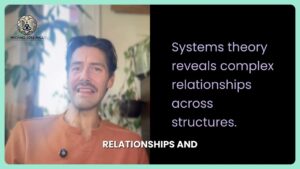
Have you ever wondered how everything from ecosystems to social structures interconnects? Welcome to the intriguing realm of systems theory! 🌐 In this video, we unravel the mysteries of complex relationships and interactions that define various systems, from how a crane operates to the intricate workings of the human mind. Systems theory provides universal insights that span across disciplines, allowing us to anticipate changes and understand the bigger picture. Join us as we delve into applying this fascinating framework across different fields and transform your perspective forever. #SystemsTheory #ComplexityUnraveled #InterdisciplinaryKnowledge

The Importance of Systems Thinking in Yoga: Seeing the Bigger Picture

The Importance of Systems Thinking in Yoga: Seeing the Bigger Picture

Yoga, at its essence, is about the union of mind, body, and spirit—a holistic practice that reminds us that everything is interconnected. This principle of interconnectedness extends beyond the practice itself, applying equally to the broader yoga industry. By adopting a systems thinking approach, we can better understand the complex relationships that exist within the yoga world—from teachers and students to studios and the economic landscape. By viewing the yoga industry as an integrated system, we open the door to innovative solutions that can address the unique challenges faced by yoga professionals today. Systems Thinking in Yoga Practice At the level of personal practice, yoga can be seen as a system of interrelated parts: the breath, the body, the mind, and the spirit. Each element…

The Role of Learning in Yoga: Education vs. Exploitation and the Broken Teacher Training System

The Role of Learning in Yoga: Education vs. Exploitation and the Broken Teacher Training System

The modern yoga industry has shifted away from teaching a practice that once ecnouraged and even required ongoing learning, self-reflection, and personal growth. Instead, the commercial interests have been prioritized over genuine education. This shift has left both students and teachers navigating a system that often exploits their desire to learn and grow. Nowhere is this tension more evident than in the yoga teacher training system, which, while serving as a lifeline for the industry, has become deeply flawed. The Importance of Lifelong Learning in Yoga The essence of yoga is continuous evolution. For students, this means approaching each class with curiosity and an open mind, recognizing that there is always more to learn—not just in the mastery of physical postures but in the exploration…

Prana and the Bathtub: Systems Thinking for the Ashtanga Practitioner

Prana and the Bathtub: Systems Thinking for the Ashtanga Practitioner

In our practice, we’re not just trying to keep the tub full. We’re learning to live in balance, where the ebb and flow of prana supports us as much as we support it. It’s not about avoiding leaks but recognizing that the small, subtle drains often compound our stress more than a single big crisis. The practice guides us in patching those leaks with awareness, restoring a harmonious flow where life feels less like a constant emergency and more like a nurturing partnership
In our practice, we’re not just trying to keep the tub full. We’re learning to live in balance, where the ebb and flow of prana supports us as much as we support it. It’s not about avoiding leaks but recognizing that the small, subtle drains often compound our stress more than a single big crisis. The practice guides us in patching those leaks with awareness, restoring a harmonious flow where life feels less like a constant emergency and more like a nurturing partnership.

The goal isn’t to always be on alert, like the little Dutch boy at the dam. Instead, we want to be more like the Indigenous stewards of land and water—understanding that the flow is only a problem when it’s out of balance. Otherwise, it’s a beautiful exchange, where prana nourishes us as much as we nourish it. This isn’t crisis management; it’s living in relationship.

Getting Great: Adaptive Resistance and Isokinetic Training: Optimizing Muscle Growth and Fat Loss

Getting Great: Adaptive Resistance and Isokinetic Training: Optimizing Muscle Growth and Fat Loss

Ever wonder how that gym buddy of yours keeps sculpting their physique while juggling a dozen other life commitments? For this Ashtanga yoga practitioner, the secret sauce often lies in mixing the right ingredients of training modalities and intensities. I‘ve been particularly partial to adaptive resistance and isokinetic training as part of my routine. Adaptive resistance is like that diligent spotter who helps carry some weight when you’re battling through injuries, ensuring you keep making gains even when life throws curveballs—like a car sending me tumbling through the air. After injuries to my wrist, shoulder, ribs, and ankle, and a good amount of warrior poses on my mat, I am delighted to say that both weight training and Ashtanga yoga continued. Adaptive resistance was a…