

Ashtanga Yoga and Acute and Chronic Pain
One of the most brilliant aspects of the ashtanga vinyasa yoga physical practice lies in its adaptability.
Not unlike the swiss army knife housing a blade, a toothpick, and a bottle opener, the ashtanga yoga practice works effectively across a spectrum of applications. Not confined to being solely a central axis meditation, one could also consider the vinyasa practice a kind of physical therapy. After all, Guruji referred to the primary series of ashtanga yoga as “yoga therapy” — yoga chitiksa.
The premise here is that this practice, when done correctly, heals the body.
What needs healing, one might ask?
To my mind, its an easing of chronic pain, the kind that subsist long after trauma has been healed. The other is acute pain, the kind that arrives due to direct trauma.
The physical practice “cleanses” us of the chronic as well as the habituations that might lead to the acute (and perhaps, vice versa).
As people with bodies, there is an inherently paradoxical relationship between us and pain: that is, too much holding can lead to pain and yet, also too much opening can lead to pain. In fact, thinking about pain can lead to pain (placebo). And, ultimately, ignoring pain can lead to even more pain (inhibition).
Sounds like a real pain… in the ass.
In a lot of young practitioners, I see folks say “Ow!” at the mere idea of folding forward. Its like a kid sister pretending to slap her brother. She goes for the fake, he yelps, etc. Same same with the hamstrings– yipe! they cry out, before even being touched. This is very common. Placebo pain.
Fast forward a few years: I see the more “advanced” practitioners going through the motions, making those big ol’ shapes, and feeling the rush and exhilaration. The challenge and the muscular effort. But, no ground-level stuff achey stuff. Then later, I hear from these more seasoned practitioners that suddenly a something hurts– shoulder, knee, hamstring, whatever. A something. And this “something” seems to have suddenly started hurting for no real reason. Inhibited pain.
Neither one of these are useful.
In order to approach this practice in a therapeutic manner, we must find a middle ground between a blacking out of sensory registration of micro-level pain and anticipatory flinching getting in the way of macro action steeped in old trauma or fear of new.
To do this we need to tune-in instead of tune-out.
As any practitioner with some time on the mat will tell you, discomfort doesn’t equal pain. Acknowledging that requires three things: 1) discomfort is real. 2) pain is real. 3) they are not the same. This requires that we don’t shut off our awareness of pain, but instead become clear on it’s reality. This creates discernment. It can also act as a healing balm to discomfort that may become pain, and also as a salve for pain that may beget more pain instead of less.
HEYAM DUHKHAM ANAGATAM (2.16)
Pain that has not yet come is avoidable.
Injuries without moments of direct trauma don’t happen over night– “incorrect” or “not useful” movement patterns, meaning those that are deleterious or injurious over time, can often make these injuries seem to come on suddenly. They don’t. This is the kind of stuff the practice can clean up. It can un-inhibit. Re-inhabit.
Placebic pain is tricky, too– that is, pain that arrives without a cause. When we bring attention to the nature of pain and its direct reality, we can sometimes release old holding that don’t serve us any more, and in that unraveling, also get rid of the chronic pain that we feel. I’m tempted to call chronic pain “psychic pain”– but, I’ll save that conversation for another time.
Its important to remember that there is nothing wrong with us. We are just people with bodies doing a thing. And, in the act of doing the thing, either we can meet certain conditions in front of us, or not. Either we feel a hurting or we don’t. Personally, I don’t like calling the chronic stuff “injury” for that very reason.
With practice we aim for a place where pain registers if it registers– and doesn’t if it doesn’t. There is a huge difference between “don’t hunt for pain” and “ignore your pain.” It might be as simple as saying “be aware” or “be present.”
This is part of the nature of a meditation practice. Letting a thing be what it is without a desire to label or edit. Don’t engage in reification– “reification generally refers to making something real, bringing something into being, or making something concrete.”
Once, through the process of discernment, when we have identified pain as being real and available, it can become a huge catalyst for catharsis. How? Because from this working place, we can go out and eliminate its root cause.
In this way, the practice can be healing.
“If the body is in dis-ease, then the mind will be in dis-ease,” says BKS Iyengar. If the ultimate aim of practice is to find yoga, meaning the cessation of the fluctuations of the mind, then we need to ease the body.
To better understand our true nature, attenuating the mind and hooking into the body in order to better understand their true nature, seems worth while.
So, what happens when pain presents itself acutely?
Find the root cause. Find the pattern thats creating it, and edit the pattern. How do we edit the pattern? By spending time observing and tuning in. Making sure we aren’t inhibiting pain signals. Making sure we’re listening for whats real. Make sure we’re inhabiting. Also, listening to your teacher.
But, can this take you away from breath, bandha, and dristhi? Perhaps, yes. Though Swami Sivananda may have said that the highest sadhana is to “bear insult, bear injury,” he wasn’t talkin’ physical, and I simply do not believe that pain needs to be exalted nor exacerbated through the continuation of the ashtanga vinyasa yoga practice. If we are to treat the ashtanga yoga practice as a healing modality that is infinitely adaptable to our needs as practitioners, then I think wielding it like a surgeons knife is appropriate: carefully, conservatively, and clearly.
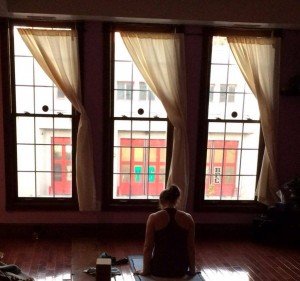
(beautiful photograph by meghan powell. horrible photoshopping by yours truly. don’t blame her for that horrible lens flare/cloud effect.)



This is timely for me as I’ve been away from my practice (well, a lot of things actually) for nearly 6 weeks due to my broken arm. After tomorrow’s MRI, I will know more about the final outcome of my healing, and will hopefully get the ok to return to it – ever be it slowly. It reminded me of your time away from your practice while healing from the attack, and wondered what advice you might have for me on ways not to accidentally do damage to myself as I return. Not only by paying attention to the types of pain described above, but the emotional ones too. What do you think, MJH? Slow and steady wins the race, that I know, but I am curious about your own mental return too.
There are a bunch of variables here, but I know that a one-handed practice is a-okay! The surya namaskars, while wonderful, does not work so well for those dealing with broken wrists. I’d advise standing postures and no big toe binds. I’d move slowly, obviously, and watch the resistance patterns in the mind. Try to watch the bubbling up of feelings in a manner that is curious and still somewhat apathetic.
I suspect you’ll see thrills and disappointments: two sides of the same coin. Go and make a shape. Nothing wrong with a few months of standing and the floor postures without transition!
Thank you for this. I’ve been having pain that seems unrelated to how “hard” I practice indicating a holding pattern of some sort. The “wah wah wah” part of me wants it to disappear. The smart part of me knows that my body has revealed a pattern that I must figure out (I love these challenges in some way). My practice will have more integrity and I’ll be a better teacher for it.
I love those challenges, too!! And I *do* believe we’re better for the work!
Often, the most educated teacher on any given subject is one who has struggled with the topic and made it to the other side. Need a hip expert? Talk to the gal who overcame tight ones. Shoulder impingement? Talk to the guy who had to rebuild his scapular stability, etc. I bet Edison new a ton about filament.
Assuming the teacher makes it ’round the bias bend, we can learn a lot from them.
Us, too.
Michael
So timely for me this sentence : “Find the root cause. Find the pattern thats creating it”, I started having acute knee pain (right knee) and could not figure out for the life of me why it came on out of the blue. Then, one day, I decided to change handbags, I always wore a cross-body handbag that was always sitting on my right hip as I walked the 1+ hours to work everyday. I switched mainly because I was tired fo the bag and wanted to use another one. Eureka moment–after a week, my knee was almost back to normal, I realized it was the pressue of the heavy bag sitting on my right hip for a few hours every day for months that was causing my hip to hurt, extending the pain to my inner knee and eventually to my ankle….back to normal now that I switched bags. HELLO LOTUS POSE –good to meet you again 🙂