If AI Is Doing the Work, Who Owns the Upside?
If AI takes the labor, we either tax the winners harder or make everyone a shareholder.

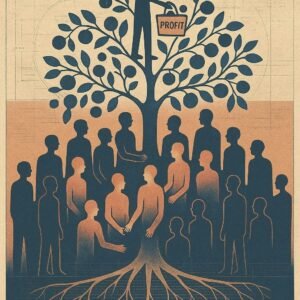
If AI takes the labor, we either tax the winners harder or make everyone a shareholder.

Savasana is where everything gets suspicious. Not suspicious in a bad way — suspicious in the way of something you can’t quite account for. You finish the last posture. You lie down. The sweat is still cooling. And then, for some practitioners, there’s a moment that doesn’t fit the usual frame: a sense of dissolution, of the boundary between where you end and where the room begins becoming briefly negotiable. Most people file it under “relaxation response” or “endorphins” and move on. A few don’t. Anirban Bandyopadhyay is a senior scientist at the National Institute for Materials Science in Japan, and he would tell you that the sensation is not mystical — it’s mechanical. The mechanism just happens to be the quantum structure of the…

AI feels like empowerment, but it’s quietly turning us into our own accountants, lawyers, and help desks — unpaid.

In the summer of 1996, my cousins and I buried a time capsule in my parents’ backyard. My mother is the oldest of seven sisters. Five of those six sisters got pregnant within about a year of each other. I was the only boy in that batch. Due to our close proximity in age—and one of my aunt’s early passing—we spent a lot of time together in the summers. I loved the summer. On the rural dirt roads and sandy private beaches of Colonial Beach, Virginia, for three months every year, I felt less like an only child and more like a sibling. I have brothers, but they were out of the house by the time I was ten. Colonial Beach gave me peers my…

Long before studios and certification programs, disciplines like yoga, martial arts, and music moved through something closer to a guild system. Not corporations, not franchises. Communities organized around the transmission of skill. The purpose wasn’t growth. It was continuity. A guild-like structure worked a certain way. Knowledge passed through apprenticeship and long-term mentorship — not standardized products. Teachers were responsible for both technical instruction and the ethical development of their students. Communities stayed small enough for relationships to remain personal. Money changed hands, but differently. Payments took the form of patronage or long-term support rather than per-transaction pricing. A teacher’s livelihood was tied to the stability of the community, not the volume of individual sales. This structure evolved for an obvious reason: disciplines that require…
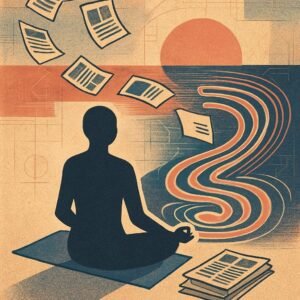
Why a yoga teacher reads three newspapers a day, and what algorithmic feeds quietly took from all of us.
A companion to The Digital Caste and The Architecture of Generosity. The conversation about yoga economics runs the same loop. Teachers can’t make a living. Studios can’t stay open. Students can’t afford classes. Everyone assumes the problem is price — find the right number and the system works. It doesn’t. And price isn’t why. The deeper problem is that yoga communities are trying to operate inside an economic framework designed for scalable products. Yoga isn’t one. It’s a discipline transmitted through relationships, repetition, and time. That makes it profoundly valuable. It also makes it economically awkward in a system that rewards growth, efficiency, and scale. The pattern is predictable. A studio takes on significant overhead — prime real estate, renovations, staff, marketing. That forces prices…

A companion to The Digital Caste People talk about yoga economics as if the central question is price. Class rates. Membership tiers. What a teacher should earn. Price matters — but it isn’t the variable that governs everything else. Overhead is. Overhead determines what prices are even possible. And once prices are fixed, the culture of a space starts to bend around them. I learned this slowly. Like most teachers, I spent years looking for the price that felt fair — one that worked for the student waking up at 5am on a teacher’s salary and also for the one who’d just come from the office. Same discipline. Different bank accounts. Eventually it became clear: this wasn’t a pricing problem at all. In many yoga…

From chatrooms at thirteen to running a world in Ultima Online to building communities for companies — a life spent tending rooms online. Now I’m turning that instinct on my own data: pulling twenty years of my life off the platforms and onto ground I own, and building the habit of micro-journaling in my own garden instead of Meta’s.

Every untracked transaction is a small act of structural resistance
Every untracked transaction is a small act of structural resistance. From The Digital Caste: Surveillance Capitalism and the Architecture of Permanent Inequality on michaeljoelhall.com
—
Read the full article: https://theyoga.club/buy-your-milk-from-someone-you-know/
Original source: https://michaeljoelhall.com/the-digital-caste-surveillance-capitalism-and-the-architecture-of-permanent-inequality/
All content: https://mjh.yoga
Concepts: Saṅgha · Sevā · Sthira · Dāna
#ashtanga #yoga #ashtangayoga #yogapractice #theyogaclub