
I Stopped Trusting the Mirror: Measuring Joints Instead of Guessing
For most of my first decade of practice, I was a very disciplined guesser.
I showed up. I did the shapes. I could hold the ones that photograph well and quietly avoided the ones that didn’t. When something hurt, I had a whole vocabulary of yoga-flavored excuses ready: I’m just tight there, it’s an old injury, it’ll open with time. What I never did — not once, for years — was actually measure anything. I never asked a joint a specific question and waited for its specific answer. I mistook repetition for inquiry, and assumed that if I kept practicing, the practice would eventually do the diagnosing for me.
It doesn’t. Naive repetition just carves the ruts you already have a little deeper.
The mirror was lying to me
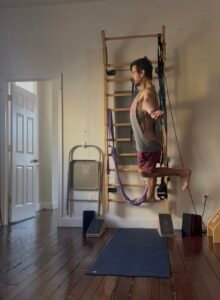
What finally broke the spell was a mirror. I had a shape that looked, from the outside, correct — clean line, right angles, the picture you’d expect from someone who’d been at this a while. And it was quietly wrecking one of my shoulders. The mirror confirmed the shape and told me nothing about the load path underneath it: which tissue was actually doing the work, which was being asked to do something it had no business doing. The image was perfect. The system was failing. And I’d been grading myself on the image the whole time.
That was the day the frame flipped. I stopped asking “does this look right?” and started asking “what is this posture telling me?” Because a posture is always telling you something. It’s a load test: put a joint under a known demand and it reports back — with range, with tremor, with the place the breath suddenly goes shallow. The report is free. It runs every single time you practice. The only variable is whether you bother to read it.
Practice is systems literacy
That’s the belief under everything I make now: practice is systems literacy. Yoga isn’t a doctrine you adopt or a personality you put on. It’s a system — your own body — that you learn to read and operate. And you can’t operate a system you refuse to measure. Every serious field settled this ages ago. You don’t tune an engine by vibes. You don’t debug code by staring harder at the screen. You instrument the thing, get a readout, change one variable, watch what moves. Somehow the room where we do the most intimate work on the most complex machine we’ll ever own is the one place we’re told to stop measuring and just feel it.
I take the tradition seriously and I take the research seriously, and I refuse to pretend those two things are enemies. The old sequences are, among other things, a full-body assessment battery nobody ever labeled as one. Functional-range work gives me the language to read what they were already testing. Put them together and practice stops being a performance and becomes an honest conversation with your own structure.
The values audit
At some point I ran an audit on myself — an actual values audit, the kind that’s easy to fake. What do I actually believe? That you should be able to read your own body. That assessment beats dogma. That the most personal record you’ll ever generate — your practice data — belongs to you, in your own garden, not on someone else’s server feeding someone else’s feed. That you shouldn’t have to phone a guru to learn whether you’re okay.
Fine words. The trouble with values is that talk is free — and the market kept proving it to me: mood-tracking apps that ask how the session felt and never what it measured. One-size sequences that don’t know your right hip from your left. Disposable PDFs that go stale the day you download them. All of it built to keep you renting reassurance. Every one of those was somebody’s stated value too — we care about your wellness — and none of it read the instrument.
So I stopped talking and built the tools I couldn’t buy. Guided audio that walks you through an assessment out loud, so your eyes stay off the mirror and on the sensation. Breath-by-breath count videos that hold the tempo for you, so timing is a fixed variable instead of a guess. A Practice Recorder that logs what you actually did, week by week, so a month from now you’re reading your own trend line instead of your own memory. And all of it lives on a platform I own — decentralized, mine, not Meta’s, not a rented app that rewrites its terms the quarter you finally get consistent. I could have written a post saying practice should be individual and your data should be yours. Instead I built the thing that makes it true. The self-built platform isn’t a flex; it’s the receipt — the difference between someone who says they value this and someone who shipped it.
Who this is for
The introduction is built around a single sentence: don’t guess, assess. It walks joint by joint — spine, shoulders, hips, out to the extremities — and it treats breathing as a trainable capacity rather than a vibe, because it’s the fastest, most reliable lever any of us has on the low-grade stress we carry around all day. It’s not a course about achieving harder shapes. It’s a course about becoming the operator of your own body — someone who reads the instrument panel instead of squinting at the mirror and hoping.
Picture the after-state honestly. Not enlightenment — literacy. A year from now you open a posture and you already know what it’s going to tell you, because you’ve been reading it all along. You can name which shoulder is doing the lying. You stop outsourcing the question of whether you’re okay. Compare that to another year of the alternative: practicing hard, understanding little, deepening the same ruts, and paying — in shoulders, in time, in quiet dependence — for the privilege of never finding out.
I made this for the person I was: sincere, consistent, and completely in the dark about their own joints. If that’s you — if you’re tired of practicing hard and understanding little — then here’s where it lives: the Self-Assessment. No mystery. No mirror. Just you, learning to read the machine you were handed.