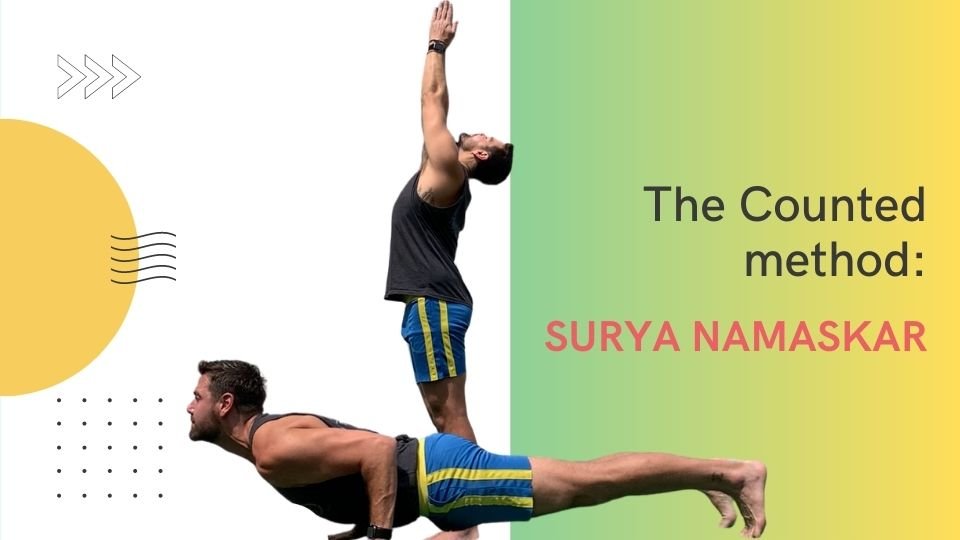
Surya Namaskar A: The Full Vinyasa Count in English and Sanskrit
| Surya Namaskar A (9 movements) | ||
| English Count | Sanskrit Count | English Instruction |
| 1 | EKAM | Inhale, arms up |
| 2 | DVE | Exhale, fold forward |
| 3 | TRINI | Inhale, look up, lengthen |
| 4 | CATVARI | Exhale, jump back, Chaturanga |
| 5 | PANCA | Inhale, Upward-Facing Dog |
| 6 | SAT | Exhale, Downward-Facing Dog |
| 7 | SAPTA | Inhale, jump forward, look up, lengthen |
| 8 | ASTAU | Exhale, fold forward |
| 9 | NAVA | Inhale, arms up |
| Exhale, Samasthiti | ||
| SURYANAMASKARAḤ B (17 movements) | ||
| 1 | EKAM | Inhale, Utkatasana |
| 2 | DVE | Exhale, fold forward |
| 3 | TRINI | Inhale, look up, lengthen |
| 4 | CATVARI | Exhale, jump back, Chaturanga |
| 5 | PANCA | Inhale, Upward-Facing Dog |
| 6 | SAT | Exhale, Downward-Facing Dog |
| 7 | SAPTA | Inhale, right side Virabhadrasana A |
| 8 | ASTAU | Exhale, Chaturanga |
| 9 | NAVA | Inhale, Upward-Facing Dog |
| 10 | DASA | Exhale, Downward-Facing Dog |
| 11 | EKĀDASA | Inhale, left side Virabhadrasana A |
| 12 | DUADASA | Exhale, Chaturanga |
| 13 | TRAYODASA | Inhale, Upward-Facing Dog |
| 14 | CATURDASA | Exhale, Downward-Facing Dog |
| 15 | PANCADASA | Inhale, jump forward, look up, lengthen |
| 16 | SODASA | Exhale, fold forward |
| 17 | SAPTADASA | Inhale, Utkatasana |
| Exhale, Samasthiti | ||
| PADANGUSTHASANA (3 MOVEMENTS) (START WITH FEET APART, HOLD BIG TOES) | ||
| 1 | EKAM | Inhale, look up, lengthen |
| 2 | DVE | Exhale, fold forward |
| 3 | TRINI | Inhale, look up, lengthen |
| Exhale | ||
| PADAHASTASANA (3 MOVEMENTS) | ||
| 1 | EKAM | Inhale, hands under feet, look up, lengthen |
| 2 | DVE | Exhale, fold forward |
| 3 | TRINI | Inhale, look up, lengthen |
| Exhale, Samasthiti | ||
| UTTHITA TRIKOŅĀSANA A (5 MOVEMENTS) | ||
| 1 | EKAM | Inhale, open to the right, arms out |
| 2 | DVE | Exhale, hold the right big toe |
| 3 | TRINI | Inhale, up |
| 4 | CATVARI | Exhale, fold, hold the left big toe |
| 5 | PANCA | Inhale, up |
| UTTHITA TRIKOŅĀSANA B (5 MOVEMENTS) | ||
| 1 | EKAM | Exhale, twist left, hand down |
| 2 | DVE | Inhale, up |
| 3 | TRINI | Exhale, twist right, hand down |
| 4 | CATVARI | Inhale, up |
| Exhale, Samasthiti | ||
| UTTHITA PĀRSVAKOŅĀSANA A (5 MOVEMENTS) | ||
| 1 | EKAM | Inhale, open to the right, arms out |
| 2 | DVE | Exhale, right hand down, left arm reaches |
| 3 | TRINI | Inhale, up |
| 4 | CATVARI | Exhale, left hand down, right arm reaches |
| 5 | PANCA | Inhale, up |
| UTTHITA PĀRSVAKONASANA B (5 MOMENTS) | ||
| 1 | EKAM | EXHALE, TWIST LEFT HAND DOWN |
| 2 | DVE | INHALE, UP |
| 3 | TRIŅI | EXHALE, TWIST RIGHT HAND DOWN |
| 4 | CATVARI | INHALE, UP |
| EXHALE, SAMASTHITI | ||
| PRASARITA PADOTTANASANA A (5 MOVEMENTS) | ||
| 1 | EXAM | Inhale, open to the right, hands to waist |
| 2 | DVE | Exhale, fold forward, hands on the floor |
| Inhale, look up, lengthen | ||
| 3 | TRINI | Exhale, fold head down |
| 4 | CATVARI | Inhale, look up, lengthen |
| Inhale, look up, lengthen | ||
| 5 | PANCA | Inhale, up |
| PRASARITA PADOTTANASANA B (4 MOVEMENTS) | ||
| 1 | EKAM | Inhale, arms out |
| 2 | DVE | Exhale, hands to waist |
| Inhale, look up, lengthen | ||
| 3 | TRINI | Exhale, fold head down. |
| 4 | CATVARI | Inhale, up |
| Exhale | ||
| PRASARITA PADOTTANASANA C (4 MOVEMENTS) | ||
| 1 | EKAM | Inhale, arms out |
| 2 | DVE | Exhale, interlace hands behind back |
| Inhale, look up, lengthen | ||
| 3 | TRINI | Exhale, fold head down |
| 4 | CATVARI | Inhale, up |
| Exhale | ||
| PRASARITA PÁDOTTANASANA D (5 MOVEMENTS) | ||
| 1 | EKAM | Inhale, hands to waist, look up |
| 2 | DVE | Exhale, fold forward, hold big toes |
| Inhale, look up, lengthen | ||
| 3 | TRINI | Exhale, fold head down |
| 4 | CATVARI | Inhale, look up, lengthen |
| Exhale | ||
| 5 | PANCA | Inhale, up |
| Exhale, Samasthiti | ||
| PÄRSVÕTTANASANA (5 MOVEMENTS) | ||
| 1 | EKAM | Inhale, open to the right, hands in prayer behind back |
| 2 | DVE | Exhale, fold |
| 3 | TRINI | Inhale, up, turn to the front |
| 4 | CATVARI | Exhale, fold |
| 5 | PANCA | Inhale, up, open to the side |
| Exhale, Samasthiti | ||
| UTTHITA HASTA PADANGUSTHASANA (14 MOVEMENTS) | ||
| 1 | EKAM | Inhale, right leg up, hold toe |
| 2 | DVE | Exhale, fold |
| 3 | TRINI | Inhale, up |
| 4 | CATVARI | Exhale, open leg out, look left |
| 5 | PANCA | Inhale, leg to the front |
| 6 | SAT | Exhale, fold |
| 7 | SAPTA | Inhale, up, hands to waist |
| Exhale, Samasthiti | ||
| 8 | ASTAU | Inhale, left leg up, hold toe |
| 9 | NAVA | Exhale, fold |
| 10 | DASA | Inhale, up |
| 11 | EKADASA | Exhale, open leg out, look right |
| 12 | DUADASA | Inhale, leg to the front |
| 13 | TRAYODASA | Exhale, fold |
| 14 | CATURDASA | Inhale, up, hands to wais |
| Exhale, Samasthiti | ||
| ARDHA BADDHA PADMOTTANASANA (9 MOVEMENTS) | ||
| 1 | EKAM | Inhale, right foot up, bind |
| 2 | DVE | Exhale, fold |
| 3 | TRINI | Inhale, look up, lengthen |
| Exhale | ||
| 4 | CATVARI | Inhale, up |
| 5 | PANCA | Exhale, leg down |
| 6 | SAT | Inhale, left foot up, bind |
| 7 | SAPTA | Exhale, fold |
| 8 | ASTAU | Inhale, look up, lengthen |
| Exhale | ||
| 9 | NAVA | Inhale, up |
| Exhale, Samasthiti | ||
| UTKATASANA (11 MOVEMENTS) | ||
| 1 | EKAM | Inhale, arms up |
| 2 | DVE | Exhale, fold forward |
| 3 | TRINI | Inhale, look up, lengthen |
| 4 | CATVARI | Exhale, jump back, Chaturanga |
| 5 | PANCA | Inhale, Upward-Facing Dog |
| 6 | SAT | Exhale, Downward-Facing Dog |
| 7 | SAPTA | Inhale, jump forward, Utkatasana |
| Exhale, fold forward | ||
| 8 | ASTAU | Inhale, up |
| 9 | NAVA | Exhale, jump back, Chaturanga |
| 10 | DASA | Inhale, Upward-Facing Dog |
| 11 | EKĀDASA | Exhale, Downward-Facing Dog |
| VIRABHADRASANA A & B (14 MOVEMENTS) | ||
| 7 | SAPTA | Inhale, right side Virabhadrasana A |
| 8 | ASTAU | Exhale, left side Virabhadrasana A |
| 9 | NAVA | Inhale, right side Virabhadrasana B |
| 10 | DASA | Exhale, left side Virabhadrasana B |
| Exhale, hands down | ||
| 11 | EKĀDASA | Inhale, up |
| 12 | DUADASA | Exhale, Chaturanga |
| 13 | TRAYODASA | Inhale, Upward-Facing Dog |
| 14 | CATURDASA | Exhale, Downward-Facing Dog |
| PASCHIMATANASANA A (14 MOVEMENTS) | ||
| 7 | SAPTA | Inhale, jump through Dandasana (5 breaths) |
| Exhale | ||
| 8 | ASTAU | Inhale, hold toes (A), look up |
| 9 | NAVA | Exhale, fold |
| 10 | DASA | Inhale, look up, lengthen |
| Exhale | ||
| 8 | ASTAU | Inhale, take your wrist (D), look up |
| 9 | NAVA | Exhale, fold |
| 10 | DASA | Inhale, look up, lengthen |
| Exhale | ||
| 11 | EKĀDASA | Inhale, lift up |
| 12 | DUADASA | Exhale, jump back, Chaturanga |
| 13 | TRAYODASA | Inhale, Upward-Facing Dog |
| 14 | CATURDASA | Exhale, Downward-Facing Dog |
| PURVATANASANA (13 MOVEMENTS) | ||
| 7 | SAPTA | Inhale, jump through |
| Exhale, hands on the floor behinds hips | ||
| 8 | ASTAU | Inhale, up |
| 9 | NAVA | Exhale, down |
| 10 | DASA | Inhale, lift up |
| 11 | EKĀDASA | Exhale, jump back, Chaturanga |
| 12 | DUADASA | Inhale, Upward-Facing Dog |
| 13 | TRAYODASA | Exhale, Downward-Facing Dog |
| ARDHA BADDHA PADMA PASCHIMATANASANA (20 MOVEMENTS) | ||
| 7 | SAPTA | Inhale, jump through, right foot bind |
| 8 | ASTAU | Exhale, fold |
| 9 | NAVA | Inhale, look up |
| ARDHA BADDHA PADMA PASCHIMATANASANA (20 MOVEMENTS) | ||
| 10 | DASA | Inhale, lift up |
| 11 | EKĀDASA | Exhale, jump back, Chaturanga |
| 12 | DUADASA | Inhale, Upward-Facing Dog |
| UTTHITA HASTA PADANGUSTHASANA (14 MOVEMENTS) | ||
| 1 | EKAM | Inhale, right leg up, hold toe |
| 2 | DVE | Exhale, fold |
| 3 | TRINI | Inhale, up |
| 4 | CATVARI | Exhale, open leg out, look left |
| 5 | PANCA | Inhale, leg to the front |
| 6 | SAT | Exhale, fold |
| Inhale, up, hands to waist | ||
| 7 | SAPTA | Exhale, Samasthiti |
| 8 | ASTAU | Inhale, left leg up, hold toe |
| 9 | NAVA | Exhale, fold |
| 10 | DASA | Inhale, up |
| 11 | EKĀDASA | Exhale, open leg out, look right |
| 12 | DUADASA | Inhale, leg to the front |
| 13 | TRAYODASA | Exhale, fold |
| 14 | CATURDASA | Inhale, up, hands to waist |
| Exhale, Samasthiti | ||
| ARDHA BADDHA PADMOTTANĀSANA (9 MOVEMENTS) | ||
| 1 | EKAM | Inhale, right foot up, bind |
| 2 | DVE | Exhale, fold |
| 3 | TRINI | Inhale, look up, lengthen |
| Exhale | ||
| 4 | CATVARI | Inhale, up |
| 5 | PANCA | Exhale, leg down |
| 6 | SAT | Inhale, left foot up, bind |
| 7 | SAPTA | Exhale, fold |
| 8 | ASTAU | Inhale, look up, lengthen |
| Exhale | ||
| 9 | NAVA | Inhale, up |
| Exhale, Samasthiti | ||
| UTKATASANA (11 MOVEMENTS) | ||
| 1 | EKAM | Inhale, arms up |
| 2 | DVE | Exhale, fold forward |
| 3 | TRINI | Inhale, look up, lengthen |
| 4 | CATVARI | Exhale, jump back, Chaturanga |
| 5 | PANCA | Inhale, Upward-Facing Dog |
| 6 | SAT | Exhale, Downward-Facing Dog |
| 7 | SAPTA | Inhale, jump forward, Utkatasana |
| Exhale, fold forward | ||
| 8 | ASTAU | Inhale, up |
| 9 | NAVA | Exhale, jump back, Chaturanga |
| 10 | DASA | Inhale, Upward-Facing Dog |
| 11 | EKĀDASA | Exhale, Downward-Facing Dog |
| VIRABHADRASANA A & B (14 MOVEMENTS) | ||
| 7 | SAPTA | Inhale, right side Virabhadrasana A |
| 8 | ASTAU | Exhale, left side Virabhadrasana A |
| 9 | NAVA | Inhale, right side Virabhadrasana B |
| 10 | DASA | Exhale, left side Virabhadrasana B |
| Exhale, hands down | ||
| 11 | EKĀDASA | Inhale, up |
| 12 | DUADASA | Exhale, Chaturanga |
| 13 | TRAYODASA | Inhale, Upward-Facing Dog |
| 14 | CATURDASA | Exhale, Downward-Facing Dog |
| PASCHIMATANASANA A (14 MOVEMENTS) | ||
| 7 | SAPTA | Inhale, jump through Dandasana (5 breaths) |
| Exhale | ||
| 8 | ASTAU | Inhale, hold toes (A), look up |
| 9 | NAVA | Exhale, fold |
| 10 | DASA | Inhale, look up, lengthen |
| Exhale | ||
| 8 | ASTAU | Inhale, take your wrist (D), look up |
| 9 | NAVA | Exhale, fold |
| 10 | DASA | Inhale, look up, lengthen |
| Exhale | ||
| 11 | EKĀDASA | Inhale, lift up |
| 12 | DUADASA | Exhale, jump back, Chaturanga |
| 13 | TRAYODASA | Inhale, Upward-Facing Dog |
| 14 | CATURDASA | Exhale, Downward-Facing Dog |
| PURVATANASANA (13 MOVEMENTS) | ||
| 7 | SAPTA | Inhale, jump through |
| Exhale, hands on the floor behinds hips | ||
| 8 | ASTAU | Inhale, up |
| 9 | NAVA | Exhale, down |
| 10 | DASA | Inhale, lift up |
| 11 | EKĀDASA | Exhale, jump back, Chaturanga |
| 12 | DUADASA | Inhale, Upward-Facing Dog |
| 13 | TRAYODASA | Exhale, Downward-Facing Dog |
| ARDHA BADDHA PADMA PASCHIMATANASANA (20 MOVEMENTS) | ||
| 7 | SAPTA | Inhale, jump through, right foot bind |
| 8 | ASTAU | Exhale, fold |
| 9 | NAVA | Inhale, look up |
| Exhale | ||
| 10 | DASA | Inhale, lift up |
| 11 | EKĀDASA | Exhale, jump back, Chaturanga |
| 12 | DUADASA | Inhale, Upward-Facing Dog |
| 13 | TRAYODASA | Exhale, Downward-Facing Dog |
| 14 | CATURDASA | Inhale, jump through, left foot bind |
| 15 | PANCADASA | Exhale, fold |
| 16 | SODASA | Inhale, look up |
| Exhale | ||
| 17 | SAPTADASA | Inhale, lift up |
| 18 | ASTAUDASA | Exhale, jump back, Chaturanga |
| 19 | EKUNAVIMŠATIḤ | Inhale, Upward-Facing Dog |
| 20 | VIMSATIH | Exhale, Downward-Facing Dog |
| TIRYANG MUKHAIKAPĀDA PASCHIMATĀNĀSANA (20 MOVEMENTS) | ||
| 7 | SAPTA | Inhale, jump through, right knee forward |
| 8 | ASTAU | Exhale, fold |
| 9 | NAVA | Inhale, look up |
| Exhale | ||
| 10 | DASA | Inhale, lift up |
| 11 | EKĀDASA | Exhale, jump back, Chaturanga |
| 12 | DUADASA | Inhale, Upward-Facing Dog |
| 13 | TRAYODASA | Exhale, Downward-Facing Dog |
| 14 | CATURDASA | Inhale, jump through, left knee forward |
| 15 | PANCADASA | Exhale, fold |
| 16 | SODASA | Inhale, look up |
| Exhale | ||
| 17 | SAPTADASA | Inhale, lift up |
| 18 | ASTAUDASA | Exhale, jump back, Chaturanga |
| 19 | EKUNAVIMŠATIḤ | Inhale, Upward-Facing Dog |
| 20 | VIMSATIH | Exhale, Downward-Facing Dog |
| JĀNU SIRṢĀSANA A (20 MOVEMENTS) | ||
| 7 | SAPTA | Inhale, jump through, right foot in |
| 8 | ASTAU | Exhale, fold |
| 9 | NAVA | Inhale, look up |
| Exhale | ||
| 10 | DASA | Inhale, lift up |
| 11 | EKĀDASA | Exhale, jump back, Chaturanga |
| 12 | DUADASA | Inhale, Upward-Facing Dog |
| 13 | TRAYODASA | Exhale, Downward-Facing Dog |
| 14 | CATURDASA | Inhale, jump through, left foot in |
| 15 | PANCADASA | Exhale, fold |
| 16 | SODASA | Inhale, look up |
| Exhale | ||
| 17 | SAPTADASA | Inhale, lift up |
| 18 | ASTAUDASA | Exhale, jump back, Chaturanga |
| 19 | EKUNAVIMŠATIḤ | Inhale, Upward-Facing Dog |
| 20 | VIMSATIH | Exhale, Downward-Facing Dog |
| JANU SİRŞASANA B (20 MOVEMENTS) | ||
| 7 | SAPTA | Inhale, jump through, right foot in |
| 8 | ASTAU | Exhale, fold |
| 9 | NAVA | Inhale, look up |
| Exhale | ||
| 10 | DASA | Inhale, lift up |
| 11 | EKĀDASA | Exhale, jump back, Chaturanga |
| 12 | DUADASA | Inhale, Upward-Facing Dog |
| 13 | TRAYODASA | Exhale, Downward-Facing Dog |
| 14 | CATURDASA | Inhale, jump through, left foot in |
| 15 | PANCADASA | Exhale, fold |
| 16 | SODASA | Inhale, look up |
| Exhale | ||
| 17 | SAPTADASA | Inhale, lift up |
| 18 | ASTAUDASA | Exhale, jump back, Chaturanga |
| 19 | EKUNAVIMŠATIḤ | Inhale, Upward-Facing Dog |
| 20 | VIMSATIH | Exhale, Downward-Facing Dog |
| JANU SIRṢĀSANA C (20 MOVEMENTS) | ||
| 7 | SAPTA | Inhale, jump through, right foot in |
| 8 | ASTAU | Exhale, fold |
| 9 | NAVA | Inhale, look up |
| Exhale | ||
| 10 | DASA | Inhale, lift up |
| 11 | EKĀDASA | Exhale, jump back, Chaturanga |
| 12 | DUADASA | Inhale, Upward-Facing Dog |
| 13 | TRAYODASA | Exhale, Downward-Facing Dog |
| 14 | CATURDASA | Inhale, jump through, left foot in |
| 15 | PANCADASA | Exhale, fold |
| 16 | SODASA | Inhale, look up |
| Exhale | ||
| 17 | SAPTADASA | Inhale, lift up |
| 18 | ASTAUDASA | Exhale, jump back, Chaturanga |
| 19 | EKUNAVIMŠATIḤ | Inhale, Upward-Facing Dog |
| 20 | VIMSATIH | Exhale, Downward-Facing Dog |
| MARICHASANA A (20 MOVEMENTS) | ||
| 7 | SAPTA | Inhale, jump through, right knee up |
| 8 | ASTAU | Exhale, fold |
| 9 | NAVA | Inhale, look up |
| Exhale | ||
| 10 | DASA | Inhale, lift up |
| 11 | EKĀDASA | Exhale, jump back, Chaturanga |
| 12 | DUADASA | Inhale, Upward-Fasing Dog |
| 13 | TRAYODASA | Exhale, Downward-Facing Dog |
| 14 | CATURDASA | Inhale, jump through, left knee up |
| 15 | PANCADASA | Exhale, fold |
| 16 | SODASA | Inhale, look up |
| Exhale | ||
| 17 | SAPTADASA | Inhale, lift up |
| 18 | ASTAUDASA | Exhale, jump back, Chaturanga |
| 19 | EKUNAVIMŠATIḤ | Inhale, Upward-Facing Dog |
| 20 | VIMSATIH | Exhale, Downward-Facing Dog |
| MARICHASANA B (20 MOVEMENTS) | ||
| 7 | SAPTA | Inhale, jump through, left foot in, right knee up, bind |
| 8 | ASTAU | Exhale, fold |
| 9 | NAVA | Inhale, look up |
| Exhale | ||
| 10 | DASA | Inhale, lift up |
| 11 | EKĀDASA | Exhale, jump back, Chaturanga |
| 12 | DUADASA | Inhale, Upward-Facing Dog |
| 13 | TRAYODASA | Exhale, Downward-Facing Dog |
| 14 | CATURDASA | Inhale, jump through, right foot in, left knee up, bind |
| 15 | PANCADASA | Exhale, fold |
| 16 | SODASA | Inhale, look up |
| Exhale | ||
| 17 | SAPTADASA | Inhale, lift up |
| 18 | ASTAUDASA | Exhale, jump back, Chaturanga |
| 19 | EKUNAVIMŠATIḤ | Inhale, Upward-Facing Dog |
| 20 | VIMSATIH | Exhale, Downward-Facing Dog |
| MARICHASANA C (16 MOVEMENTS) | ||
| 7 | SAPTA | Inhale, jump through |
| Exhale, take posture twist to the right | ||
| 8 | ASTAU | Inhale, lift up |
| 9 | NAVA | Exhale, jump back, Chaturanga |
| 10 | DASA | Inhale, Upward-Facing Dog |
| 11 | EKĀDASA | Exhale, Downward-Facing Dog |
| 12 | DUADASA | Inhale, jump through |
| Exhale, take posture twist to the left | ||
| 13 | TRAYODASA | Inhale, lift up |
| 14 | CATURDASA | Exhale, jump back, Chaturanga |
| 15 | PANCADASA | Inhale, Upward-Facing Dog |
| 16 | SODASA | Exhale, Downward-Facing Dog |
| MARICHASANA D (16 MOVEMENTS) | ||
| 7 | SAPTA | Inhale, jump through |
| Exhale, left foot lotus right, knee up, twist right, bind hands | ||
| 8 | ASTAU | Inhale, lift up |
| 9 | NAVA | Exhale, jump back, Chaturanga |
| 10 | DASA | Inhale, Upward-Facing Dog |
| 11 | EKĀDASA | Exhale, Downward-Facing Dog |
| 12 | DUADASA | Inhale, jump through |
| Exhale, right foot lotus left knee up, twist left, bind hands | ||
| 13 | TRAYODASA | Inhale, lift up |
| 14 | CATURDASA | Exhale, jump back, Chaturanga |
| 15 | PANCADASA | Inhale, Upward-Facing Dog |
| 16 | SODASA | Exhale, Downward-Facing Dog |
| NAVASANA (11 MOVEMENTS) | ||
| 7 | SAPTA | Inhale, jump through, legs up, reach forward |
| 8 | ASTAU | Inhale, lift up |
| repeat SAPTA ASTAU 5 times | ||
| 9 | NAVA | Exhale, jump back, Chaturanga |
| 10 | DASA | Inhale, Upward-Facing Dog |
| 11 | EKĀDASA | Exhale, Downward-Facing Dog |
| BHUJAPIDASANA (13 MOVEMENTS) | ||
| 7 | SAPTA | Inhale, jump around hands, cross feet |
| 8 | ASTAU | Exhale, fold chin down |
| 9 | NAVA | Inhale, lift up |
| Exhale, Bakasana | ||
| 10 | DASA | Inhale, lift up |
| 11 | EKĀDASA | Exhale, jump back, Chaturanga |
| 12 | DUADASA | Inhale, Upward-Facing Dog |
| 13 | TRAYODASA | Exhale, Downward-Facing Dog |
| SUPTA KŪRMĀSANA (14 MOVEMENTS) | ||
| 7 | SAPTA | Inhale, jump back, Kurmasana |
| 8 | ASTAU | Exhale, take arms back |
| 9 | NAVA | Cross feet |
| 10 | DASA | Inhale, lift up with both legs behind the head and look up |
| Exhale, Bakasand | ||
| 11 | EKĀDASA | Inhale, lift up |
| 12 | DUADASA | Exhale, jump back, Chaturanga |
| 13 | TRAYODASA | Inhale, Upward-Facing Dog |
| 14 | CATURDASA | Exhale, Downward-Facing Dog |
| GARBHA PINDASANA (13 MOVEMENTS) | ||
| 7 | SAPTA | Inhale, jump through, take Dandasana |
| 8 | ASTAU | Exhale, take lotus, arms through, take face |
| 9 | NAVA | Exhale, roll in circles (inhale up, exhale down) |
| KUKKUTASANA (13 MOVEMENTS) | ||
| 9 | NAVA | Inhale, lift up, take Kukkutasana |
| Exhale, down, release arms | ||
| 10 | DASA | Inhale, lift up |
| 11 | EKADASA | Exhale, jump back, Chaturanga |
| 12 | DUADASA | Inhale, Upward-Facing Dog |
| 13 | TRAYODASA | Exhale, Downward-Facing Dog |
| BADDHA KONASANA (13 MOVEMENTS) | ||
| 7 | SAPTA | Inhale, jump through, feet together |
| 8 | ASTAU | Exhale, fold, chest forward (A) |
| 9 | NAVA | Inhale, up |
| 10 | DASA | Exhale, fold, head down (B) |
| 11 | EKĀDASA | Inhale, up |
| Exhale | ||
| 12 | DUADASA | Inhale, lift up |
| 13 | TRAYODASA | Exhale, jump back, Chaturanga |
| 14 | CATURDASA | Inhale, Upward-Facing Dog |
| 15 | PANCADASA | Exhale, Downward-Facing Dog |
| UPAVIṢTHA KOŅĀSANA (14 MOVEMENTS) | ||
| 7 | SAPTA | Inhale, jump through, hold feet |
| 8 | ASTAU | Exhale, fold |
| Inhale, look up | ||
| 9 | NAVA | Exhale |
| Inhale, lift up, look up | ||
| 10 | DASA | Exhale |
| 11 | EKĀDASA | Inhale, lift up |
| 12 | DUADASA | Exhale, jump back, Chaturanga |
| 13 | TRAYODASA | Inhale, Upward-Facing Dog |
| 14 | CATURDASA | Exhale, Downward-Facing Dog |
| SUPTA KOŅASANA (14 MOVEMENTS) | ||
| 7 | SAPTA | Inhale, jump through |
| Exhale, lie down | ||
| 8 | ASTAU | Inhale, legs up, take toes |
| 9 | NAVA | Inhale, roll up, hold |
| Exhale, down | ||
| 10 | DASA | Inhale, look up |
| Exhale | ||
| 11 | EKĀDASA | Inhale, lift up |
| 12 | DUADASA | Exhale, jump back, Chaturanga |
| 13 | TRAYODASA | Inhale, Upward-Facing Dog |
| 14 | CATURDASA | Exhale, Downward-Facing Dog |
| SUPTA PADANGUSTHASANA (26 movements) | ||
| 7 | SAPTA | Inhale, jump through |
| Exhale, lie down | ||
| 8 | ASTAU | Inhale, right leg up, take toe |
| 9 | NAVA | Exhale, fold |
| 10 | DASA | Inhale, head down |
| 11 | EKÁDASA | Exhale, externally rotate right leg to the side, look left |
| 12 | DUADASA | Inhale, leg to the front |
| 13 | TRAYODASA | Exhale, fold |
| 14 | CATURDASA | Inhale, head down only |
| 15 | PANCADASA | Exhale, leg down |
| 16 | SODASA | Inhale, left leg up, hold toe |
| 17 | SAPTADASA | Exhale, fold |
| 18 | ASTAUDASA | Inhale, head down |
| 19 | EKUNAVIMSATIḤ | Exhale, externally rotate left leg to the side, look right |
| 20 | VIMSATIH | Inhale, leg to the front |
| 21 | EKAVIMSATIḤ | Exhale, fold |
| 22 | DUAVIMSATIḤ | Inhale, head down |
| 23 | TRAYOVIMSATIḤ | Exhale, leg down |
| 24 | CATURVIMSATIH | Inhale, Chakrasana |
| Exhale, Chaturanga | ||
| 25 | PANCAVIMSATIḤ | Inhale, Upward-Facing Dog |
| 26 | ŞATVIMSATIḤ | Exhale, Downward-Facing Dog |
| UBHAYA PADANGUSTHASANA (13 MOVEMENTS) | ||
| 7 | SAPTA | Inhale, jump through |
| Exhale, lie down | ||
| 8 | ASTAU | Inhale, legs up |
| Exhale, take toes | ||
| 9 | NAVA | Inhale, roll up, look up |
| Exhale, down | ||
| 10 | DASA | Inhale, lift up |
| 11 | EKADAŠA | Exhale, jump back, Chaturanga |
| 12 | DUADASA | Inhale, Upward-Facing Dog |
| 13 | TRAYODASA | Exhale, Downward-Facing Dog |
| URDHVA MUKHA PASCIMATANASANA (15 MOVEMENTS) | ||
| 7 | SAPTA | Inhale, jump through |
| Exhale, lie down | ||
| 8 | ASTAU | Inhale, legs up |
| Exhale, take feet | ||
| 9 | NAVA | Inhale, roll up, balance with straight arms |
| 10 | DASA | Exhale, fold head toward thigh |
| 11 | EKADAŠA | Inhale, head up, straight arms |
| Exhale, hold the position | ||
| 12 | DUADASA | Inhale, lift up |
| 13 | TRAYODASA | Exhale, jump back, Chaturanga |
| 14 | CATURADASA | Inhale, Upward-Facing Dog |
| 15 | PANCHADASA | Exhale, Downward-Facing Dog |
| SETU BANDHASANA (13 movements) | ||
| 7 | SAPTA | Inhale, jump through, lie down |
| 8 | AŞTAU | Exhale, prepare for the pose with feet out, arms crossed |
| 9 | NAVA | Inhale, lift up |
| 10 | DASA | Exhale, down |
| 11 | EKADAŚA | Inhale, Chakrasana |
| Exhale, Chaturanga | ||
| 12 | DUÄDASA | Inhale, Upward-Facing Dog |
| 13 | TRAYODAŚA | Exhale, Downward-Facing Dog |
| PASASANA | ||
| 7 | SAPTA | Inhale, jump forward |
| Exhale, twist left | ||
| 8 | ASTAU | Twist right |
| 9 | NAVA | Inhale, lift up |
| 10 | DASA | Exhale, jump back, Chaturanga Dandasana |
| 11 | EKADAŠA | Inhale, Urdhva Mukha Svanasana |
| 12 | DUADASA | Exhale, Urdhva Mukha Svanasana |
| KROUNCĀSANAD | ||
| 7 | SAPTA | Inhale, jump through, bind hands around left foot, |
| straight arms | ||
| 8 | ASTAU | Exhale, chin to shin |
| 9 | NAVA | Inhale, straight arms |
| Exhale | ||
| 10 | DASA | Inhale, lift up |
| 11 | EKÁDASA | Exhale, jump back, Chaturanga Dandasana |
| 12 | DUADASA | Inhale, Urdhva Mukha Svanasana |
| 13 | TRAYODASA | Exhale, Urdhva Mukha Svanasana |
| 14 | CATURDASA | Inhale, jump through, bind hands around right foot, |
| straight arms | ||
| 15 | PANCADASA | Exhale, chin to shin |
| 16 | SODASA | Inhale, straight arms |
| Exhale | ||
| 17 | SAPTADASA | Inhale, lift up |
| 18 | ASTAUDASA | Exhale, jump back, Chaturanga Dandasana |
| 19 | EKUNAVIMSATIḤ | Inhale, Urdhva Mukha Svanasana |
| 20 | VIMSATIH | Exhale, Urdhva Mukha Svanasana |
| SALABHASANA | ||
| 4 | CARVÄRI | Hold, exhale, lower |
| 5 | PANCA | Inhale, position A position, five breaths |
| 6 | SAT | Inhale, position B, five breaths |
| 7 | SAPTA | Inhale, Urdhva Mukha Svanasana |
| 8 | ASTAU | Exhale, Urdhva Mukha Svanasana |
| BHEKASANA | ||
| 4 | CATVÄRI | Hold, exhale, lower |
| 5 | PAŃCA | Inhale, take position, five breaths |
| 6 | SAT | Inhale, Urdhva Mukha Svanasana |
| 7 | SAPTA | Exhale, Urdhva Mukha Svanasana |
| DHANURASANA | ||
| 4 | CARVĂRI | Hold, exhale, lower |
| 5 | PAŃCA | Inhale, take position, five breaths |
| 6 | ŞAT | Inhale, Urdhva Mukha Svanasana |
| 7 | SAPTA | Exhale, Urdhva Mukha Svanasana |
| PĀRSVA DHANURASANA | ||
| 4 | CARVÄRI | Hold, exhale, lower |
| 5 | PANCA | Inhale, take position, lift up, one breath |
| 6 | ŞAT | Exhale, go right, five breaths |
| 7 | SAPTA | INHALE, COME UP |
| 8 | AṢṬAU | Inhale, come up, five breaths |
| 9 | NAVA | Inhale, Urdhva Mukha Svanasana |
| 10 | DASA | Exhale, Adho Mukha Svanasana |
| 11 | Ekādasa | Exhale, go left, five breaths |
| USTRĂSANA | ||
| 7 | SAPTA | Inhale, jump forward, hold waist |
| Exhale, engage the pelvic floor | ||
| Inhale, prepare by lifting the spine away from the pelvis | ||
| 8 | ASTAU | Exhale, hold heels to enter posture, five breaths |
| 9 | NAVA | Inhale, come up, hold waist, exhale |
| 10 | DASA | Inhale, lift up |
| 11 | EKĀDASA | Inhale, Urdhva Mukha Svanasana |
| 12 | DUĀDASA | Exhale, Adho Mukha Svanasana |
| 13 | TRAYODASA | Exhale, jump back, Chaturanga Dandasana |
| LAGHU VAJRASANA | ||
| 7 | SAPTA | Inhale, jump forward, hold waist |
| Exhale, engage the pelvic floor | ||
| Inhale, prepare by lifting the spine away from the pelvis | ||
| 8 | ASTAU | Exhale, hold ankles, go back to position, five breaths |
| 9 | NAVA | Inhale, come up, hold waist |
| Exhale | ||
| 10 | DASA | Inhale, lift up |
| 11 | EKADAŚA | Exhale, jump back, Chaturanga Dandasana |
| 12 | DUADASA | Inhale, Urdhva Mukha Svanasana |
| 13 | TRAYODASA | Exhale, Adho Mukha Svanasana |
| KAPOTĀSANA | ||
| 7 | SAPTA | Inhale, jump forward, hold waist |
| Exhale, engage the pelvic floor | ||
| Inhale, prepare by lifting the spine away from the pelvis | ||
| 8 | ASTAU | Exhale, catch heels, five breaths |
| 10 | DASA | Inhale, straight arms, five breaths |
| Inhale, come up, hold waist | ||
| Exhale | ||
| 11 | EKADAŚA | Inhale, lift up |
| 12 | DUADASA | Exhale, jump back, Chaturanga Dandasana |
| 13 | TRAYODASA | Inhale, Urdhva Mukha Svanasana |
| 14 | CATURDASA | Exhale, Adho Mukha Svanasana |
| SUPTA VAJRASANA | ||
| 7 | SAPTA | Inale, jump through, straight legs, sit |
| 8 | ASTAU | Padmasana |
| 9 | NAVA | Exhale, place your head down, five breaths |
| Go up and down three times | ||
| Stay down, five breaths | ||
| 10 | DASA | Inhale, bring your head back up and return to Baddha |
| Padmasana | ||
| Exhale, engage the pelvic floor, release your feet | ||
| 11 | EKADAŚA | Inhale, lift your Padmasana up |
| 12 | DUADASA | Exhale, jump back, Chaturanga Dandasana |
| 13 | TRAYODASA | Inhale, Urdhva Mukha Svanasana |
| 14 | CATURDASA | Exhale, Adho Mukha Svanasana |
| BAKASANA A | ||
| 7 | SAPTA | Inhale, jump forward to squat, prepare |
| 8 | ASTAU | Inhale, lift up |
| 9 | NAVA | Exhale, jump back, Chaturanga Dandasana |
| 10 | DASA | Inhale, Urdhva Mukha Svanasana |
| 11 | EKADAŚA | Exhale, Adho Mukha Svanasana |
| BAKASANA B | ||
| 7 | SAPTA | Inhale, jump to position |
| 8 | ASTAU | Inhale, lift up |
| 9 | NAVA | Exhale, jump back, Chaturanga Dandasana |
| 10 | DASA | Inhale, Urdhva Mukha Svanasana |
| 11 | EKADAŚA | Exhale, Adho Mukha Svanasana |
| BHARADVĀJĀSANA | ||
| 7 | SAPTA | Inhale, jump through, straight legs, sit |
| 8 | ASTAU | Take position right side, five breaths |
| 9 | NAVA | Inhale, lift up |
| 10 | DASA | Exhale, jump back, Chaturanga Dandasana |
| 11 | EKÁDASA | Inhale, Urdhva Mukha Svanasana |
| 12 | DUADASA | Exhale, Urdhva Mukha Svanasana |
| 13 | TRAYODASA | Inhale, jump through, straight legs, sit |
| 14 | CATURDASA | Take position left side, five breaths |
| 15 | PANCADASA | Inhale, lift up |
| 16 | SODASA | Exhale, jump back, Chaturanga Dandasana |
| 17 | SAPTADASA | Inhale, Urdhva Mukha Svanasana |
| 18 | ASTAUDASA | Exhale, Adho Mukha Svanasana |
| ARDHA MATSYENDRASANA | ||
| 7 | SAPTA | Inhale, jump through, straight legs, sit |
| 8 | ASTAU | Take position right side, five breaths |
| 9 | NAVA | Inhale, lift up |
| 10 | DASA | Exhale, jump back, Chaturanga Dandasana |
| 11 | EKÁDASA | Inhale, Urdhva Mukha Svanasana |
| 12 | DUADASA | Exhale, Urdhva Mukha Svanasana |
| 13 | TRAYODASA | Inhale, jump through, straight legs, sit |
| 14 | CATURDASA | Take position left side, five breaths |
| 15 | PANCADASA | Inhale, lift up |
| 16 | SODASA | Exhale, jump back, Chaturanga Dandasana |
| 17 | SAPTADASA | Inhale, Urdhva Mukha Svanasana |
| 18 | ASTAUDASA | Exhale, Adho Mukha Svanasana |
| EKA-PADA SİRŞASANA | ||
| 7 | SAPTA | Inhale, jump around right side |
| 8 | ASTAU | Exhale, fold forward, hold wrist, five breaths |
| 9 | NAVA | Inhale, come up, prayer hands |
| Exhale | ||
| 10 | DASA | Inhale, lift up, chin to shin |
| 11 | EKÁDASA | Exhale, jump back, Chaturanga Dandasana |
| 12 | DUADASA | Inhale, Urdhva Mukha Svanasana |
| 13 | TRAYODASA | Exhale, Adho Mukha Svanasana |
| 14 | CATURDASA | Inhale, jump around left side |
| 15 | PAÑCADASA | Exhale, fold forward, five breaths |
| 16 | SODASA | Inhale, come up, prayer hands |
| Exhale | ||
| 17 | SAPTADASA | Inhale, lift up, chin to shin |
| 18 | AŞṬAUDASA | Exhale, jump back, Chaturang Dandasana |
| 19 | EKUNAVIMŚATIH | Inhale, Urdhva Mukha Svanasana |
| 20 | VIMSATIḤ | Exhale, Adho Mukha Svanasana |
| DVI PADA SIRȘĂSANA | ||
| 7 | SAPTA | Inhale, jump legs around, legs behind head, five breaths |
| 8 | ASTAU | Inhale, lift up, five breaths |
| 9 | NAVA | Bakasana |
| 10 | DASA | Exhale, jump back, Chaturanga Dandasana |
| 11 | EKÁDASA | Inhale, Urdhva Mukha Svanasana |
| 12 | DUADASA | Exhale, Adho Mukha Svanasana |
| YOGANIDRASANA | ||
| 7 | SAPTA | Inhale, jump through, lie down |
| 8 | ASTAU | Legs behind head, five breaths |
| 9 | NAVA | Inhale, Chakrasana, land in Chaturanga Dandasana |
| 10 | DASA | Inhale, Urdhva Mukha Svanasana |
| 11 | EKÁDASA | Exhale, Adho Mukha Svanasana |
| TITTIBHASANA | ||
| 7 | SAPTA | 4 Inhale, Tittibhasana A, five breaths |
| 8 | ASTAU | Tittibhasana B, bind hands around back, straight legs, five |
| breaths | ||
| 9 | NAVA | Walk forward five times, walk back five times |
| 10 | DASA | Fingers around ankles, five breaths |
| 10 | DASA | Inhale, lift up, Tittibhasana A |
| 11 | EKÁDASA | Exhale, Bakasana |
| 12 | DUADASA | Exhale, jump back, Chaturanga Dandasana |
| 13 | TRAYODASA | Inhale, Urdhva Mukha Svanasana |
| 14 | CATURDASA | Exhale, Adho Mukha Svanasana |
| PINCA MAYŪRĀSANA | ||
| 7 | SAPTA | Prepare |
| 8 | ASTAU | Inhale, lift up, five breaths |
| 9 | NAVA | Exhale, jump back, Chaturanga Dandasana |
| 10 | DASA | Inhale, Urdhva Mukha Svanasana |
| 11 | EKÁDASA | Exhale, Adho Mukha Svanasana |
| KARANDĀVĀSANA | ||
| 7 | SAPTA | Prepare |
| 8 | ASTAU | Lift up, Pinchamayurasana |
| 9 | NAVA | Padmasana, lower, five breaths |
| 10 | DASA | Inhale, lift up, hold, don’t jump back |
| 11 | EKÁDASA | Exhale, jump back, Chaturanga Dandasana |
| 12 | DUADASA | Inhale, Urdhva Mukha Svanasana |
| 13 | TRAYODASA | Exhale, Adho Mukha Svanasana |
| 14 | CATURDASA | Inhale, jump forward, stand up, look up |
| 15 | PANCADASA | Exhale, fold forward |
| Inhale, return to standing | ||
| Samsthiti | ||
| MAYŪRASANA | ||
| 1 | EKAM | Feet hip-width apart, fold forward, open feet, flip hands/wrists, |
| look up | ||
| 2 | DVE | Fold forward, head between arms |
| 3 | TRINI | Inhale, look up |
| 4 | CATVARI | Jump back |
| 5 | PANCA | Inhale, take position, five breaths |
| 6 | SAT | Inhale, Urdhva Mukha Svanasana |
| 7 | SAPTA | Exhale, Adho Mukha Svanasana |
| 8 | ASTAU | Inhale, jump forward, look up |
| 9 | NAVA | Exhale, fold forward, head between arms |
| Inhale, Samsthiti | ||
| NAKRĀSANA | ||
| 1 | EKAM | Inhale, lift arms, look up |
| 2 | DVE | Exhale, fold forward |
| 3 | TRINI | Inhale, look up |
| 4 | CATVARI | Jump back, Chaturanga Dandasana, hold |
| 5 | PANCA | Jump forward five times, backward five times |
| 6 | SAT | Inhale, Urdhva Mukha Svanasana |
| 7 | SAPTA | Exhale, Adho Mukha Svanasana |
| 8 | ASTAU | Inhale, jump forward, stand up, look up |
| 9 | NAVA | Exhale, fold forward |
| Inhale, Samsthiti | ||
| VATAYANASANA | ||
| 1 | EKAM | Inhale, fold right leg into half-lotus, bind foot with hand |
| 2 | DVE | Exhale, fold forward, hands on floor |
| 3 | TRINI | Inhale, look up |
| 4 | CATVARI | Exhale, jump back, lotus foot off floor |
| 5 | PANCA | Inhale, Urdhva Mukha Svanasana |
| 6 | SAT | Exhale, Adho Mukha Svanasana |
| 7 | SAPTA | Inhale, jump forward, take position right side, five breaths |
| 8 | AŞTAU | Inhale, lift up |
| 9 | NAVA | Exhale, jump back |
| 10 | DASA | Inhale, Urdhva Mukha Svanasana |
| 11 | EKADAŚA | Exhale, Adho Mukha Svanasana |
| 12 | DUÄDASA | Inhale, jump forward, take position left side, five breaths |
| 13 | TRAYODAŚA | Inhale, lift up |
| 14 | CATURDAŚA | Exhale, jump back |
| 15 | PAÑCADAŚA | Inhale, Urdhva Mukha Svanasana |
| 16 | SODASA | Exhale, Adho Mukha Svanasana |
| 17 | SAPTADASA | Inhale, jump forward, look up, bind left foot with hand |
| 18 | AṢṬAUDASA | Exhale, fold foward |
| 19 | EKUNAVIMŚATIḤ | Inhale, look up |
| 20 | VIMSATIḤ | Exhale, stand up |
| Inhale, Samsthiti | ||
| PARIGHASANA | ||
| 1 | EKAM | Inhale, lift arms, look up |
| 2 | DVE | Exhale, fold forward |
| 3 | TRINI | Inhale, look up |
| 4 | CATVARI | Jump back, Chaturanga Dandasana |
| 5 | PANCA | Inhale, Urdhva Mukha Svanasana |
| 6 | SAT | Exhale, Adho Mukha Svanasana |
| 7 | SAPTA | Inhale, jump through, straight legs, sit |
| 8 | AŞTAU | Inhale, hands to waist |
| Exhale to posture, bend right knee, lean left | ||
| 9 | NAVA | Inhale, hands to waist |
| Exhale | ||
| 10 | DASA | Inhale, lift up |
| 11 | EKADAŚA | Exhale, jump back, Chaturanga Dandasana |
| 12 | DUÄDASA | Inhale, Urdhva Mukha Svanasana |
| 13 | TRAYODAŚA | Exhale, Adho Mukha Svanasana |
| 14 | CATURDAŚA | Inhale, jump through, straight legs |
| Exhale | ||
| 15 | PAÑCADAŚA | Inhale, hands to waist |
| Exhale into posture, bend left, lean right | ||
| 16 | SODASA | Inhale, hands to waist |
| Exhale | ||
| 17 | SAPTADASA | Inhale, lift up |
| 18 | AṢṬAUDASA | Exhale, jump back, Chaturanga Dandasana |
| 19 | EKUNAVIMŚATIḤ | Inhale, Urdhva Mukha Svanasana |
| 20 | VIMSATIḤ | Exhale, Adho Mukha Svanasana |
| GOMUKHASANA | ||
| 7 | SAPTA | Inhale, jump through, straight legs, sit |
| Take position right side, five breaths | ||
| 8 | AṢṬAU | Lift arms, five breaths |
| 9 | NAVA | Inhale, lift up |
| 10 | DASA | Exhale, jump back, Chaturanga Dandasana |
| 11 | EKADAŚA | Inhale, Urdhva Mukha Svanasana |
| 12 | DUÄDASA | Exhale, Urdhva Mukha Svanasana |
| 13 | TRAYODAŚA | Inhale, jump through, straight legs, sit |
| Take position left side, five breaths | ||
| 14 | CATURDAŚA | Lift arms, five breaths |
| 15 | PAÑCADAŚA | Inhale, lift up |
| 16 | SODASA | Exhale, jump back, Chaturanga Dandasana |
| 17 | SAPTADASA | Inhale, Urdhva Mukha Svanasana |
| 18 | AṢṬAUDASA | Exhale, Adho Mukha Svanasana |
| SUPTA URDHVA PADA VAJRASANA | ||
| 7 | SAPTA | Inhale ump through, lie down |
| 8 | AŞTAU | Lift legs, right half-lotus, bind foot to hand |
| Exhale | ||
| 9 | NAVA | Inhale, roll up, twist right, five breaths |
| 10 | DASA | Inhale, lift up |
| 11 | EKADAŚA | Exhale, jump back |
| 12 | DUÄDASA | Inhale, Urdhva Mukha Svanasana |
| 13 | TRAYODAŚA | Exhale, Adho Mukha Svanasana |
| 14 | CATURDAŚA | Inhale, jump through, lie down |
| 15 | PAÑCADAŚA | Lift legs, left half-lotus, bind foot to hand |
| Exhale | ||
| 16 | SODASA | Inhale, roll up, twist left, hold for five breaths |
| 17 | SAPTADASA | Inhale, lift up |
| 18 | AṢṬAUDASA | Exhale, jump back to Chaturanga Dandasana |
| 19 | EKUNAVIMŚATIḤ | Inhale, Urdhva Mukha Svanasana |
| 20 | VIMSATIḤ | Exhale, Adho Mukha Svanasana |
| MUKTA HASTA SIRSASANA A | ||
| 7 | SAPTA | Prepare |
| 8 | AṢṬAU | Inhale, lift up |
| 9 | NAVA | Exhale, jump back, Chaturanga Dandasana |
| 10 | DASA | Inhale, Urdhva Mukha Svanasana |
| 11 | EKADAŚA | Exhale, Adho Mukha Svanasana |
| MUKTA HASTA SİRŞĂSANA B | ||
| 7 | SAPTA | Prepare |
| 8 | AṢṬAU | Inhale, lift up |
| 9 | NAVA | Exhale, jump back, Chaturanga Dandasana |
| 10 | DASA | Inhale, Urdhva Mukha Svanasana |
| 11 | EKADAŚA | Exhale, Adho Mukha Svanasana |
| MUKTA HASTA SĪRȘĂSANA C | ||
| 7 | SAPTA | Prepare |
| 8 | AṢṬAU | Inhale, lift up |
| 9 | NAVA | Exhale, jump back, Chaturanga Dandasana |
| 10 | DASA | Inhale, Urdhva Mukha Svanasana |
| 11 | EKADAŚA | Exhale, Adho Mukha Svanasana |
| BADDHA HASTA SIRṢASANA A | ||
| 7 | SAPTA | Prepare |
| 8 | AṢṬAU | Inhale, lift up |
| 9 | NAVA | Exhale, jump back, Chaturanga Dandasana |
| 10 | DASA | Inhale, Urdhva Mukha Svanasana |
| 11 | EKADAŚA | Exhale, Adho Mukha Svanasana |
| BADDHA HASTA SIRṢĀSANA B | ||
| 7 | SAPTA | Prepare |
| 8 | AṢṬAU | Inhale, lift up |
| 9 | NAVA | Exhale, jump back, Chaturanga Dandasana |
| 10 | DASA | Inhale, Urdhva Mukha Svanasana |
| 11 | EKADAŚA | Exhale, Adho Mukha Svanasana |
| BADDHA HASTA SIRSASANA C | ||
| 7 | SAPTA | Prepare |
| 8 | AṢṬAU | Inhale, lift up |
| 9 | NAVA | Exhale, jump back, Chaturanga Dandasana |
| 10 | DASA | Inhale, Urdhva Mukha Svanasana |
| 11 | EKADAŚA | Exhale, Adho Mukha Svanasana |
| BADDHA HASTA SIRŞĂSANA D | ||
| 7 | SAPTA | Prepare |
| 8 | AṢṬAU | Inhale, lift up |
| 9 | NAVA | Exhale, jump back, Chaturanga Dandasana |
| 10 | DASA | Inhale, Urdhva Mukha Svanasana |
| 11 | EKADAŚA | Exhale, Adho Mukha Svanasana |
| SETU BANDHASANA (13 movements) | ||
| 7 | SAPTA | Inhale, jump through, lie down |
| 8 | AŞTAU | Exhale, prepare for the pose with feet out, arms crossed |
| 9 | NAVA | Inhale, lift up |
| 10 | DASA | Exhale, down |
| 11 | EKADAŚA | Inhale, Chakrasana |
| Exhale, Chaturanga | ||
| 12 | DUÄDASA | Inhale, Upward-Facing Dog |
| 13 | TRAYODAŚA | Exhale, Downward-Facing Dog |
| ÜRDHVA DHANURASANA (13 movements) | ||
| 7 | SAPTA | Inhale, jump through, lie down |
| Exhale, prepare | ||
| 8 | AŞTAU | Inhale, lift up |
| 9 | NAVA | Exhale, down |
| 10 | DASA | repeat NAVA DASA 3 times |
| Inhale, Chakrasana | ||
| 11 | EKADAŚA | Exhale, Chaturanga |
| 12 | DUÄDASA | Inhale, Upward-Facing Dog |
| 13 | TRAYODAŚA | Exhale, Downward-Facing Dog |
| PASCHIMATANASANA (14 movements) | ||
| 7 | SAPTA | Inhale, jump through |
| Exhale | ||
| 8 | AŞTAU | Inhale, hold feet or wrist, look up |
| 9 | NAVA | Exhale, fold |
| 10 | DASA | Inhale, look up, lengthen |
| Exhale | ||
| 11 | EKADAŚA | Inhale, lift up |
| 12 | DUÄDASA | Exhale, jump back, Chaturanga |
| 13 | TRAYODAŚA | Inhale, Upward-Facing Dog |
| 14 | CATURDASA | Exhale, Downward-Facing Dog |
| SARVANGASANA (11 movements) | ||
| 7 | SAPTA | Inhale, jump through |
| Exhale, lie down | ||
| 8 | AŞTAU | Inhale, lift up |
| HALASANA (11 movements) | ||
| 8 | ASTAU | Exhale, lower feet, bind |
| KARNAPIDASANA (11 movements) | ||
| 8 | ASTAU | Exhale, bend knees, bind |
| ÚRDHVA PADMASANA (12 movements) | ||
| 9 | NAVA | Inhale, take lotus balance |
| PINDASANA (12 movements) | ||
| 9 | NAVA | Exhale, fold, bind |
| MATSYASANA (12 movements) | ||
| 9 | NAVA | Exhale, lift up |
| UTTANA PADASANA (12 movements) | ||
| 9 | NAVA | Inhale, take pose |
| Exhale, down | ||
| 10 | DASA | Inhale, Chakrasana |
| Exhale, Chaturanga | ||
| 11 | EKADAŚA | Inhale, Upward-Facing Dog |
| 12 | DUÄDASA | Exhale, Downward-Facing Dog |
| SİRŞASANA (11 movements) | ||
| 7 | SAPTA | Exhale, prepare |
| 8 | AŞTAU | Inhale, up |
| 9 | NAVA | Exhale, halfway down |
| Inhale, lift up | ||
| 10 | DASA | Exhale, down |
| Balasana s breaths | ||
| 11 | EKADAŚA | Exhale, jump back, Chaturanga |
| 12 | DUÄDASA | Inhale, Upward-Facing Dog |
| 13 | TRAYODAŚA | Exhale, Downward-Facing Dog |
| BADDHA PADMASANA/YOGA MUDRĀ (14 movements) | ||
| 7 | SAPTA | Inhale, jump through |
| 8 | AŞTAU | Exhale, take pose |
| 9 | NAVA | Exhale, fold, yoga mudra |
| PADMASANA (14 MOVEMENTS) | ||
| 10 | DASA | Inhale, come up, take pose |
| Uthpluthi (14 MOVEMENTS) | ||
| 11 | EKÁDASA | Inhale, lift up |
| 12 | DUADASA | Exhale, jump back, Chaturanga |
| 13 | TRAYODASA | Inhale, Upward-Facing Dog |
| 14 | CATURDASA | Exhale, Downward-Facing Dog |
| 15 | PANCADASA | Inhale, jump forward, look up |
| 16 | SODASA | Exhale fold |
| Inhale, Samasthiti | ||
| 1 | EKAM | Inhale, arms up |
| 2 | DVE | Exhale, fold forward |
| 3 | TRINI | Inhale, look up, lengthen |
| 4 | CATVARI | Exhale, jump back, Chaturanga |
| 5 | PANCA | Inhale, Upward-Facing Dog |
| 6 | SAT | Exhale, Downward-Facing Dog |
| 7 | SAPTA | Inhale, jump through, lie down, rest |
| Final relaxation | ||