Mastering Uttitha Hasta Padangusthasana: A Deep Dive into The Count
| 1 | EKAM | Inhale, right leg up, hold toe |
| 2 | DVE | Exhale, fold |
| 3 | TRINI | Inhale, up |
| 4 | CATVARI | Exhale, open leg out, look left |
| 5 | PANCA | Inhale, leg to the front |
| 6 | SAT | Exhale, fold |
| Inhale, up, hands to waist | ||
| 7 | SAPTA | Exhale, Samasthiti |
| 8 | ASTAU | Inhale, left leg up, hold toe |
| 9 | NAVA | Exhale, fold |
| 10 | DASA | Inhale, up |
| 11 | EKĀDASA | Exhale, open leg out, look right |
| 12 | DUADASA | Inhale, leg to the front |
| 13 | TRAYODASA | Exhale, fold |
| 14 | CATURDASA | Inhale, up, hands to waist |
| Exhale, Samasthiti | ||
Anatomy
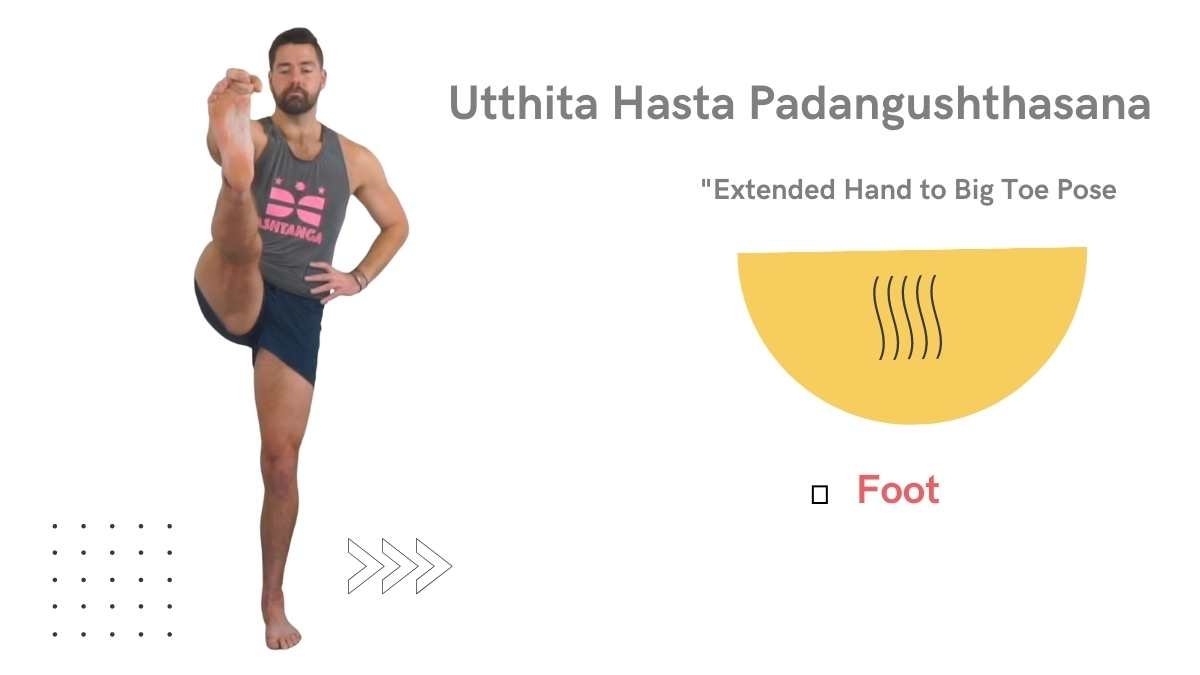
Utthita Hasta Padangusthasana (Extended Hand-to-Big-Toe Pose) intricately weaves together elements of balance, strength, and flexibility. Much like the foundational principles found in Tree Pose, this asana demands a narrative across various body parts while balancing on one leg. As you stretch the lifted leg, keep your back elongated to maintain an erect posture. The subtle play of muscle engagement — from gripping the big toe to rooting through the standing foot — serves as a microcosm of the holistic practice of yoga. The essential takeaway is not merely to elevate the foot with the hand but to engage the hip flexors dynamically for true mastery.
BASIC JOINT POSITIONS
- The standing knee extends.
- The standing hip is in neutral.
- The raised knee extends.
- The raised hip flexes.
- The shoulder of the raised arm flexes.
- The back extends slightly to counterbalance reaching forward for the foot.
Preparation
Start by utilizing a wall for support. Train yourself to engage the hip flexors by lifting the leg without hand assistance; simply bend the knee initially. This forms a strong foundation for the pose. Progress to using a belt around the foot for stability before moving away from the wall. Gradually straighten the standing leg while keeping both knees bent if balance begins to falter. Each stage is a stepping stone towards achieving fluidity in both strength and flexibility.
STEP 1: Activate the quadriceps to straighten the standing leg’s knee, allowing the tensor fascia lata to assist with stabilization. Employ the gluteus medius to support the pelvis as you align your femur and tibia. Be mindful of avoiding hyperextension.
STEP 2: Focus on the hip flexors and knee extensors of the lifted leg, with the psoas as the primary driver of hip flexion. The action of holding the bent knee aids in training the psoas, with the quadriceps assisting in straightening the leg and the sartorius refining the action.
STEP 3: Engage the arm to elevate the leg further. Activate the anterior deltoid and pectoralis major, and visualize this action to enhance your lift into the pose. Flex your elbow through the biceps and brachialis, simultaneously augmenting the stretch through the posterior chain.
STEP 4: Combat the tendency to lean forward by arching the lumbar and activating the erector spinae. Involve the standing leg’s glutes for increased stability, drawing the raised leg upward to enhance the hamstring stretch.
Conclusion
Mastering Uttitha Hasta Padangusthasana requires not just physical engagement but the interplay of breath and focus, echoing the broader themes within Ashtanga yoga of balance and mindfulness. The main journey within this pose lies in the hamstring stretch of the lifted leg, while the subplot unfolds through the activation of other supporting muscles. The nuances in each movement detail how interconnectedness is vital in the practice.
For a more comprehensive breakdown of the counts involved in this elegant pose, visit this detailed guide.
“`