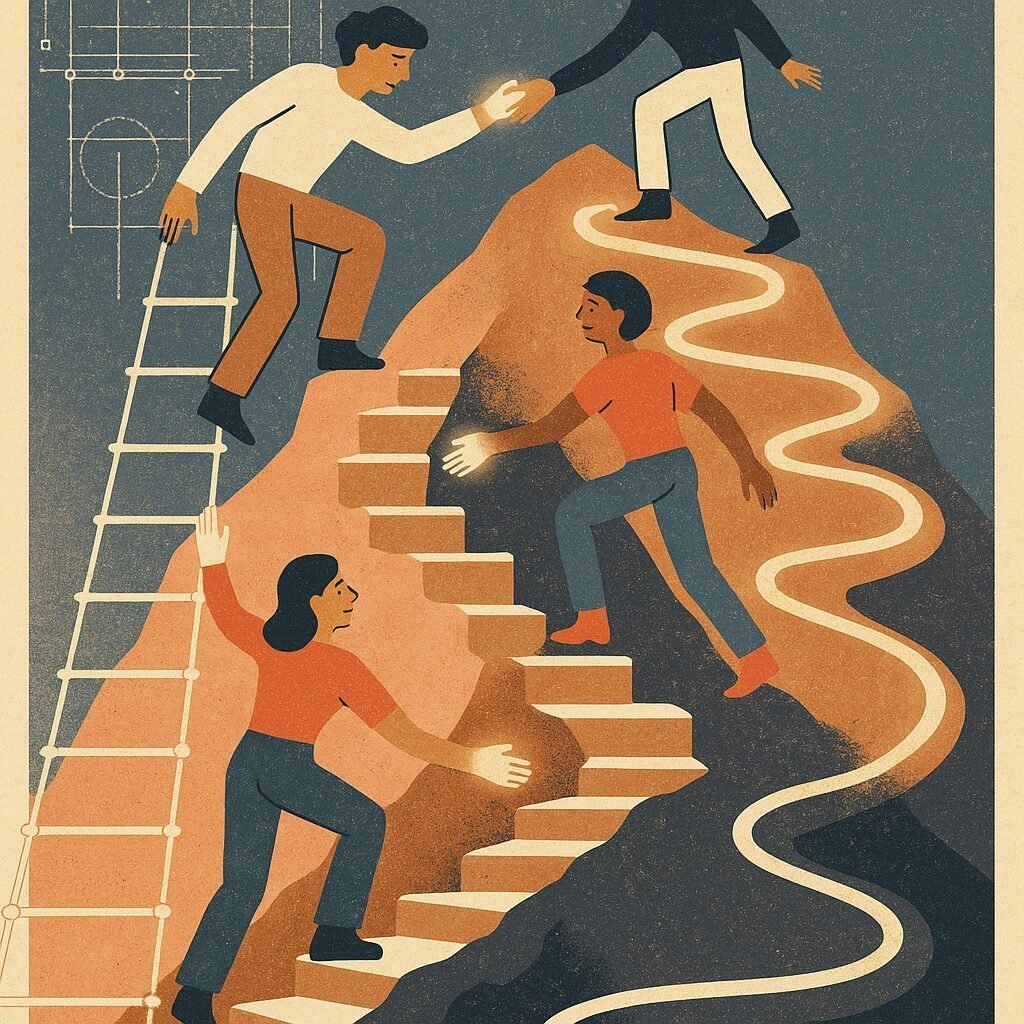
Why Beginners Quit: Replacing the Wall of Poses With an On-Ramp
A woman came to her first class, curious and a little nervous, and I did what every teacher does. I handed her the whole sequence. Sixty-some poses on a laminated sheet, a cheerful “just do what you can,” and a spot in the back row. She came for three weeks. Then, like most of them, she quietly disappeared — and I never found out whether it was the poses or the wall of them.
I used to tell myself a comfortable story about this. Yoga is hard. Not everyone is ready. The ones who stay wanted it badly enough. It took me an embarrassingly long time to notice that the story flattered me and blamed them. The dropouts weren’t lazy. They were doing exactly what any sane person does when handed an impossible amount at once: protecting themselves from the certainty of failing. The problem was never their discipline. It was my dosage.
What every other skill already knows
I think about practice as a system — something you learn to read and operate, not a belief you adopt. And every other system that builds a durable skill has already solved the dosage problem. Nobody teaches a language by handing you the dictionary. Nobody starts a beginner at their one-rep max. You add a small increment, let it settle into the body, and only then add the next. The technical name is progressive overload, and it isn’t a fitness gimmick. It is simply how a nervous system learns without breaking.
Ashtanga, of all methods, should have been the easiest place to see this. The sequence is fixed and ordered precisely so it can be learned one piece at a time — traditionally, a teacher gives you the next pose only when the last one is stable. That gatekeeping earns a bad reputation, and some of it is deserved. But underneath the culture was a genuinely good piece of instructional design: never more than you can integrate, never less than you’re ready for. Somewhere in the rush to make practice accessible, we threw out the ordering and kept the overwhelm. The laminated sheet is the artifact of that mistake — a disposable, one-size handout that treats every body on day one as the same body.
So I ran the audit on myself
At some point I stopped and asked myself a blunt question: what do I actually value here, underneath the teaching? Two things. That a beginner deserves the right dose from day one — a staircase, not a wall. And that your practice is yours — the record of it should live in your hands, not on a platform renting you a streak. Those are easy things to say, and I’d been saying them from the front of a room for years. But the honest part of a values audit is the follow-up question: if you believe it, what did you build? Talk is cheap. A post telling you to start small and be consistent costs nothing and changes nothing; the internet is already drowning in them. So I built the thing instead.
I rebuilt the delivery from scratch, on a platform I own rather than one I rent, and that choice is the whole argument. The wellness-app economy runs on the opposite of what practice needs: engagement for its own sake, a streak you protect out of guilt, your history living on somebody else’s server to be mined and, eventually, deleted when the company pivots. I didn’t want to hand people a mood. I wanted to hand them a method — and let their record of it live in their own garden, not Meta’s, not a startup’s that might not exist next year. If I’m going to tell you your practice is yours to own, the least I can do is not put it behind someone else’s login.
The course itself is one mechanic, and its simplicity is the point: one pose is added each week. Across five sections and sixty-nine lessons, the sequence grows with you instead of landing on top of you. Foundation and the standing sequence give you a floor to stand on. From there the Primary Series compounds, week over week, toward Bakasana — and if a full Primary isn’t your goal, a standing-only track builds instead toward Pincha. Second and Third Series open up later, for the practitioners who’ve genuinely earned the room. At any given moment you are working on exactly one new thing. The mountain becomes a staircase.
But sequencing alone wasn’t enough, because there’s a second, quieter failure mode: growth you can’t see, you can’t trust. People practice for weeks and still feel like they’re standing still, because nothing keeps the record, and memory is a liar — it files intentions as if they were actions. So every lesson deep-links a Practice Recorder tied to that week. You log what you actually did, not what you planned or felt you probably did. This is the least glamorous part of the whole course and, I’ve come to believe, the most important: it turns a fixed sequence into instrumented progressive overload, the load going up one tracked increment a week. That’s the difference between a practice and a vibe. A vibe is a warm feeling that evaporates by Thursday. A practice is a system with a memory — something you can look back on and see, in your own honest log, that last month’s edge is this month’s warm-up. That isn’t guessing. It’s assessing. And when the evidence of your own progress is sitting right there, you don’t need me to motivate you. The compounding does it.
Who you become
What I want for the people who practice this way is bigger than a party-trick asana. I want you to become the operator of your own practice — to hold the manual, add and log and adjust without waiting on permission from anyone, me included. That is the whole quiet ambition behind the one-pose-a-week format. Not to keep you dependent on a teacher, but to hand you a method you can run yourself, for the rest of your life.
The alternative is another year of the wall. Another sheet, another January, another quiet disappearance from the back row — guessing whether you’re improving, renting your history from an app, obeying a sequence you never got to understand. A year of that costs more than the year. It costs the belief that practice is something you’re built for.
So this is the receipt for a value I wasn’t willing to only talk about. If you’ve ever bounced off a whole sequence and blamed yourself, I’d gently suggest the sequence was the problem, not you. If this is you — if you want a practice built slowly, in order, on the record and in your own hands — here’s where it lives: Build Your Practice. Add one pose. Log it. Come back next week. That really is the whole thing, and it’s enough.