
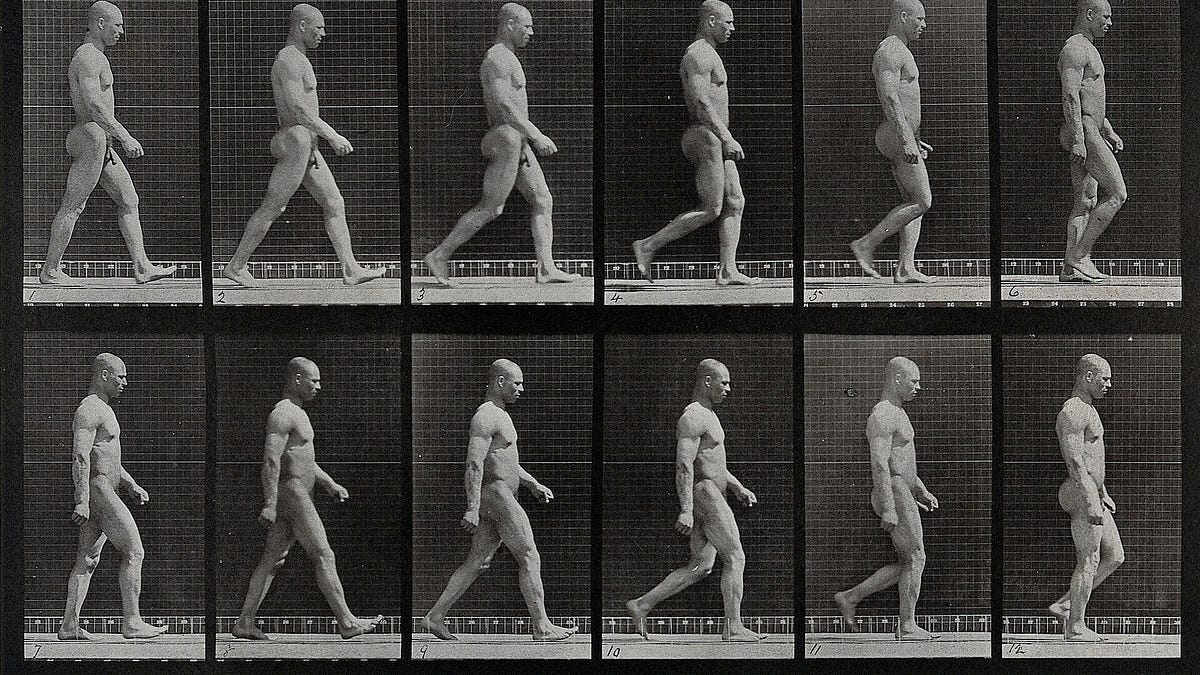
Walking
Note: This is the ninth chapter of my serialized book Healthy Movements for Human Animals. You can find an archive of previous chapters here.
This chapter begins a new section of the book on what I call Bipedal World: the movements that emerged when our ancestors left the trees and began moving over the ground on two feet. These movements are walking, running, jumping, and pursuit/avoidance (or agility).
This chapter covers walking, which is the foundation. Walking differs from many of the other primal movements in this book because it remains a central part of everyday modern life. Unlike climbing, sprinting or crawling, some amount of walking is required. It is not considered exercise and is part of many enjoyable activities.
And yet we walk far less than we should. In an ancestral environment, covering 5 to 10 miles a day on foot is almost unavoidable. In the modern world, most of us manage half that, and many far less. One reason is lack of time and energy, but another is simply a lack of respect for the health and performance benefits of walking as a form of exercise. For someone who is sedentary, even a few thousand extra steps a day can substantially decrease the risk for a number of diseases. And for someone who already trains hard, trading a little of that intensity for more easy walking would likely mean fewer injuries, quicker recovery from hard workouts, and better general health.
If you take only a few practical tips from this book, one of them should be this: walk more. Walking is so central to the human animal that it connects with almost every dimension of health and function: structural, physiological, even cognitive, emotional, and social. It should be considered a basic building block for life, not an afterthought.
With that in mind, this chapter considers how walking evolved, how it develops in children, the way it manifests in natural lifestyles, and why its health benefits are so broad.
The first strong evidence of human bipedalism dates back more than 3 million years. Lucy, the famous Australopithecus afarensis fossil, shows clear lower body adaptations for walking on two legs. But she maintained long arms and curved fingers, indications that she still spent significant time in the trees, and probably slept above ground.
Our ancestors probably didn’t fully commit to a bipedal, ground-based life until about 2 million years ago. By then Homo erectus had relatively modern body proportions, including long legs and short arms. These adaptations traded some climbing ability for the capacity to walk and run long distances efficiently on two legs.
Why did we start walking on two legs instead of four?
Bipedalism is very rare for large animals. Four limbs on the ground offer more speed, stability and agility than two. For example, chimps can easily outsprint humans over short distances. And they are far more agile and less prone to falls. Aside from kangaroos and flightless birds like ostriches and emus, humans are one of the very few animals heavier than a few pounds that move on two legs as their default. So why did we stand up? Here are six of the leading theories.
Carrying. Bipedalism freed the hands to carry food, infants, water, and tools.
Gait efficiency. Walking on two legs costs human bodies far less energy than knuckle-walking costs chimpanzees. This might have been valuable in environments where food was sparse and widely distributed, requiring long daily travel.
Thermoregulation. An upright posture exposes less of the body’s surface to direct overhead sun. This allows more activity during the day when many predators are sleeping.
Vision. Standing upright allows a better view across tall grass, making it easier to spot predators and prey at distance.
Threat and combat. Many animals rise onto two legs briefly to look larger during confrontations, or to strike with the hands.
Postural feeding. Reaching upward for fruit on low branches may have favored bodies that could comfortably stand and reach for extended periods.
These explanations are not mutually exclusive, and most researchers assume that some combination accounts for the move to bipedalism.
It’s interesting to consider the structural and functional adaptations that allowed us to walk on two feet. This provides a lot of insight into how the human body is organized.
Following are some of the key transitions. Most can be understood by comparing humans to chimps, whose anatomy is roughly similar to that of our prebipedal ancestors.
The legs became longer, which increases step length, and the arms became shorter, reducing their dead weight.

The legs also became straighter, by angling the femur inward from the hip, placing the knee and foot more in line with the center of mass, improving single-leg balance.
The spine developed lumbar lordosis to better stack the body mass vertically. By comparison, a chimp’s low back is relatively flat.

The pelvis adapted to provide better stability and balance on one foot. This is what allows us to take relatively narrow, stable steps without shifting the trunk from side to side to stay balanced. This involved some changes in the function and structure of the glutes that we will discuss in more detail in the chapter on running.
The feet adapted to become stiffer and better able to channel ground forces into forward movement, by developing strong arches and a lengthened Achilles tendon. The result was that ankle plantarflexion could contribute far more power during walking and running.
The power of the ankle was assisted by increased flexibility at the hip into extension. This allows the ankle to push when the leg is behind the pelvis, creating a force that drives the body up and forward.

Chimps don’t have the hip range of motion into hip extension that allows this trailing leg position when walking. They walk with more bent hips and knees and flat feet, and generate much less propulsive power at the ankle.
You can feel this difference yourself. Walk tall and notice how each step ends with the trailing leg behind you and your weight rolling forward over the toes. Then walk with your hips and knees more bent, taking short steps and keeping your feet relatively flat. This reduces the trailing leg angle and makes it much harder to use the powerful late-stance push-off that characterizes ordinary human walking.
These structural changes made walking efficient, and this allowed our ancestors to walk a lot more. David Raichlen and Daniel Lieberman estimate that step counts tripled over the course of human evolution. Human metabolism shifted as well: Herman Pontzer and colleagues find that humans burn more energy per day than other great apes of similar size. Raichlen and Lieberman hypothesize that this high baseline of activity shaped our physiology and metabolism, tuning it to expect large volumes of low-intensity movement throughout the day.

Like many of the other primal movements discussed in this book, walking develops in infants in ways that have interesting parallels with the evolutionary progression.
Infants start walking in a pattern that is similar to how our ancestors would have walked before getting better adapted to bipedalism: short and broad steps, relatively bent knees and hips, and flat feet. The trunk shifts side to side to provide balance.
It takes several years for the adult walking pattern to emerge gradually. The base of support narrows, steps lengthen, the stance leg becomes more extended, and the foot starts to use a more heel-strike-to-toe-off pattern. Hip extension range of motion increases to allow the trailing leg to push off, allowing the calf to power the forward movement.
As people age and their walking function declines, a similar pattern happens in reverse. Studies have found that older adults walk with shorter and wider steps, more bent knees and hips, less hip extension, and less contribution from the calf in powering forward movement.
None of this means that there is some mystical force requiring us to move in the same ways as our distant ancestors, or that getting older involves some form of “devolution.” It simply means that there are few solutions to the problem of walking on two legs, and that these solutions will cluster together into certain patterns of combined joint movements. The evolutionary perspective is an easy way to see how these patterns fit together. In particular, it reveals a functional synergy between hip extension and foot/ankle function, with potential insights into improving gait mechanics.
Walking is a central physical activity of hunter-gatherer life, required for obtaining food, water, firewood, and relocating camp. Ethnographic studies reveal considerable variation in how often different groups run, climb, swim, or dive. These activities depend on the culture, ecology and the season. But every group walks extensively as part of daily life because it’s unavoidable.
Hadza men walk about 8-9 miles per day and the women about 5 miles (often while carrying children). The Tsimane forager-horticulturalists of the Bolivian Amazon average around 7 miles per day. Similar distances are covered by the Baka of Cameroon and the BaYaka of the Congo, in forests with irregular and demanding terrain.
Taken together, the available data suggest that hunter-gatherers typically walk between 5 and 10 miles per day, or roughly 10,000 to 20,000 steps. By contrast, the average American adult takes between 3,000 and 5,000 steps per day, roughly 1.5 to 2.5 miles.
What about running?
