You’re Practicing the Picture, Not the Pose
A student once asked me whether a quadriplegic could do chaturanga. She meant it as a trap — obviously not, so stop being precious about “functional” versions and admit some poses require certain bodies.
I said: it depends on what chaturanga is for.
She looked at me like I’d lost my mind. Chaturanga is that low push-up position. Four limbs, chest hovering above the floor, elbows at ninety degrees. Everyone knows what chaturanga looks like.
And that’s exactly the problem. We’ve confused the pose with the picture of the pose.
Chaturanga creates specific joint actions: shoulder extension, elbow flexion, scapular protraction, trunk stabilization. That’s what it’s for. The aesthetic — the specific arrangement of limbs we call chaturanga — is one body’s solution to creating those joint actions. It works for a certain range of bodies under a certain range of conditions.
A quadriplegic using a wheelchair can create shoulder extension and scapular protraction by pressing their hands into their thighs and generating resistance. The function is there even though the form looks completely different. That’s not a modification. That’s chaturanga.
The word “modification” is doing quiet damage in yoga communities. It implies a hierarchy: the real version, and then the lesser versions for people who can’t manage it. When a teacher says “here’s the modification,” what students hear is “here’s what you do if you can’t do it.” The judgment is built into the word.
But if a pose is a set of joint actions — a functional demand — then any version that creates those actions is the pose. Not a watered-down version. The pose.
This matters beyond semantics. If you believe chaturanga is a shape, your job is to make your body match the shape. You look at the teacher. You look at the picture. You try to close the gap. That’s not practice. That’s performance. You’re working on the aesthetic without necessarily working on the function.
The question that changes everything: not “can I make my body look like the picture?” but “can I create these joint actions with the body I have today?”
That second question requires you to understand what the pose is actually building. You have to know what shoulder extension is. You have to know what scapular protraction does at 5 AM when the sequence picks up speed. None of it is mystical. All of it is learnable.
Once you understand it, you can apply it to any body, any day, any limiting factor. Tight hamstrings on Tuesday. Shoulder strain after moving furniture. Third trimester. Sixty-seven years old. The question is always the same: what joint actions does this pose create, and what version creates those actions given what I’m working with right now?
Paschimottanasana is a forward fold. What it builds is lumbar flexion, hamstring length, posterior chain release. Someone with a disc injury might skip the fold and practice the seated hip position with a tall spine. That’s not a failure to do paschimottanasana. That’s paschimottanasana, understood.
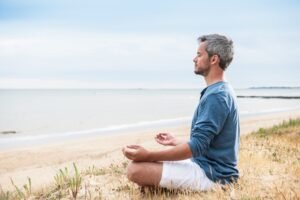
Padmasana’s goal is a comfortable seat where you can maintain steady breath and alert presence. The pretzel is one possible method. If you sit cross-legged on a blanket and your breath is steady and your attention is clear, you’re doing lotus. The picture just shows you a different person’s answer to the same question.
The shape is not the thing. The shape is a hint about the thing.
So: before your next practice, pick one pose and ask what joint actions it creates. Then find your own version of those actions. You might be surprised how much less you need to fight your body once you stop asking it to look like someone else.