
A Decade of Practice, Almost No Data: Closing the Explanation Gap
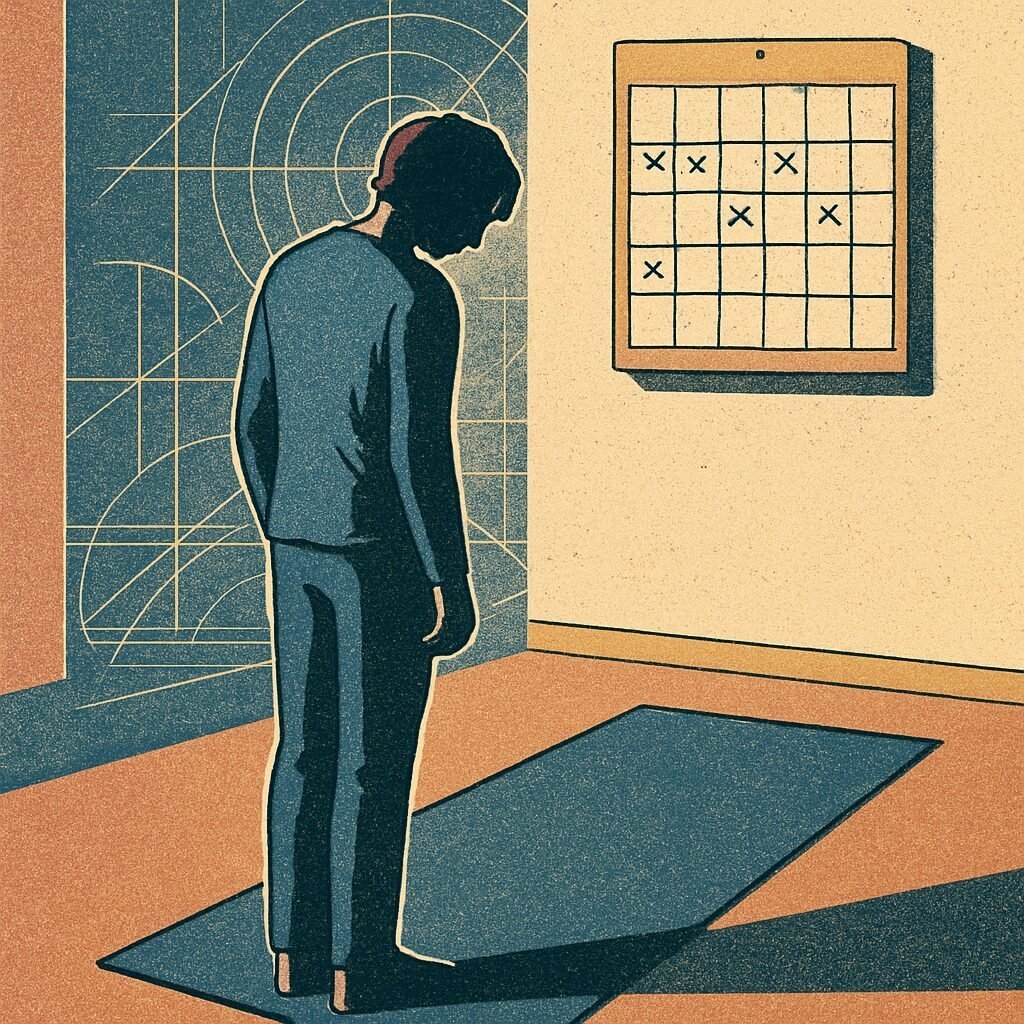
I remember the morning it broke. Same mat, same room, same breath count I could recite in my sleep. I got to the end, sat down, and felt the thing I’d been outrunning for a year: I had just performed a decade of practice I could not explain. Ask me the order and I’d give you every posture, every vinyasa, the Sanskrit for all of it. Ask me what any single piece of it was doing to my body that morning and I had nothing. A decade of repetition. Almost no data.
That gap is what I’ve spent every year since trying to close. And the more I looked, the more I understood it wasn’t my failure. It was designed in.
Obedience was the product
Traditional practice is brilliant at transmission and terrible at literacy. It hands you a fixed form and asks for faith: do this, in this order, this many times, and don’t ask what the lever does. There’s a reason it works that way — it scales, it protects the method from a beginner’s ego, it holds up well enough for long enough. But it quietly trains dependence. You learn to obey the sequence; you never learn to read it. And the day the sequence stops delivering, you have no instruments and no way to intervene in your own practice. You push harder on a pedal you can’t see and wait for a teacher to confirm what you already suspect.
Look at what the market built on top of that dependence. Mood-tracking apps that ask how your session felt and call it progress. One-size sequences pushed at ten thousand different bodies. Disposable PDFs. A rented account where your years of practice quietly become Meta’s data instead of yours. It’s slop — comforting, frictionless, engineered so you never graduate. Another year of it costs you the one thing it pretends to give: the ability to run your own practice without asking permission.
The audit I ran on myself
So I stopped and asked a blunt question: what do I actually value here — not what do I say in workshops, what do I value? The answer came back clean. A practitioner should be the executive of their own practice, not a lifelong follower of a count. Your practice data is yours. Understanding should arrive on day one, not get withheld as a reward for obedience. Practice is systems literacy — yoga is not a belief you adopt, it’s a system you learn to operate.
Then came the uncomfortable part of any honest audit: I could have just written that down. A nice post, a manifesto, a talk. But talk is cheap, and the internet is already full of people who say they value your agency. I decided I wasn’t willing to only say it. If I believed the practitioner should hold the controls, then the method had to actually hand them over. So I built the controls.
Why I built the tools
I’m the founder of Ashtanga Tech, and the whole reason it exists is that I needed instruments that didn’t. Not more content — controls. So the method ships with them.
The count videos hold the breath-by-breath timing so you can stop performing the sequence from memory and start watching what each vinyasa does. Guided audio carries the rhythm while you establish a new load, so your attention is free to observe instead of count. The Practice Recorder is the part I’m proudest of: it logs your sessions week by week — every lesson deep-links straight into it with ?week=N — so a month from now you’re reading your own trend line instead of trusting a feeling. That’s the value loop made real: make a choice, record it, see whether it paid.
And all of it runs on a platform I own, not one I rent. Your practice data lives in your own garden, not inside an app that can change its terms or vanish. I built it self-owned on purpose — a course about taking back the controls of your practice has no business handing your record to a landlord. The platform isn’t a feature. It’s the receipt: the difference between a man who says he values your ownership and one who shipped it.
What Agentic Ashtanga actually is
It’s the method with the cultural scaffolding removed and the controls handed back. It moves from adjusting your relationship to the practice, through what an intervention actually is and how to build the value loops that tell you whether a choice paid, into how you adapt the form to your body and stand up the safety infrastructure that lets you keep doing this for forty years instead of four. And it ends with leadership — because once you can read your own practice, you can hold it for someone else, and that turns out to be the point too.
This isn’t anti-tradition. It’s what I think the tradition was always trying to produce and often forgot to: a practitioner who is the executive of their own agency, not a follower of a count. An operator. An owner. Radical accountability — Ashtanga without the cult.
Picture a year of it. You sit down after practice and instead of a vague feeling you have a record, a reason, and a next move. You stop waiting to be told and start deciding. You still love the form — more, actually, now that you can see inside it.
If you’ve hit that quiet plateau — devoted, disciplined, and increasingly unsure what any of it is doing — this was built for you. Not written about. Built. If that’s you, here’s where it lives: Agentic Ashtanga. The controls are already on. Come take them.