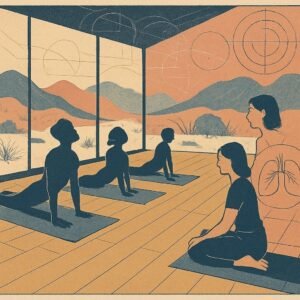

Ten Years of Practice, No Idea Why: Building the System I Couldn’t Find
One morning about a decade in, I finished a clean primary series — full count, dropbacks, the whole thing — rolled up my mat, and realized I couldn’t have told you a single reason I was working on any of it. I knew what came next in the sequence. I couldn’t have told you why. Ten years of near-daily data, and no idea what any of it meant.
By every visible measure I was a good practitioner. I showed up before dawn. I followed the count. I could do the postures people photograph. And underneath it I was drifting — because drift disguises itself as discipline. I was doing a lot, doing it faithfully. What I wasn’t doing was deciding. Every meaningful choice about my practice — what to work, why, in what order, toward what — had been quietly handed to someone else. The lineage decided. The teacher decided. The tradition’s momentum decided. My job was to obey well and wait for the practice to do something to me.
It’s a comfortable arrangement. It’s also how you spend ten years and compound almost nothing.
The moment the frame broke
The shift didn’t come from a posture. It came from the rest of my life — years spent building systems, watching organizations succeed and fail, learning that the people who steer anything well are the ones who can see the whole board. Not the ones working hardest. The ones with altitude.
That morning it landed on the mat like a slap: I had altitude everywhere except here. In the one domain I cared about most, I was a diligent employee of my own practice. Never the executive.
So I started asking the questions an operator asks. What are the real feedback loops in this practice? Where does effort accumulate, and where does it leak? Which constraint is actually governing my progress, and which one am I just superstitious about? What is this whole sequence for — and am I running it, or is it running me?
The postures didn’t change. I did. The mat stopped being a place I obeyed and became a place I operated — the most honest management system I’ve ever had, because it lies to no one and gives feedback every single day.
The audit I ran on myself
Then I did something uncomfortable: I audited my own values. Not the ones I’d say out loud — the ones my behavior actually revealed. And the one that kept surfacing was ownership. I believed, with real conviction, that a practitioner should own their own practice — the data and the decisions both. No guru holding the map. No landlord holding the record.
So I went looking for a tool that respected that, and everything on offer was slop. Mood apps that ask how you feel and call it data. One-size sequences that never once looked at your shoulder. Guru dependency dressed up as devotion. Disposable PDFs you download, lose, and re-buy. Rented software that owns your history and hands it back as a monthly bill — and quietly ships the rest to Meta. None of it was mine. None of it could ever be yours.
That’s the moment a value stops being talk. I could have written this exact paragraph as a post — own your practice, resist the landlords — collected the nods, and changed nothing. Instead I built the thing I couldn’t find. That’s the whole difference between someone who says they value something and someone who shipped it.
Which is what Ashtanga Tech actually is: technology in service of practice, not slop dressed as it. A self-owned, decentralized platform where your practice log is yours — your data, your garden. A Practice Recorder that lets you log week by week (?week=N), so a year of practice becomes something you can read instead of a fog you half-remember. Guided audio and breath-by-breath count videos, so the count itself is teachable instead of mysterious. The platform is the argument. I refused to hand my own record to a landlord, so I’m not going to ask you to hand over yours.
Why this had to be a course, not a slogan
I could have made this a nice phrase too. “Be the executive of your own practice.” Motivational, forgettable. But you can’t slogan your way into a new altitude — you have to be walked up to it, deliberately, in the right order.
So the course climbs. You start with systems thinking in general, because you can’t read a specific system until you can read systems at all. Then you turn that lens on Ashtanga itself — Ashtanga as a system, then its dynamics: the stocks and flows and loops that were always there under the count. Only then does strategy make sense, because strategy without a model is just guessing with confidence. And it ends where it has to: with the recognition that once you can read one system, you can’t stop. Your practice was never separate from the rest of your life — it was a training ground for how you’d run all of it.
This is Ashtanga without the cultural scaffolding — the tradition treated with full respect and full honesty at once. Decentralized. Accountable. Yours to run. Not a belief to adopt, but a system to become literate in. Don’t guess. Assess. Then decide — because you’re finally high enough to see what you’re deciding about.
Who it’s for
It’s for the practitioner I used to be. The faithful one. The one doing everything right and quietly suspecting that “right” was somebody else’s answer to a question they never got to ask. If you’ve hit the plateau that no amount of extra effort will move, I don’t think you need more effort. I think you need altitude.
Picture the other version: another year of the same sequence, run on faith, its record scattered across apps that aren’t yours, still unable to say why you’re working what you’re working. That’s not neutral. That’s a year of compounding almost nothing. Now picture the year you can read your own practice — where week twelve knows what week one was for, where you make one deliberate call at a time and watch the board respond. That practitioner isn’t working harder. They’re operating. They own the whole thing.
If that’s who you want to become, here’s where it lives: Yoga for Executives. The door’s open. Come see what your practice looks like from the executive’s chair.
— Michael