
Walking
 toddhargrove.substack.comWalkingChapter 9 of Healthy Movements for Human Animals✦ Read ad free and get the full MichaelFilter · $5.50
Part of the MichaelFilter
Members read the whole piece — the writeup, the pull-lines, and the full transcript. Unlock access for $5.50.
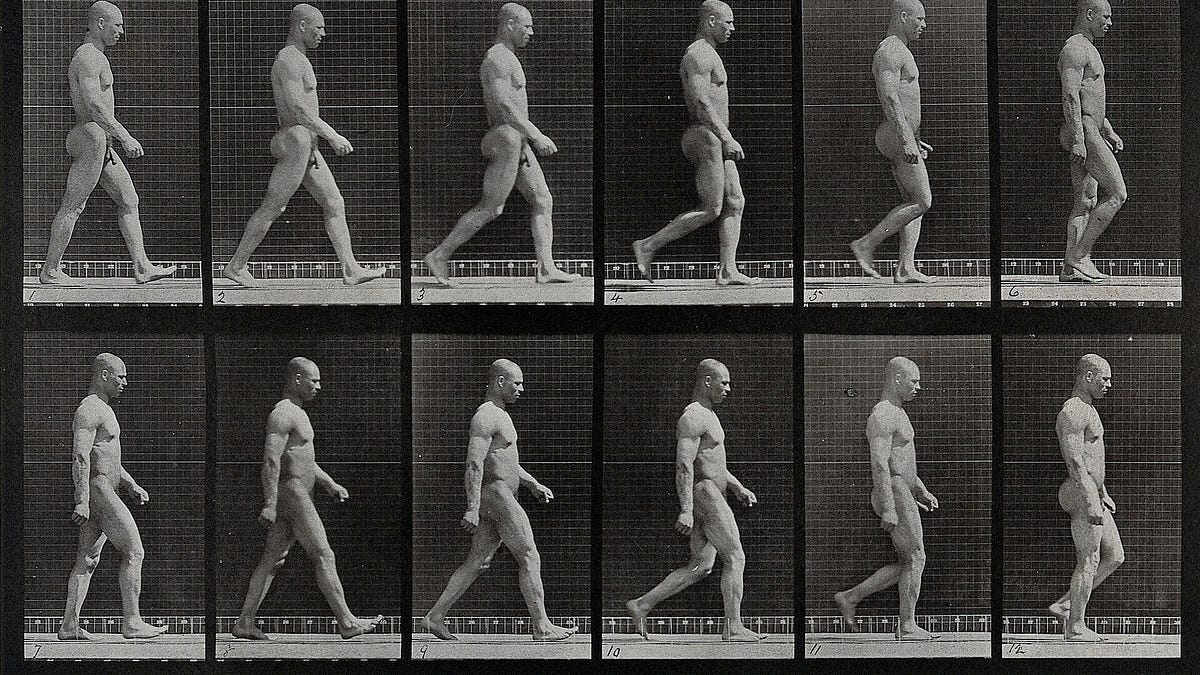
Unlock the full reading · $5.50 →Todd Hargrove's serialized chapter frames walking as the foundational bipedal movement humans evolved for, contrasting modern undermovement with ancestral norms of 5-10 miles daily. He outlines six theories for why bipedalism emerged (carrying, efficiency, thermoregulation, vision, threat display, postural feeding) and details the anatomical adaptations—longer legs, lumbar lordosis, arched feet, hip extension range—that made upright locomotion possible. The core practical takeaway: walk more, because walking touches structural, physiological, cognitive, emotional, and social health.
Teaching:
• Frame Surya Namaskar A's step-back and step-forward as expressions of hip extension range—the same architecture that powers walking
• Prescribe daily walking as the recovery and nervous system substrate that lets students train Ashtanga harder with fewer injuries
• Use the chimp-to-human spine comparison when cueing lumbar curve in Samasthiti—lordosis is the load-bearing default, not a fault
• Address foot arches and Achilles loading in standing postures as the same system that channels ground force in gait
Writing seeds:
• Essay: Walking as the missing Ashtanga prerequisite—why a 10,000 step floor changes what happens on the mat
• Shala Daily seed: Hip extension is the engine of both walking and jump-back; here's how to feel it
• Post for ashtanga.tech: Six evolutionary reasons we stand up, and what each one teaches about practice posture
• Functional Ashtanga piece: The foot as a spring—arch, Achilles, and the load path from gait to chaturanga
Idea map:
• Walking as systems literacy: a movement that integrates structural, physiological, cognitive, and social layers in one act
• Reinforces MJH's frame that practice is not separate from daily life—the body is always practicing something
• Connects to embodiment thread: anatomy reveals values, and bipedal adaptations encode trade-offs we inherit on the mat
• Attention angle: walking as the low-intensity baseline that makes higher-intensity practice legible and recoverable
Source: https://toddhargrove.substack.com/p/walking
Teaching:
• Frame Surya Namaskar A's step-back and step-forward as expressions of hip extension range—the same architecture that powers walking
• Prescribe daily walking as the recovery and nervous system substrate that lets students train Ashtanga harder with fewer injuries
• Use the chimp-to-human spine comparison when cueing lumbar curve in Samasthiti—lordosis is the load-bearing default, not a fault
• Address foot arches and Achilles loading in standing postures as the same system that channels ground force in gait
Writing seeds:
• Essay: Walking as the missing Ashtanga prerequisite—why a 10,000 step floor changes what happens on the mat
• Shala Daily seed: Hip extension is the engine of both walking and jump-back; here's how to feel it
• Post for ashtanga.tech: Six evolutionary reasons we stand up, and what each one teaches about practice posture
• Functional Ashtanga piece: The foot as a spring—arch, Achilles, and the load path from gait to chaturanga
Idea map:
• Walking as systems literacy: a movement that integrates structural, physiological, cognitive, and social layers in one act
• Reinforces MJH's frame that practice is not separate from daily life—the body is always practicing something
• Connects to embodiment thread: anatomy reveals values, and bipedal adaptations encode trade-offs we inherit on the mat
• Attention angle: walking as the low-intensity baseline that makes higher-intensity practice legible and recoverable
Source: https://toddhargrove.substack.com/p/walking
Notes from the field
No notes yet · members & customers welcome
- No notes yet. Be the first to leave one.
Join MichaelFilter
Michael Joel Hall’s daily reading — the field journal, critical-thinking cards, and synthesis — as a membership.
$5.50/month · cancel anytime
Join — $5.50/mo →Secure checkout on theyoga.club. A yearly option ($55) is available there too.