
What Happened to the Fourth Series Practitioners
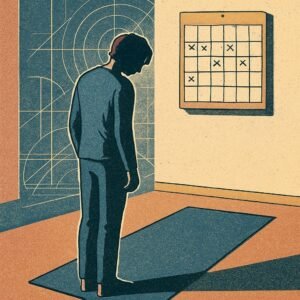
The first thing I notice in those rooms is the silence. Not meditation silence — the other kind. The kind where nobody helps the new person find a mat. Where someone with an extraordinary kapotasana watches a student struggle with the same bind they cracked fifteen years ago, and says nothing. Where the room’s most experienced body is also, somehow, its least present.
I have been in enough of those rooms.
The traditional logic of Ashtanga was supposed to work like a slow burn. You give the practice years. Decades, even. You show up. You get confused. You get humbled. The point isn’t the series — the series is just the vehicle. What you’re actually learning is patience, receptivity, the capacity to hold a space for someone else’s confusion without needing to fix it. That’s the long game. Or it was supposed to be.
Here’s what happened instead.
In the post-Jois era, inside a globalized, monetized marketplace for yoga credentials, the series became currency. Fourth series isn’t just hard anymore — it’s a marker. A signal. It tells people something about the kind of practitioner you are, the lineage access you have, the rooms you’ve been permitted to enter. And the problem with turning practice into a ladder is that ladders only go one direction. You climb. You don’t look down to help anyone else up.
I’ve been saying this more plainly lately: my experience with fourth series practitioners is that roughly sixty percent of them are tools. That’s not a polished observation. But it’s what I’ve clocked. People who have, as far as anyone can tell, climbed extraordinarily high — and never learned how to support a community. Not because they’re bad people. Because the system that produced them never required it. You can move through the entire Ashtanga transmission structure without being asked to hold space for anyone even once. The credential doesn’t demand it.
What it does demand: years. Money. Devotion. Ideally, multiple trips to Mysore. Ideally, a body that cooperates. Ideally, a teacher who counts you ready. You pay into this system in a currency that isn’t recoverable, and what you get back — if the extraction works in your favor — is authorization. You’re now a person who knows the sequence.
The question nobody asks is: what did you actually absorb?
Because here’s the thing. I have also been in rooms where someone who has done the work — genuinely done it, not just collected it — walks in and you feel the whole temperature change. They’re not performing their practice. They’re not subtly narrating their credentials. They’re just present. They see who’s in the room. They adjust. They make space.
Katie is like that. She makes a real effort at it. That might sound faint as praise, but it isn’t — making a real effort at community, in a culture that has systematically stripped the expectation of community from advanced practice, is actually a countercultural act. She noticed what the credential system quietly trains people to unsee, and she chose to see it anyway.
That’s rarer than fourth series.
What worries me is structural, not personal. The extractive model doesn’t create bad people. It creates people who learned one thing very well — how to advance — inside a system that never required them to learn anything else. And then we import those people into teaching roles and wonder why the room feels thin. Why students feel uncared for. Why the whole apparatus, which is supposed to transmit something ancient and human, sometimes produces people who look extraordinary and can’t actually see you.
The transmission has always been the point. Not the series. Not the count. Not the certification. The capacity to receive what someone is offering and give it forward with some care. Ashtanga has always, at its best, been a system for producing people who can hold space — for themselves first, then for others. The series are the training ground for that. They’re not the output.
When the series becomes the output, you end up with exactly what we have now: a room full of impressive bodies and a shortage of actual support. The system performed its function. The function was just wrong.
If you made it to fourth series and the whole ride taught you how to climb — you learned the mechanics. The question worth sitting with is whether you learned how to stay.