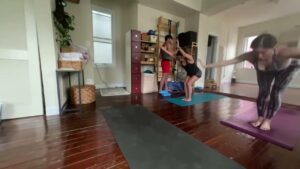
Ashtanga Vinyasa Inspired Flow
75 Minutes
6:12:12:6 grower pranayama
Touch & Go Standing
Intermediate A
Advanced A
Primary Marichi
Maitri Meditation

75 Minutes
6:12:12:6 grower pranayama
Touch & Go Standing
Intermediate A
Advanced A
Primary Marichi
Maitri Meditation

Ever asked yourself ‘Who am I?’ and found no simple answer? 🌿 Welcome to day 1 of our transformative course, ‘Dharma Intention and Wisdom,’ where we dive deep into this profound question. Discover how self-inquiry leads to wisdom and alignment with your true purpose. You’ll explore: 🔹 The essence of self-inquiry in Ashtanga yoga 🔹 Moving beyond societal labels 🔹 Using patience for deeper insights Start your journey of self-discovery today and unlock the wisdom within. #SelfInquiry #Dharma #PersonalGrowth
In this episode, I delve into the importance of balancing objectivity and subjectivity in Ashtanga Yoga practice. Objective analysis focuses on measurable aspects such as alignment, breath length, stance, and body placement. However, maintaining awareness of your subjective experience—your personal journey and internal responses—is equally crucial. The video also highlights the role of a skilled teacher and the significance of developing your internal compass to guide your practice, empowering you to adapt practices to your unique needs.
00:00 Objective Analysis of Practice
00:26 Embracing Subjective Experience
00:53 The Role of the Teacher
01:11 Developing Your Inner Compass
In this episode, MJH delves into the methods of qualification for an Ashtanga Yoga teacher, contrasting traditional practices with modern approaches. Hall discusses the historical context of authorization by Patabi the current certification processes. He highlights issues with evaluation models, explaining the benefits of a non-linear understanding of system dynamics over linear assessments. Hall shares personal experiences, including conflicts in teaching methods, and emphasizes the importance of ethical frameworks and personal growth for both teachers and students in Ashtanga Yoga.
00:00 Ashtanga Yoga Assessment Paradigms
00:13 Historical vs. Modern Certification Methods
01:15 Challenges in Modern Certification
02:18 Open Systems, Closed Systems, and Narrow Minds
03:11 Personal Teaching Conflicts and Adaptations
04:13 Linear vs. Non-Linear System Dynamics
05:57 Holistic Criteria for Assessing Teachers
06:26 Balancing Physical and Ethical Development
07:16 Questions for Personal Practice and Teaching
08:35 Conclusion: The Importance of Ethical Teaching
Individualized Sequencing in Ashtanga Yoga
—
**Introduction**
Hello! Michael Joel Hall here, diving into the world of individualized sequencing in Ashtanga Yoga. While Ashtanga is known as a structured system, it’s crucial to realize that adaptability is its core strength. Without it, the practice becomes fragile. The traditional sequence, developed throughout the late 20th century, is designed to cultivate strength, flexibility, and resilience through its progressive and intentional design. But what happens when the system faces the individual realities of injuries, physical limitations, and unique biomechanics?
—
**Understanding Challenges and Adaptations**
Ashtanga Yoga, like any practice, meets unique individual challenges. When faced with pain, limitations in breath stability, or when a posture aggravates an existing injury, adjustments become essential. It’s vital to adapt intelligently without compromising the essence of the practice. Obstacles such as existing injuries or unique physical structures can sometimes act as barriers that cannot be overcome by sheer determination or force.
—
**Integrating Therapeutic Adaptations and Vinyasa Flow**
Therapeutic adaptations can be integrated smoothly without breaking the vinyasa count, by maintaining the rhythm of breath and incorporating regressive movements that facilitate appropriate breathing and motion. The core purpose of Vinyasa is to preserve the continuous flow of energy. As long as substitutions support these core goals rather than disrupt them, why not embrace them? This way, the integrity of the system remains intact.
—
**Balancing Tradition with Sustainability**
One of the significant challenges in modern Ashtanga Yoga is balancing tradition with the sustainability of practice. As we incorporate our western conditions and lifestyles, rigid adherence can lead to more injuries or create unnecessary exclusion. There’s a misconception that modifying the practice will dismantle its structure, but that only happens if modifications are made without discernment. Understanding why the sequence exists and adapting it with respect and intelligence gives it a long-term vision.
For me, this practice extends beyond a single session. It’s an insight practice—a lifelong journey. Don’t you want a practice that offers lifetime insights?
—
In conclusion, individualized sequencing in Ashtanga Yoga is about making intelligent adaptations to honor both the tradition and personal needs. This nuance allows for sustainability and inclusivity, ensuring that the practice benefits each practitioner uniquely over their lifetime.
In this video, Michael Joel Hall explores the concept of self-awareness through the practice of yoga. He discusses how physical patterns observed during yoga can mirror deeper mental models affecting our life experiences. Hall encourages understanding not just what we do, but why we do it, by relating the approach to challenging yoga postures with how we handle life’s challenges. He outlines how beliefs manifest in actions and outcomes, and emphasizes the transformative power of awareness. Practical tools such as morning check-ins, pattern journaling, body scans, and mindful transitions are suggested to deepen self-awareness. Hall also highlights the importance of community in accelerating growth and understanding our broader impact on the world. The video invites viewers to start their own journey of self-observation and build a foundation of awareness for personal transformation.
00:00 Introduction to Self-Awareness
00:24 The Mirror of Practice
00:48 Breaking Down Mental Models
01:23 Practical Steps for Self-Awareness
02:37 Tools and Community Support
Embracing fear, rather than avoiding it, can present new opportunities and lead to a more fulfilling life. Throughout history, visionary leaders have shown us that risk and opportunity are often intertwined. In this video, we explore how stepping into the unknown can lead to growth and reinvention. Learn how vulnerability can be your greatest strength, and why a life without risk is a life unfulfilled. Be the hero in your own story and step into a future filled with potential. #Courage #RiskTaking #PersonalGrowth
No notes yet · members & customers welcome
Michael Joel Hall’s daily reading — the field journal, critical-thinking cards, and synthesis — as a membership.
$5.50/month · cancel anytime
Join — $5.50/mo →Secure checkout on theyoga.club. A yearly option ($55) is available there too.