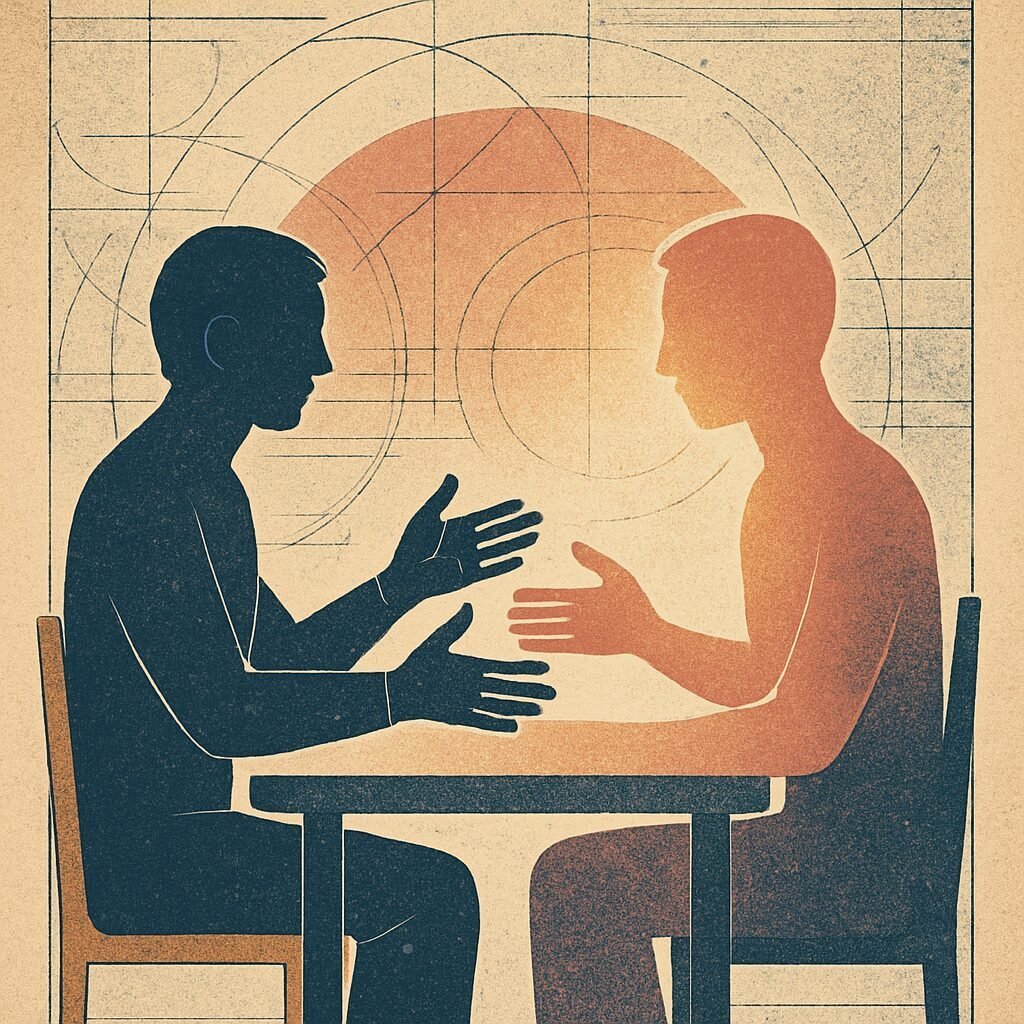
A silhouetted figure gently reaches across a table toward their own shadow, which begins to glow warmly, symbolizing the act of meeting pain with love instead of avoidance.

Pain Is Not Progress

There’s a moment most practitioners know. Something in your shoulder says stop. The teacher calls the next vinyasa. You go anyway.

That choice — made in a fraction of a second, almost without noticing — is the entire problem. Not the shoulder. The going anyway.

The first rule of a functional yoga practice is don’t hurt yourself. It sounds so obvious that writing it down feels condescending. And yet it’s the rule most consistently violated by people who know exactly what they’re doing. The violation isn’t ignorance. It’s a belief that’s been installed so thoroughly it stopped feeling like a belief and started feeling like physics.

The math goes: hard things are uncomfortable, growth requires hard things, therefore discomfort means growth. Somewhere in that chain the logic inverts. If I’m not suffering, I must not be trying. If I’m not trying, I’m failing.

This is nonsense. Persuasive nonsense, delivered from everywhere — coaches who built their reputations on pushing athletes past limits, fitness culture that sells transformation through ordeal, spiritual traditions that confused mortification with awakening. The yoga world absorbed all of it, then added its own layer: the teacher is watching, the room is watching, stopping is weakness, weakness is shame.

So practitioners sit through the shoulder impingement. They push through lower back pain. They practice performance. Occasionally they practice self-harm. Not yoga.

When something hurts — genuinely hurts, not “this is hard” but “this is a signal” — there are exactly three options: adjust, modify, or skip. That’s it. There is no fourth option. The fourth option, the one where you push through because the teacher called the next pose, is where acute injuries become chronic ones, where the practice you love becomes the thing that broke you.

The distinction between challenge and harm is learnable. It takes time. It requires attention that most people are actively trained away from — attention that turns inward rather than toward the mirror, the teacher, the person on the next mat. Challenge has a quality of aliveness. Harm has a quality of wrongness, of tissue objecting to something it wasn’t built for.

Here’s the practical consequence of ignoring this: when you’re bracing against pain, you cannot access the states that make practice worth returning to. This isn’t philosophy. It’s attention. The nervous system can’t hold the absorption required for flow while also managing a pain response. The clarity, the particular quality of being fully inside your own body — those require conditions. Pain forecloses them.

You’re not getting tougher. You’re not going deeper. You’re generating noise that drowns out the signal.

The rule “don’t hurt yourself” does something people don’t expect when they first hear it stated plainly. It doesn’t give you permission to be lazy. It gives you access to information that belongs only to you: what is actually happening in your body right now, not in the teacher’s vision of who you should be, not in yesterday’s practice, not in the version of yourself you’re performing for the room.

That information is yours. Using it — adjusting, modifying, skipping without apology — is the practice. Not in spite of what the room expects. Regardless of it.

What you build on that foundation looks entirely different from what you build by learning to override your own signals. One of those structures is still standing forty years later.

Similar Posts

  • What is Ashtanga Vinyasa Yoga? What’s Mysore Style? And More!

    Over the last few years, I’ve received all sorts of questions about the type of yoga I practice and teach. Since before my last trip to India, I’ve been teaching Sunday-Friday at Kali Yoga Studio in Columbia Heights in a traditional format called “Mysore Style” Ashtanga Vinyasa Yoga. We call this program “DC Ashtanga.” In my experience of both practicing and teaching, I have come across no system of yoga more effective, exacting, or straight-up powerful as Ashtanga Vinyasa Yoga as it’s taught in Mysore. Right now, we have a $45-two week get-started special that will help new practitioners get their feet off the ground and flying high. Like sugar’s taste, its hard to explain, easy to experience. (and pretty darn sweet) Without further ado:…

  • The Secret Life of Prana: A Beginner’s Guide to Energy in Yoga

    Are you an Ashtanga yoga practitioner looking to deepen your knowledge of energy in yoga? Look no further! In this post, we’ll cover the basics of prana, prana vayus, nadis, and how they relate to Hatha yoga. Let’s get started! What is Prana? Prana is the life force energy that flows within us. Think of it as the gas that fuels your car. We extract prana from various sources, including food, light, and love. According to yoga teacher Gregor Maehle, although there is only one prana, it is in different locations, flows in different nadis, and has different functions. These various types of prana are called by different names.  Prana Vayus Prana vayus are the movements or functions of prana. There are five prana vayus,…

  • how does compression work help you find concavity without fighting your hips?

    This is Ashtanga Yoga Tech Support. Real questions from the yoga community, answered. The Question I've been thinking about using compression work with my legs parallel so I can find the concave quality in my stomach while letting my hips move naturally. Does that make sense as a way to work? — from a MJH note Our Response Yes. That’s exactly the direction.Compression work with parallel legs gives you a container. You get to feel what your abdomen does when your hips aren’t externally rotated, when there’s no flinch pattern steering you away from the midline.

    —
    Read more: https://ashtanga.tech/tech-support/how-does-compression-work-help-you-find-concavity-without-fighting-your-hips/
    All content: https://mjh.yoga

    #ashtanga #yoga #ashtangayoga #techsupport #ashtangatech

  • Counting Parsvottanasana with Mindful Prep

    Counting Your Way to Clarity: The Transformative Journey of Parsvottanasana Embark on a transformative journey with Parsvottanasana, the intense side stretch pose. This powerful asana transcends physicality, offering profound insights into both body and mind. As you dive deeper into the pose, discover how the art of counting can illuminate your practice, providing clarity and focus that enhances your ashtanga experience. Anatomy of Parsvottanasana Parsvottanasana challenges the body, inviting the pelvis to rotate towards the front leg while engaging key muscle groups. Seamlessly transitioning from Ardha Chandrasana, this pose not only intensifies the stretch but also awakens various muscle fibers, particularly in your hamstrings and calves. PÄRSVÕTTANASANA (5 MOVEMENTS) 1 EKAM Inhale, open to the right, hands in prayer behind back 2 DVE Exhale, fold 3 TRINI Inhale, up, turn to the front 4 CATVARI Exhale, fold 5 PANCA Inhale, up, open to the side Exhale, Samasthiti Counterbalancing the Mind and Body Each count in Parsvottanasana connects breath, movement, and intention, creating a rhythm that anchors your practice. As you breathe, you cultivate awareness and clarity, harmonizing the mental and physical realms—ultimately discovering the profound interconnectedness of your being. Mindful Preparations Preparation is crucial for a safe and effective Parsvottanasana. Begin in Tadasana with hands in reverse namaste, opening your shoulders and releasing tension. This mindful approach sets the stage for a deeper stretch, inviting clarity into your alignment and practice. Synergizing for Success The pectoralis major collaborates with the subscapularis and teres major to inwardly rotate the upper arm while stretching shoulder external rotators. Upper back muscles pull shoulder blades toward the spine, creating space in the chest. The rectus abdominis stabilizes the fold, while the psoas maintains the extended leg’s position. By harnessing these relationships, you amplify your experience in Parsvottanasana, moving beyond physicality to cultivate clarity both on and off the mat. For deepening your understanding of Parsvottanasana and its counting, explore our detailed guide: Parsvauttanasana – The Count. Ultimately, Parsvottanasana invites us into a dance of awareness—a fusion of physical engagement and mental clarity. Embrace each of the five movements, counting intentionally, and uncover how this practice can enhance your yoga journey and everyday life.

Notes from the field

No notes yet · members & customers welcome

  1. No notes yet. Be the first to leave one.

Leave a note

Want more? (optional — commenting alone never subscribes you)
Comments are for members & customers. We’ll email a one-tap link to confirm it’s you.