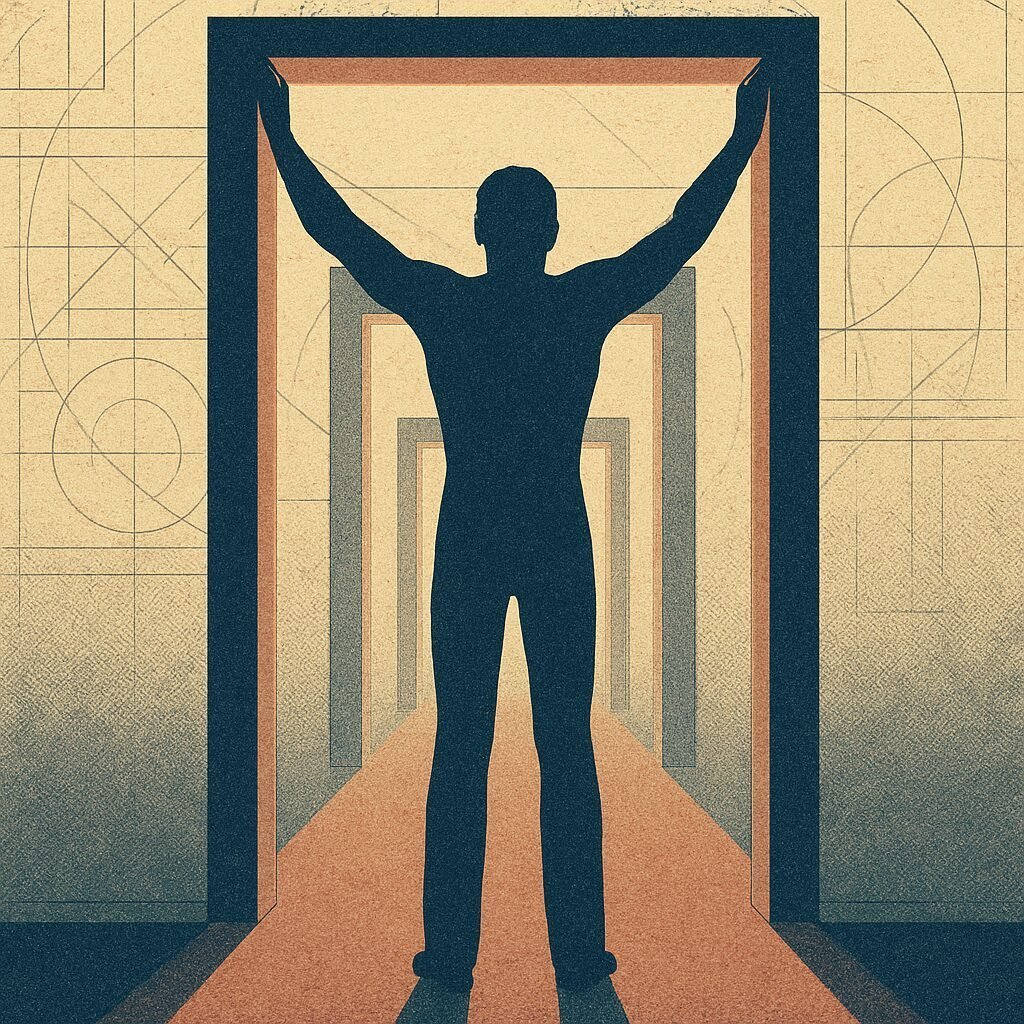
A silhouette stretches in a doorway while a foggy corridor of identical doorframes extends behind them, symbolizing flexibility that never progresses.

The Intermediate Trap

Three years in and you have the sequence memorized. You know the Sanskrit names, or most of them. You can get through Primary without stopping to think about what comes next. You have also stopped noticing anything.

That is the intermediate trap. You learned the shapes and skipped the system.

This is the thing about yoga that nobody tells you at the beginning, mostly because it sounds like a contradiction: the people who are often practicing best are the ones who have just started. Not because they are more flexible or more focused. Because they are paying attention to what is actually happening, instead of managing how it looks.

A beginner has no performance to maintain. They arrive, they try, they fall. They breathe because they need to, not because they are supposed to. They cannot sequence ahead because they do not know what is coming. Everything is new, which means everything gets noticed.

Intermediate practitioners have a different problem. They know enough to have expectations. They know what the pose is supposed to look like, so they pursue that image instead of exploring the position. They have replaced attention with choreography. The system — the actual system, the one doing the work — gets bypassed. They are executing shapes in the right order and getting very little from it.

This is what I mean by “advanced yoga for beginners.” Not that beginners are inherently more advanced. Not that experience is a liability. I mean that the quality available in a beginner’s first sincere attempt — the hyper-local, nothing-to-prove attention — is precisely what advanced practice is trying to recover, deliberately, after you have learned the forms.

Advanced practice is not more difficult poses. It is more honest attention. Those are different things, and they do not automatically develop together.

Here is the counterintuitive part: honesty about your limitations is how you build capacity.

Most people assume the path forward is to push through their edges — that self-assessment is for people who are not committed enough. What actually happens when you ignore where you actually are is that you repeat what you already know how to do, slightly harder and with worse mechanics, until something gives. The intermediate practitioner who has gotten by on momentum for three years has a different injury pattern than the beginner, but the same root cause: not knowing what is actually happening in this body, on this mat, right now.

The practice that works is built on accurate self-knowledge. Not flattering self-knowledge, not brutal self-knowledge — just accurate. You assess your actual capacity. You work from there. The edges move. This is not motivational language. It is a description of a mechanism.

Ashtanga Yoga is a sequence, a breath system, and a set of attention instructions. When those three work together — when you are actually applying all of them, rather than performing the version that looks right — the system generates states that are genuinely difficult to believe until you experience them. Flow states. Nervous system regulation. A quality of presence that carries beyond the mat.

The intermediate practitioner misses most of this because they have short-circuited the attention component. They have kept the sequence and the breath, more or less, and dropped the precision. The form is intact. The function is not running.

The fix is not to go back to the beginning and relearn the poses. It is to go back to the beginner’s relationship with attention. Show up. Notice what is actually here. Do not manage the experience; observe it. Bring the same quality of honest inquiry to the third year that you had on the first day, before you knew what you were supposed to be doing.

That is advanced yoga. It looks like paying attention. It often looks boring from the outside.

What it produces, over time, is a person who can accurately assess their own capacity. Not perfect capacity — nobody has that. But honest capacity. And a person who knows where they actually are is much harder to push past that, shame past that, or sell improvements to.

Self-knowledge, it turns out, is a performance inhibitor. If what you are performing is the version of yourself that needs constant refinement, constant upgrading, constant external guidance — then yes. It inhibits that.

That is not a side effect. That is the point.

Similar Posts

  • Before You Modify, Have a Reason

    Most people don’t actually choose which version of a pose to do. They notice which version they end up in. The difference matters. Choosing means you weighed something, decided something. Noticing means you started moving, arrived somewhere, and called it good — or not good, usually with a story about why it’s not the version you wanted. The story is the problem. “This is the version I can do” sounds practical. It isn’t. It’s a statement about identity. It describes a ceiling. It’s self-critical information dressed up as pragmatic information. The person saying it is usually apologizing. “This serves me better today given what I’m working with” is different. It’s a statement about intelligence. It describes a choice made from understanding. The person saying it…

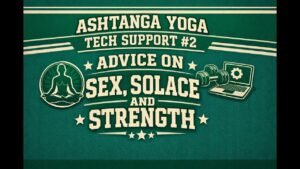
  • Ashtanga Yoga Tech Support #2: Solace, Sex, and Strength

    Welcome back to Tech Support Tuesday. Each week, I pull questions from the yoga corners of Reddit and answer them on video. This week’s session covers three questions — grief on the mat, yoga’s quieter effects on intimacy, and whether this practice can actually change your body.

    visit ashtanga.tech to learn more!
    visit theyoga.club for more yoga!
    visit mjh.yoga for more from Michael Joel Hall!

    🕊️ Navigating Grief in Yoga Practice
    One listener returned to yoga to find solace after their father passed away. During Shavasana, the tears flowed. That’s not a problem with your practice — that is your practice. Shavasana holds power in its stillness. When you’re moving through postures, your body and mind are occupied. Lying down removes those distractions and lays bare whatever you’re carrying.

    Crying on the mat is bearing witness. Your body has been waiting for you to stop, to allow for rest. Shavasana may have been the first time you gave it that chance.

    ☯️ Permission to Grieve and Move Forward
    If Shavasana feels too overwhelming, it’s okay to skip it occasionally. The first rule is do no harm. The yoga mat is one of the few places where you don’t need to explain yourself — nor should you judge yourself. Communicate with your teacher if necessary. Your journey on the mat is deeply personal, and sometimes laying still and letting emotions flow is the whole point.

    Going back to practice after a week? That says something about you. A lot of people wouldn’t. Don’t rush. You’ve got time.

    🌟 Transforming Physical and Emotional Landscapes
    Another question explores yoga’s impact on intimacy. The physical stuff is obvious — stamina improves, you’re stronger, more flexible in every sense. Ujjayi breathing coordinates your nervous system. You learn to down-regulate on demand, and that means you’re actually present with your partner instead of stuck in your head.

    But the bigger shift is subtler. Ashtanga trains you to stay present with intense sensation without reacting to it. To breathe through discomfort. To notice what’s happening in your body without narrating it. These are transferable skills. When you stop bracing against your own body, everything changes — including intimacy.

    ⚖️ Beyond Aesthetic Goals
    Can yoga tone your body? Sure. Ashtanga will absolutely change your body composition — you’re holding your own weight in ways that build lean, functional muscle. Sun salutations are progressions of a push-up. Your arms, core, and legs will all get worked.

    But here’s the thing. Once you start practicing, you’ll probably notice something shift. You stop caring as much about what your body looks like and start caring about what it can do. Santosha — contentment — changes how you show up in every physical relationship. Self-love looks good on everyone.

    ✨ The Side Effects Are the Point
    Start with what hurts — anxiety, back pain, whatever brought you here. The toning, the calm, the adamantine body the Yoga Sutra talks about? Those are side effects. Remarkable ones. But side effects nonetheless.

    That’s Tech Support Tuesday #2. Three questions. Grief, connection, and what your body is actually for. Bring yours next week.
    00:00 The Question
    00:21 Why Shavasana Is Hard
    00:49 Your Practice Is Working
    01:10 The Grief Will Change
    01:51 Permission to Grieve
    02:41 Moving Forward
    03:16 The Question
    03:37 Physical Benefits
    04:00 Presence & Breathwork
    04:45 Body Acceptance
    05:10 Connection & Self-Love
    05:38 The Question
    05:58 Posture & Spine Health
    06:41 Anxiety & Flow State
    07:28 Pain Relief
    07:42 Body Composition & Strength
    08:19 Beyond Aesthetics
    09:08 The Takeaway

  • What’s one piece of advice you’d give to your past-self when you first started yoga?

    This is Ashtanga Yoga Tech Support. Real questions from the yoga community, answered. The Question Mine would be that it doesn't matter if you're not flexible for all poses, most if not all of them can be modified. submitted by /u/YogaGoApp — via r/ashtanga Our Response The OP's answer is great — flexibility doesn't matter, most poses can be modified. That's true. But my advice to past-me would be different. Stop trying to be good at it. I spent years treating practice like a performance review. Every morning I'd roll out my mat and grade myself.

    Read more: https://ashtanga.tech/tech-support/whats-one-piece-of-advice-youd-give-to-your-past-self-when-you-first-started-yoga/
    All content: https://mjh.yoga

    #ashtanga #yoga #ashtangayoga #techsupport #ashtangatech

  • Jungle Physicians and Insight Through Ancient Wisdom and Modern Practice

    In an age of relentless distraction, the quest for insight—that deep, intuitive understanding of ourselves and our place in the world—has never been more urgent. We seek clarity in a sea of information, purpose in a world of fleeting trends, and connection in an era of digital isolation. The answers, as a series of profound questions suggest, may not lie in the latest technology, but in the timeless wisdom of ancient traditions and the rigorous discipline of practices designed to turn our awareness inward. By exploring indigenous ways of knowing, the offerings of wisdom traditions, the nature of consciousness-altering states, and the cultural calls for awareness, we can chart a course toward a more insightful existence. At the center of this journey lies Ashtanga yoga,…

  • What is Mysore Style Ashtanga Yoga

    Understanding Mysore Style Ashtanga Yoga with Michael Joel Hall
    I practice and teach Mysore style Ashtanga yoga, which is a little different from other styles of yoga. People are often confused about what makes it special and they have a good reason to be so confused. Let’s get into it.
    00:00 Introduction to Mysore Style Ashtanga Yoga
    00:13 Origins and Unique Approach
    00:29 Key Methods and Techniques
    00:38 Commitment and Benefits
    00:47 Historical Roots and Modern Adaptations
    00:59 Conclusion: A Path to Transformation

Notes from the field

No notes yet · members & customers welcome

  1. No notes yet. Be the first to leave one.

Leave a note

Want more? (optional — commenting alone never subscribes you)
Comments are for members & customers. We’ll email a one-tap link to confirm it’s you.