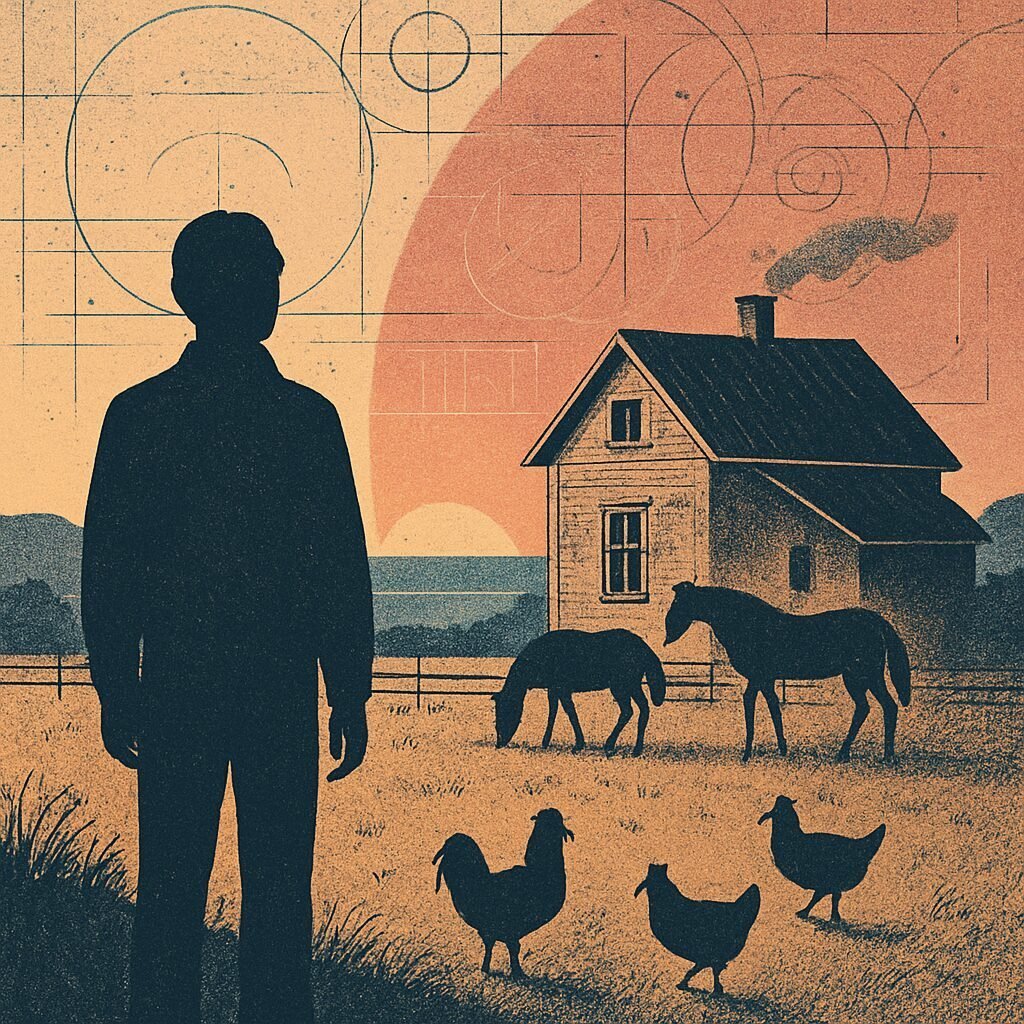
A silhouetted figure stands near a small farmhouse with faint horses and chickens in a dusky field, the horizon glowing gently to suggest quiet sufficiency instead of grandeur.

Paradise Is Just Having Enough

Slide Deck · [ESSAY] Paradise Is Just Having Enough
Slide 1Slide 2

The phrase came out sounding almost embarrassing. A little piece of the fat of the land. I said it in conversation and immediately heard myself want to take it back — not because it wasn’t true, but because it was too true, and too small. In an era where everyone brands their ambitions, calls their newsletter a “platform,” invokes their morning routine as spiritual infrastructure, wanting land and animals and no bill-anxiety sounds like giving up. Like settling. Like something to admit quietly, apologetically, the way you’d admit you don’t really want to be famous.

It isn’t any of those things. But I understand why it feels that way, and I spent a long time pretending I wanted something bigger.

Here’s what I’ve noticed after years of practice: the mat doesn’t expand your appetite. It contracts it. Not into asceticism — I’m not talking about renunciation as performance, the kind where you eat brown rice and call it consciousness. I mean that the daily discipline of waking up and moving through sequences that don’t care about your mood or your self-image slowly burns off the noise. What’s left is a shorter list. More precise. Quieter. One you can say out loud without adding five qualifiers and a strategic hedge.

Mine: somewhere to live without the background hum of financial dread. No ambient pressure from other people’s expectations. Some animals around. No one waiting for me to become something other than what I already am.

That’s it. The full list. A little embarrassing that it took this long to see it clearly, and a little clarifying too.

The word santosha gets deployed in yoga circles like it means “being okay with less.” That’s not quite right. Santosha is an architectural principle — the practice of understanding what a life actually requires versus what the culture has convinced you to want. Contentment isn’t low standards. It’s precision. There’s a meaningful difference between accepting a smaller life and building an accurate one. Most people don’t get to that distinction because the culture is very loud about what constitutes arrival.

I grew up around horses and chickens. Not a farm exactly, but enough land that morning had a particular quality — feeding schedules, the smell of hay, the way an animal reads you before you’ve managed to form a sentence. I spent most of my adult life in cities after that. That was a trade I made deliberately, and I knew what I was giving up. It left a specific negative space in me. Not nostalgia, exactly. More like a stored data point: what “enough” felt like in the body when I had it. Evidence that this isn’t fantasy. It’s memory.

Cultural paradise is large and public. Square footage, dinner reservations, an audience for your creative process, a brand that scales. It performs. It needs to be legible to other people or it doesn’t quite count. What I’m describing does the opposite: a life that feels complete even when no one is watching, that doesn’t require a caption.

“I don’t want it just handed to me, although that would be nice.” That’s the honest version. I want it earned. The practice to mean something, the work to hold up, the systems to run because they were actually built correctly — not because I got lucky or performed the right identity at the right moment. But I also know what “earning it” typically means in the culture: optimize toward excess, want more than you need, then need more than you wanted. It’s a loop that doesn’t have a natural floor.

What I’m after is simpler and harder to defend in public: just enough. Not “enough for now.” Enough. The closed sentence. The complete system. To me, that’s kind of paradise, to be able to just have enough.

Daily practice is one of the better diagnostic tools I know for separating what you actually want from what you’ve absorbed. Long enough on the mat, and the things that seemed urgent become clearly optional. The things you kept postponing turn out to be the real ones. Most people come to practice expecting it to make them more capable — sharper, calmer, better at the things they already value. It does that. But the secondary effect, the one nobody mentions at the beginning, is that it also makes you more honest about desire. It shows you what you’re actually working toward. And sometimes what it shows you is startling in its modesty. Not a movement. Not a legacy. Not an empire built on the right combination of suffering and charisma. Just some land. Some animals. The month’s bills covered. No constant low-grade worry about whether the floor is about to give.

The ambition isn’t small — it just refuses to apologize for fitting inside a life.

Similar Posts

  • MJH on “Get Your Sanskrit On: The Language of Yoga”

    As Ashtanga yoga practitioners, we are familiar with the Sanskrit names of the yoga poses, or asanas. But have you ever wondered about the origins of this ancient language and its significance in the yoga tradition? In this post, we will explore the fascinating world of Sanskrit and its connection to our practice. What is Sanskrit? Sanskrit is an ancient language that originated in India over 3,000 years ago. It is considered to be the mother of all Indo-European languages and is one of the oldest languages on Earth. The…

  • Action Indicates Priority

    I’m sending these out because I quit social media and I need attention. What I actually want is for you to reply and tell me you’re coming. I’ll drop one every night at midnight. You can register in the morning when you get up — something to read besides everything else. Karma yoga is the yoga of action. I say it a lot — usually when I notice a gap between what someone says they want and what they’re actually doing about it. All talkie-talkie, no walkie-walkie. Easy to spot in someone else. Quite another to see in yourself. That’s the whole puruṣa and prakṛti problem. But I digress. I’ve been helping support my parents — a lot of Halls under one roof. I’ve been…

  • The Eight Limbs Aren’t a Ladder

    There’s a version of yoga instruction that goes like this: master the ethics first, then the postures, then the breath, then the senses, then the concentration, then the meditation, then the union. Eight rungs. Bottom to top. Do the lower ones right and eventually you earn the higher ones. Most people have heard some version of this. Most people implicitly believe it. And it produces a specific, persistent problem: students spend years waiting to be advanced enough to access the states that practice is supposed to generate. They’re waiting to meditate until they’re good enough at asana. Waiting for sustained concentration until they’ve mastered breath. Waiting for presence until they’ve fixed their ethics. The ladder frames the higher limbs as rewards for the lower ones….

  • The Zero-Sum Trap

    Predatory hegemony isn’t strength—it’s avidya dressed up as strategy, mistaking extraction for security and deference for respect.

    Stephen Walt’s analysis of predatory hegemony in Foreign Affairs reads like a case study in what happens when avidya — fundamental misperception — drives policy. The premise is simple: if you believe the world is zero-sum, you’ll act like a predator. You’ll extract, exploit, demand tribute. You’ll mistake deference for respect and compliance for partnership. Walt describes a shift from benevolent hegemony — where the U.S.

    —
    Read the full article: https://theyoga.club/the-zero-sum-trap/
    Original source: https://www.foreignaffairs.com/united-states/predatory-hegemon
    All content: https://mjh.yoga

    Concepts: Avidya · Aparigraha · Dharma · Santosha

    #ashtanga #yoga #ashtangayoga #yogapractice #theyogaclub

  • Who Is Your Honesty For?

    “I’m just being honest.” This sentence has preceded more cruelty than almost anything else I know. It’s used to justify whatever someone wanted to say, frame unkindness as virtue, and make the person on the receiving end feel small for minding. The speaker’s conscience clears. The harm still lands. There’s a distinction worth naming, because most people never make it: honesty as information versus honesty as punishment. Honesty as information: you say something true because the person in front of you needs it to move forward. The content matters. The timing matters. The relationship matters. You’re trying to transfer something useful. The measure of success is whether they could actually use it. Honesty as punishment: you say something true because you’re frustrated, because you’ve decided…

  • The Building Failed. Not You.

    Somebody you know left. Maybe it was a yoga studio. Maybe a job, a team, a community they’d given years to. They left quietly, a little ashamed. They told a story about how they just couldn’t handle it. Weren’t disciplined enough. Too sensitive. Not the right fit. What they didn’t say — what they maybe still haven’t said — is that they got hurt in there. That story, the one where they failed the system instead of the system failing them, didn’t form on its own. It was handed to them on the way out. In certain yoga communities, the frame used for students who leave is clarifying. They weren’t dedicated. Weak mind. Couldn’t take it. The teacher stays infallible. The community stays intact. The…

Notes from the field

No notes yet · members & customers welcome

  1. No notes yet. Be the first to leave one.

Leave a note

Want more? (optional — commenting alone never subscribes you)
Comments are for members & customers. We’ll email a one-tap link to confirm it’s you.