The Comeback Was a Business Model

The podcast host said something about aspect ratios. That’s what got me. Not the feminist reading of Valerie Cherish, not the bit about the laugh track—something about the way the camera in Room and Board, the show-within-the-show, was always slightly wider, flatter, more exposed than the documentary-style footage following Valerie around. Old Hollywood aesthetics on one side of the lens. New Hollywood surveillance on the other. The visual grammar was the argument. I had not thought about The Comeback seriously in twenty years. It aired in 2005. Nine episodes. HBO canceled it. Lisa Kudrow won a SAG Award for it, and still nobody talked about it the way they talked about, say, Arrested Development. Now, watching clips in between podcast timestamps, I kept thinking: this…

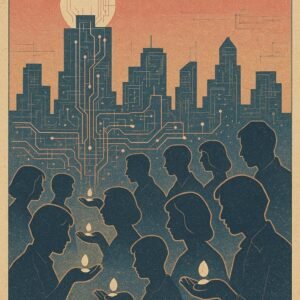
A dusk cityscape with circuit-like lights in the towers, while silhouetted people below hold small glowing orbs that echo the skyline, symbolizing shared stakes in technological wealth.

The Harms Are Specific, the Gains Are Vague

I was half-listening to an AI regulation podcast when the pattern landed. Not a new podcast — there are a thousand of them now, all saying roughly the same things with different levels of alarm. This one had someone who had actually read the filings, the testimony, the CEO letters to Congress. I was not taking notes. I was making lunch. That is where I heard it: the AI company leaders are very specific about harms. They can name the displaced workers — coders, first, but then radiologists, paralegals, customer service reps. They cite the studies on teenage mental health and algorithmic exposure. They talk about AI-generated pornography with enough specificity to suggest they have thought hard about it internally. The precision is striking when…

A diverse group of silhouetted people sit in a circle in a corporate room while their shadows extend toward a city skyline, suggesting connection between institutional spaces and surrounding communities.

Equity in the Practice Room

A student in the front row can’t hinge forward. She’s seated, legs extended, trying to reach toward her feet. Her pelvis won’t move. Her spine is rounding from the base. Her face is doing the thing faces do when the body refuses and the person inside has decided this is a personal failure. I tell her: put something under your butt. She looks at me like I offered her a reduced sentence. The prop mythology runs deep. Blocks are for beginners. Props are for people who can’t do it yet. Put the block away when you’re ready. Some of this comes from lineage — traditions where the shapes were sacred, where modification was equivalent to deviation. Some of it is aesthetic. A room of people…