
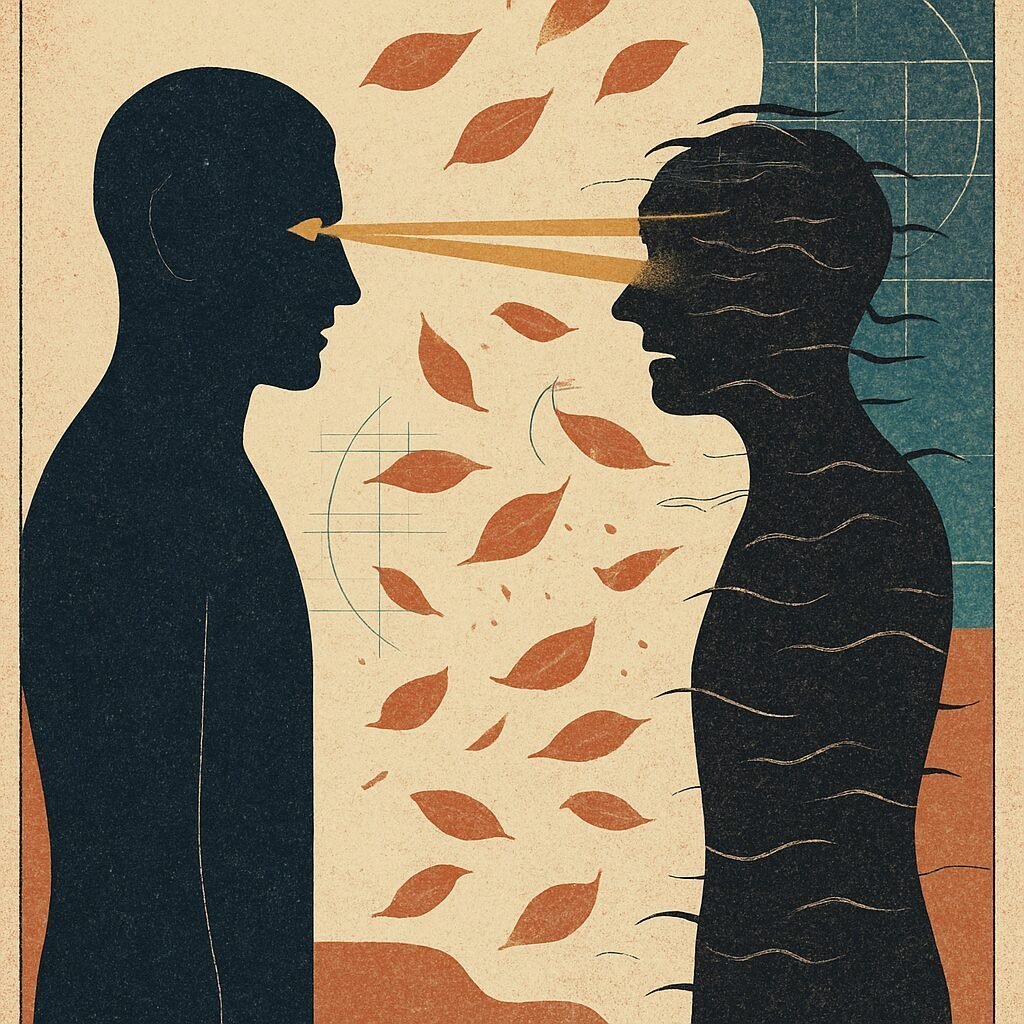
The Coercers Are the Ones Who Fear Being Seen
I was trying to describe someone — a teacher, a manager, the kind of authority figure who issues a lot of direction without doing much of it themselves — and I kept landing on a word that surprised me.
Not incompetent. Not lazy. Afraid.
Fear isn’t what I usually reach for when I’m trying to explain coercive leadership. But sit with it long enough and it makes a very specific kind of sense. The people who lead by force and mandate and the threat of consequence are, very often, the people who most fear leading by example. Not for personal reasons. For structural ones.
When you lead by example, your behavior is the argument. Not your title. Not your seniority, your credential, your years in the field. What you actually do — in public, under observation, on a day when it’s inconvenient — that’s the case you’re making. It’s exposed. Evaluable. Someone can watch you and reach a verdict.
When you lead by coercion, the mechanics are different. You issue standards you don’t meet. You require things you don’t demonstrate. The asymmetry isn’t incidental; it’s load-bearing. Your authority lives in the gap between what you demand of others and what you require of yourself. Close that gap — or let someone else close it, by simply doing the thing where people can see — and the authority you’ve built starts to look like something else entirely.
This is why exemplary leadership makes a certain kind of leader nervous. Not because it singles them out. Because it makes visible a system that depends on the gap remaining invisible. The coercive model runs on concealment — concealment of what leading actually requires, concealment of whether the leader meets those requirements. Someone doing the work openly, showing it’s possible, showing what it looks like when you actually embody what you’re asking of others, is a structural threat. Not a personal enemy. A fact the system doesn’t know how to absorb.
Most institutions are quietly built around this. The people with the most authority to set expectations are the least accountable to them. They write the rubric. They administer the test. They do not take the test. That isn’t always cynical. In a lot of cases it’s just how those systems reproduce themselves — authority and accountability are deliberately decoupled, and the whole thing would have to become something else if they weren’t.
So when you lead by example and someone responds with hostility, the useful question isn’t what you did wrong. It’s what your presence made visible. That hostility is usually a system-defense response. You’ve made the gap harder to ignore. The system is defending the gap. You’re not doing anything wrong — you’re being something the system can’t accommodate, which turns out to be a harder problem for the system than if you’d simply transgressed a rule.
I’ve been teaching long enough to watch this play out in small rooms and large institutions with the same mechanics each time. There are teachers who cue from authority — lineage, seniority, the presumption that their word is sufficient — and who practice very little themselves. And there are teachers whose entire argument is their body, their consistency, their willingness to keep doing the work in public. The second group occasionally makes the first group uncomfortable. Not by design. Not as critique. Just by existing and being visible.
The people who fear leading by example are the people who lead by force and coercion. The example of leading by example is the example — it doesn’t editorialize, doesn’t argue, doesn’t make a move. It just sits there, being what it is, which is precisely what some people most need it not to be.
Understanding this changes what you’re looking at when you encounter the hostility. You’re not reading a personal rejection. You’re reading a system telling you what it needs to protect.
The coercion is the tell: they’re not protecting their authority, they’re protecting themselves from what your example would require them to admit about their own.