
The Enclosure of Expertise: What the AI Labor Debate Keeps Missing
There’s a cue I’ve said maybe ten thousand times. “Pull the floor with your hands.” It sounds wrong until it doesn’t — until the student feels their lats engage and chaturanga stops being a daily defeat. I spent years developing it. Heard something like it from a teacher, refined it, discarded three versions that didn’t land, and finally settled on one that does. It works because it’s precise. It’s precise because it’s been tested on actual bodies.
I said it once in a class someone was recording for their home practice. That video is probably somewhere on the internet right now.
A few months ago I watched Jon Stewart interview MIT economists Daron Acemoglu and David Autor about AI and labor. For a long stretch I felt like they were describing someone else’s problem. Factories. Call centers. Truck drivers. Very real. Not my world.
Then Acemoglu used the word “enclosure.”
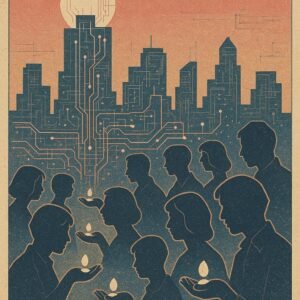
He meant it the way historians do: the 18th-century seizure of English commons. Land that communities had worked for generations, fenced off, made private. His argument was that AI does something structurally similar to expertise: human knowledge, accumulated over careers, extracted without compensation, used to build systems that get sold back to the people who produced them. AI strip-mines human expertise and creative work — a failure of property rights and legislation that undermines the very data quality needed for anything you’d want to call pro-worker AI.
That’s when I stopped feeling like it was someone else’s problem.
The economists’ core distinction is pro-capital AI versus pro-worker AI. A pro-worker application helps a nurse do their job better, and the nurse captures some of the value. A pro-capital application replaces the nurse’s judgment, and the capital owner captures it instead. The tech sector’s focus on AGI as an ideological goal keeps pulling investment and attention away from more practical, worker-augmenting applications. Everything in the current incentive structure points toward the capital side.
The mechanism is the data question. AI systems need human expertise to train on. That expertise — medical reasoning, therapeutic skill, teaching methodology — was produced by workers who got compensated for it once, at the time, and have no claim on what it’s worth the second time around. You got paid for the session. You didn’t get paid for what the session taught the model.
This is where the factory metaphor breaks down, and where the yoga teacher becomes a cleaner case than the assembly-line worker. When mechanization replaced a weaver, the weaver’s knowledge wasn’t the raw material. Their hands were being replaced. But when a language model trains on transcribed yoga classes, it isn’t replacing my hands. It’s consuming the pattern I spent twenty years developing.
The pattern, not the person. That’s the distinction nobody in the AI labor debate is making.
Embodied knowledge domains — yoga lineages, therapy modalities, skilled trades — are particularly vulnerable for the same reason they seem safe. Embodied expertise has to be put into words to be transmitted. A teacher doesn’t guide students through complex poses in silence; they talk. They explain. They develop metaphors, a vocabulary, a theory of the body that makes the experience legible. That articulation is what makes teaching teachable. It’s also exactly what makes it extractable. The most human-specific, relationship-embedded knowledge is also the most articulable. And articulable means data.
Acemoglu rejected the “we can’t regulate AI” narrative directly — pointed to China’s regulatory capacity and called US tech companies’ claims of regulatory impossibility what they are. He’s right that the policy appetite exists somewhere. What doesn’t exist yet is a concept of property rights for knowledge that can’t be patented or copyrighted but still has a clear author.
Who owns the way I cue a hip flexor release? Not the studio where I worked. Not the student who received the cue. Not the company whose model trained on recordings of my classes. The question sounds absurd until you realize it’s the only question with real stakes once the model exists.
The economists proposed wage insurance and capital-sharing schemes for workers displaced by automation — reasonable framings for factory-floor displacement, awkward for anyone whose livelihood is a methodology. Previous transformations created enormous wealth and severe transitional harm, with benefits and costs falling on entirely different groups. The enclosure frame is right. The property-rights vocabulary just hasn’t caught up to the terrain it needs to cover — which is less about who owns a field and more about who owns the pattern a teacher refined over decades of asking bodies what they actually needed.