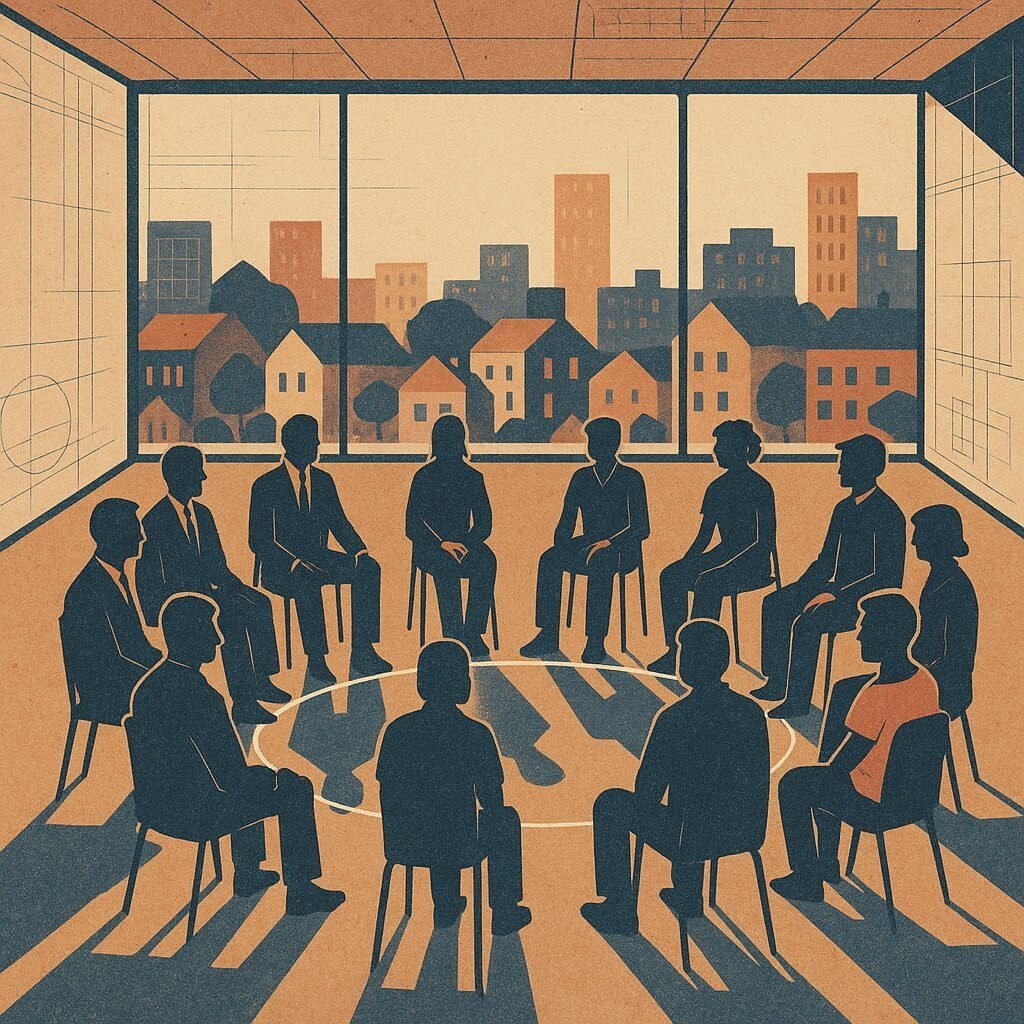
A diverse group of silhouetted people sit in a circle in a corporate room while their shadows extend toward a city skyline, suggesting connection between institutional spaces and surrounding communities.

Equity in the Practice Room

A student in the front row can’t hinge forward. She’s seated, legs extended, trying to reach toward her feet. Her pelvis won’t move. Her spine is rounding from the base. Her face is doing the thing faces do when the body refuses and the person inside has decided this is a personal failure. I tell her: put something under your butt. She looks at me like I offered her a reduced sentence.

The prop mythology runs deep. Blocks are for beginners. Props are for people who can’t do it yet. Put the block away when you’re ready. Some of this comes from lineage — traditions where the shapes were sacred, where modification was equivalent to deviation. Some of it is aesthetic. A room of people all in the same shape has a visual authority that a room full of blocks and blankets and folded mats doesn’t. And some of it is gatekeeping: the form is the standard, and your ability to achieve it is the measure.

All of this confuses uniformity with fairness. Those are not the same thing.

There’s a cartoon that circulates in education circles. Three people at a baseball game, standing behind a fence. One is tall. One is average. One is short. In the equality panel, each gets the same box to stand on. The tall person and the average person can see. The short person still can’t. In the equity panel, the boxes are distributed by need. Everyone sees the game.

Yoga applies this problem constantly, and calls the result good instruction.

Every cue I give produces a different result in every body in the room. Same words, wildly different physiological events. Two people doing what looks like the same seated forward fold might be accessing completely different things — one is actually lengthening through their posterior chain, the other is loading a lumbar spine that’s already under stress. Same box. Different game.

The goal was never the shape. The goal is the physiological event — the tilt of the pelvis, the lengthening of the hamstrings, the decompression through the posterior chain. A block isn’t a shortcut to that event. A block is the access point to that event, for a body whose geometry doesn’t make the event available otherwise. Taking the block away doesn’t accelerate development. It removes access and teaches the body to compensate with whatever it has — usually something that reinforces the exact restriction you’re trying to change.

If you’re not moving, put something under your butt so you can see what I’m talking about. That’s not accommodation. That’s precision. The seat gets elevated, the pelvis tilts, the movement becomes available, and suddenly the student isn’t performing a shape from the outside — they’re experiencing something from the inside. Make it close to the simple version. Further away from complicated, closer to simple.

Don’t let the forces of good or bad get in the way of pragmatism for development. The teacher who trained in a tradition where form was sacred isn’t being malicious when they take the block away. They’ve identified the visual shape with the thing itself. Their body probably got there through years of persistence. They’re offering everyone the same box because they genuinely believe the box worked — and for their specific architecture, it did.

Good teaching is not clear instruction. Clear instruction is table stakes. Good teaching is knowing which box each student needs to stand on. That requires giving up the idea that your job is to transmit a shape, and replacing it with the idea that your job is to engineer access. Different proportions, different histories, different tolerances. The physiological event is the same. The path there is not.

This isn’t a yoga problem. Any system that mistakes uniform treatment for fair treatment fails the same way — hiring, education, medicine. Yoga just makes it visible, because the bodies are right there in front of you. You can see who’s in the pose and who’s performing the pose. You can see who sees the game and who’s staring at a fence.

The prop doesn’t make the practice easier. It makes the practice available. The fence is not the game.

Similar Posts

  • Ancient Wisdom Didn’t Know Why It Worked — And That’s the Point

    A student stayed after class and asked me, a little apologetically, whether the practice actually regulates the nervous system or whether that’s just a thing teachers say. Fair question. The honest answer is that the people who built this had no idea what a nervous system was, and it worked anyway. That should bother you more than it does. We’re standing on two thousand years of instruction written by people who couldn’t have told you why a single piece of it helped. No mechanism. No study. No control group. And yet here we are, still doing it, because it kept producing something worth coming back for. I’ve stopped finding that embarrassing. I’ve started finding it clarifying. Here is what the ancients actually had: outcome data….

  • The Enclosure of Expertise: What the AI Labor Debate Keeps Missing

    There’s a cue I’ve said maybe ten thousand times. “Pull the floor with your hands.” It sounds wrong until it doesn’t — until the student feels their lats engage and chaturanga stops being a daily defeat. I spent years developing it. Heard something like it from a teacher, refined it, discarded three versions that didn’t land, and finally settled on one that does. It works because it’s precise. It’s precise because it’s been tested on actual bodies. I said it once in a class someone was recording for their home practice. That video is probably somewhere on the internet right now. A few months ago I watched Jon Stewart interview MIT economists Daron Acemoglu and David Autor about AI and labor. For a long stretch…

  • The Harms Are Specific, the Gains Are Vague

    I was half-listening to an AI regulation podcast when the pattern landed. Not a new podcast — there are a thousand of them now, all saying roughly the same things with different levels of alarm. This one had someone who had actually read the filings, the testimony, the CEO letters to Congress. I was not taking notes. I was making lunch. That is where I heard it: the AI company leaders are very specific about harms. They can name the displaced workers — coders, first, but then radiologists, paralegals, customer service reps. They cite the studies on teenage mental health and algorithmic exposure. They talk about AI-generated pornography with enough specificity to suggest they have thought hard about it internally. The precision is striking when…

  • Airport and Ivy League — on writing for everyone

    The first time I said it out loud, I was describing a podcast — Next Big Idea, the one where they take two recent books and have the authors on for twelve-minute snippets of takeaways — and I heard myself say: I appreciate the skillfulness of a communicator who can reach the kinds of audiences that are both at airports and at Ivy Leagues. That was my whole endorsement. That was what I meant. Then I sat with it, because it could sound like a compliment and it could also sound like a hedge. Like I was saying: readable by the masses, and also respectable. Smart enough to impress, simple enough to sell. Which is where I had to stop myself, because that’s not what…

  • The Coercers Are the Ones Who Fear Being Seen

    I was trying to describe someone — a teacher, a manager, the kind of authority figure who issues a lot of direction without doing much of it themselves — and I kept landing on a word that surprised me. Not incompetent. Not lazy. Afraid. Fear isn’t what I usually reach for when I’m trying to explain coercive leadership. But sit with it long enough and it makes a very specific kind of sense. The people who lead by force and mandate and the threat of consequence are, very often, the people who most fear leading by example. Not for personal reasons. For structural ones. When you lead by example, your behavior is the argument. Not your title. Not your seniority, your credential, your years in…

  • You Don’t Have to Suffer Under a Bad Teacher to Learn Anything

    I was on a yoga ethics panel last fall, and something became clear to me around twenty minutes in. Not during the panel — during the prep. I kept being asked to think about whether yoga communities actually articulate basic norms out loud. Things like: don’t sleep with your students. And it became clear, fast, that most of the other panelists assumed they didn’t. They assumed that norm was private. Aspirational, maybe. Muttered somewhere. But not said plainly, in the actual rooms where people practice, every year, to everyone new who walks in. My community says it plainly. It’s not a big moment. It’s just a thing we do. I was embarrassed by how much of the conversation’s practical weight fell on Greg and me…

Notes from the field

No notes yet · members & customers welcome

  1. No notes yet. Be the first to leave one.

Leave a note

Want more? (optional — commenting alone never subscribes you)
Comments are for members & customers. We’ll email a one-tap link to confirm it’s you.