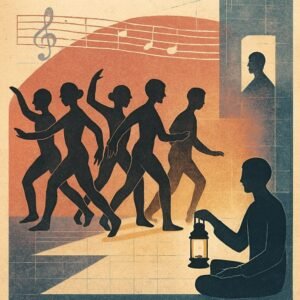
A small circle of silhouetted figures stand connected by glowing threads to each other and the surrounding landscape, while distant digital billboards dim behind them.

Narayana and Practice

Doctors prescribe yoga. Gyms franchise it. Most people come for strength, flexibility, and a little less cortisol—and yoga will deliver all three. That’s fine. That’s the surface.

But yoga is about returning to the collective of all things. Not just a Wilberian unity consciousness—but the nexus, the intersection, the confluence of all things.

Every life that’s ever lived. Every joy. Every sorrow. More than Gibran promised. No longer our own sorrow unmasked, but every sorrow that has ever sorrowed—the most unspeakable of horrors.

But every joy. Every triumph. Every first moment a mother holds her child. Every first puppy adoption. Every accepted proposal. Every kiss goodnight, for every kiss and every night.

Who wants all of this? To be up to one’s ears in the everything of it all. Waterboarded by every memory ever made, and every event that passes by unremembered.

Our union—the yoga—is with all of this. Learning to breathe the blood and water that makes each of us Narayana, when showing his form would spook practitioners.

When I was held by Narayana, I could not stop the feeling of drowning. Even as Narayana sang to me the song of still-aliveness, I could not comprehend. I did not know I was safe.

Poor Narayana. Exalting me with his Form, and I could not exalt back. Narayana must have seen my fear. How sad it must be to show your most majestic, infinite form to the world—and have the world fear it.

No. Fuck that. Not even the world. To show your child. Your students. Your beloved. A form so incomprehensible that it feels like dying. Drowning. My breath would not come, because I was choking on my ignorance.

Narayana showed me the underworld, the overworld, and a glimpse of my tiny planet from such a great height that the rotation of the sun cast three-quarter-world shadows. All night I retched on my own limited capacity to hold a greater view.

Om Namo Bhagavate Vasudevaya.

Swami Swaroopananda gave me a name on purpose. Charmer. Trickster. Pretty boy. And capable of greatness. I was so ignorant to my own nature that the name fell on deaf ears. I am a charmer, a trickster, and a lover. I would bleed my own blood to heal the injustice.
Similar Posts

  • Fostering Self-Awareness Through Yoga

    Introduction The unique intersection of physical and mental in yoga practice Thesis: Yoga offers a powerful mirror for self-discovery by revealing how physical patterns reflect deeper mental models I. The Body as a Messenger How physical sensations carry deeper information Quote: “The body never lies – physical tension reveals mental and emotional states.” The intelligence of our physical form Quote: “Our bodies have wisdom that’s often quieter than our thoughts, but no less profound.” Learning to listen to bodily feedback Quote: “Through practice, the brain constructs a ‘map’ of body positions, improving our body awareness.” II. The Mirror of the Mat How asana practice reveals habitual patterns Quote: “Struggling with balance poses often mirrors self-doubt, while rushing through transitions reflects daily hurriedness.” The yoga mat…

  • Bindu: The Secret Yogic Nectar Thats Most Often Missed

    This is a post created for Ashtanga Tech, Michael’s online esucation platform. What is Bindu According to Yoga Texts? In yogic philosophy and spiritual traditions, the term “Bindu” holds significant meaning and symbolizes various concepts associated with energy, consciousness, and creation. Bindu translates to “point”, “drop” or “dot” in Sanskrit[3]. In yoga, however, the concept of bindu goes beyond its literal interpretation, symbolizing the absolute, the infinite, and the unmanifest potential that lies within each individual[3]. Bindu is viewed as the cosmic seed from which all creation arises[3]. It symbolizes the unmanifest potential that preceded the materialization of the universe[3]. In yoga philosophy, bindu is associated with the fundamental concept of unity, representing the underlying oneness of all existence and symbolizing the union of individual…

  • Samadhi on a Tuesday

    Samadhi lives in a particular part of the spiritual imagination — somewhere between mountaintop and miracle. You picture it arriving after years of austere practice, maybe in a cave, definitely in silence. When it finally comes, it announces itself with appropriate ceremony. This is wrong on every count. Here’s what actually happens: you’re in downward dog. You’ve been doing this sequence for months, or years. The breath is the right length, in the right place. The bandhas are engaged. You’re looking at the right spot. And at some point — between inhale and exhale, between one position and the next — the quality of attention changes. The practitioner having the experience and the experience being had briefly stop being separate things. There’s just the experience….

  • Cognitive Biases and Their Impact on Your Ashtanga Yoga Practice

    In this insightful video, Michael Joel Hall delves into the concept of cognitive bias and its significant implications for Ashtanga Yoga practitioners. He explains how biases are systematic deviations from the norm and how they can lead to judgment errors and groupthink. Hall emphasizes the importance of recognizing and checking these biases to achieve a clear and unclouded perception crucial for yoga. He details common biases such as availability heuristic, anchoring bias, confirmation bias, and hindsight bias, while illustrating how Ashtanga Yoga practices offer tools for critical thinking and self-awareness. Ultimately, the video encourages practitioners to use these insights to enhance their awareness, make better decisions, and transcend cognitive biases for a more impactful yoga practice.
    00:00 Introduction to Cognitive Bias and Ashtanga Yoga
    00:43 Understanding Cognitive Bias
    04:31 Types of Cognitive Bias
    07:20 Mitigating Cognitive Bias with Ashtanga Yoga
    08:42 Building Awareness and Critical Thinking
    09:29 Conclusion and Final Thoughts

  • Unveiling the True Power of Ashtanga Yoga

    Are you truly reaping the benefits of Ashtanga Yoga? Discover why it’s crucial to embrace Ashtanga Yoga as more than just physical postures. Michael Duhal sheds light on the indigenous insight practices that fuel deep personal transformation. Learn how decontextualizing these practices may unintentionally reduce their effectiveness. Join us in this engaging dialogue on preserving cultural and spiritual scaffolding that gives Ashtanga Yoga its profound power. Embrace Ashtanga Yoga holistically and unlock its true potential. #AshtangaYoga #HolisticJourney #TrueEfficacy

Notes from the field

No notes yet · members & customers welcome

  1. No notes yet. Be the first to leave one.

Leave a note

Want more? (optional — commenting alone never subscribes you)
Comments are for members & customers. We’ll email a one-tap link to confirm it’s you.