What Happens When I Leave the Room
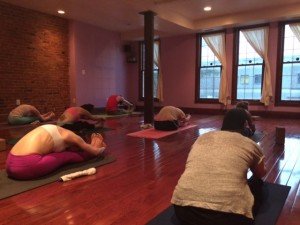
There is a student I have in mind. She’s been practicing for three years. In class, she’s steady. She follows the sequence. Her breath is mostly even. She adjusts when I adjust her. When I watch her, I see someone who knows what she’s doing.
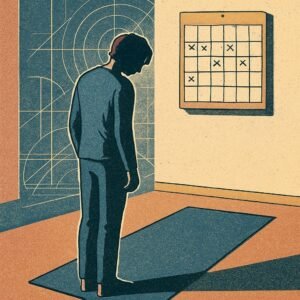
Then I find out she hasn’t practiced at home in six months.
“I just can’t get myself going without you there,” she says. She means it as a compliment. It isn’t one.
This is the method problem that doesn’t get talked about. Not: is the teacher ethical. Not: is the lineage healthy. Those are real questions, but they’re not this one. This one is simpler and more embarrassing for everyone involved: I have been teaching this person for three years, and she cannot practice without me in the room.
Everything I taught her was a response to my cues. Inhale — she inhaled. Adjust her hip — her hip moved. Ask her to notice her breath — she noticed it, right then, with me watching. But she was responding to me, not to herself. The practice I taught her required me to be there. That’s not a practice. That’s a class.
Here is what was missing.
The first thing a teacher actually needs to teach — not eventually, early — is what to pay attention to and in what order. Not just “keep your breath even.” That’s a rule. I mean: here is how to notice when your breath has already changed. Here is the specific sensation that tells you you’ve gone past your edge. Here is the difference between heat and pain, and here is how you tell them apart in real time without asking anyone.
Breath is the primary tool. Not as instruction (“breathe here”) but as signal — something the student learns to read herself. The sound of the breath changes before the body starts to strain. When you’re overworking, the exhale gets clipped. When you’re checking out, the inhale shallows. These are things a teacher can point at, live, in the room, and say: hear that? That’s what too much feels like. Not to evaluate. To calibrate.
The second thing is modification logic. Students who need a teacher present have never been taught how to make decisions mid-practice. They’ve been taught poses. They haven’t been taught: if this doesn’t work today, here are the three things to try and here is how you decide between them. The teacher who only ever adjusts — and never explains the principle behind the adjustment — is building a student who cannot self-correct. Every modification should come with a sentence. “I’m doing this because your hip needs more external rotation before we ask the forward fold.” That sentence is more valuable than the adjustment.
The third thing is what I’d call honest reporting. Most students, when left alone, don’t actually practice — they perform their idea of practice. They go through the sequence without checking in, because checking in requires admitting what they find. A teacher can interrupt this by asking, regularly, mid-class: what are you actually noticing right now? Not “how are you feeling” — that gets a social answer. What is actually happening in your right hip, this moment, at this level of effort? Over time, the student learns to ask herself.
When those three things are in place — signal-reading, decision-making, honest self-reporting — the student can practice alone. She doesn’t need me to tell her what to do next, because she’s built an internal monitoring system that gives her better information than I can, because she’s the one inside her body.
When she comes back to class, the questions change. Not “what should I do?” but “I’ve been noticing this thing in my left shoulder — does it match what you see?” That’s a different relationship. That’s one where she brings something. I bring something. We get somewhere neither of us could alone.
The goal was never for her to not need anyone. The goal was for her to not need me in the room.