
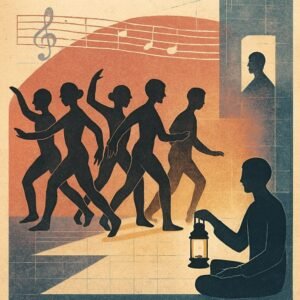
Silhouettes practice together in a dim yoga studio beneath a faint musical staff, while a teacher holds a lantern and a practitioner steps into the shared rhythm.

Samadhi on a Tuesday

Samadhi lives in a particular part of the spiritual imagination — somewhere between mountaintop and miracle. You picture it arriving after years of austere practice, maybe in a cave, definitely in silence. When it finally comes, it announces itself with appropriate ceremony. This is wrong on every count. Here’s what actually happens: you’re in downward dog. You’ve been doing this sequence for months, or years. The breath is the right length, in the right place. The bandhas are engaged. You’re looking at the right spot. And at some point — between inhale and exhale, between one position and the next — the quality of attention changes. The practitioner having the experience and the experience being had briefly stop being separate things. There’s just the experience….

A peaceful silhouette sits on a bench beneath a vast cosmic spiral with time expanding in gentle ripples around them, illustrating unhurried presence and grounded stillness.

Stop Trying to Stop Thinking

Everyone who has tried to meditate has failed the same way. You sit down, close your eyes, and try to stop thinking. Then you think about trying to stop thinking. Then you think about how bad you are at not thinking. Then you wonder if you’re doing it wrong. You’re not doing it wrong. You’re doing the thing that thinking does: it runs. The problem isn’t discipline. The problem is you gave the thinking mind nothing else to do. Ashtanga yoga takes a different approach. It doesn’t ask you to stop thinking. It occupies your attention so completely that thinking doesn’t fit. The mechanism is called tristhana. Three things, coordinated simultaneously: breath, posture, gaze. Each one sounds simple. Together, they fill every available slot in…