
Safety Is Not Real: Why the Alarm Is Not a Fire
Or: The Alarm Is Not a Fire
You feel unsafe. What do you do?
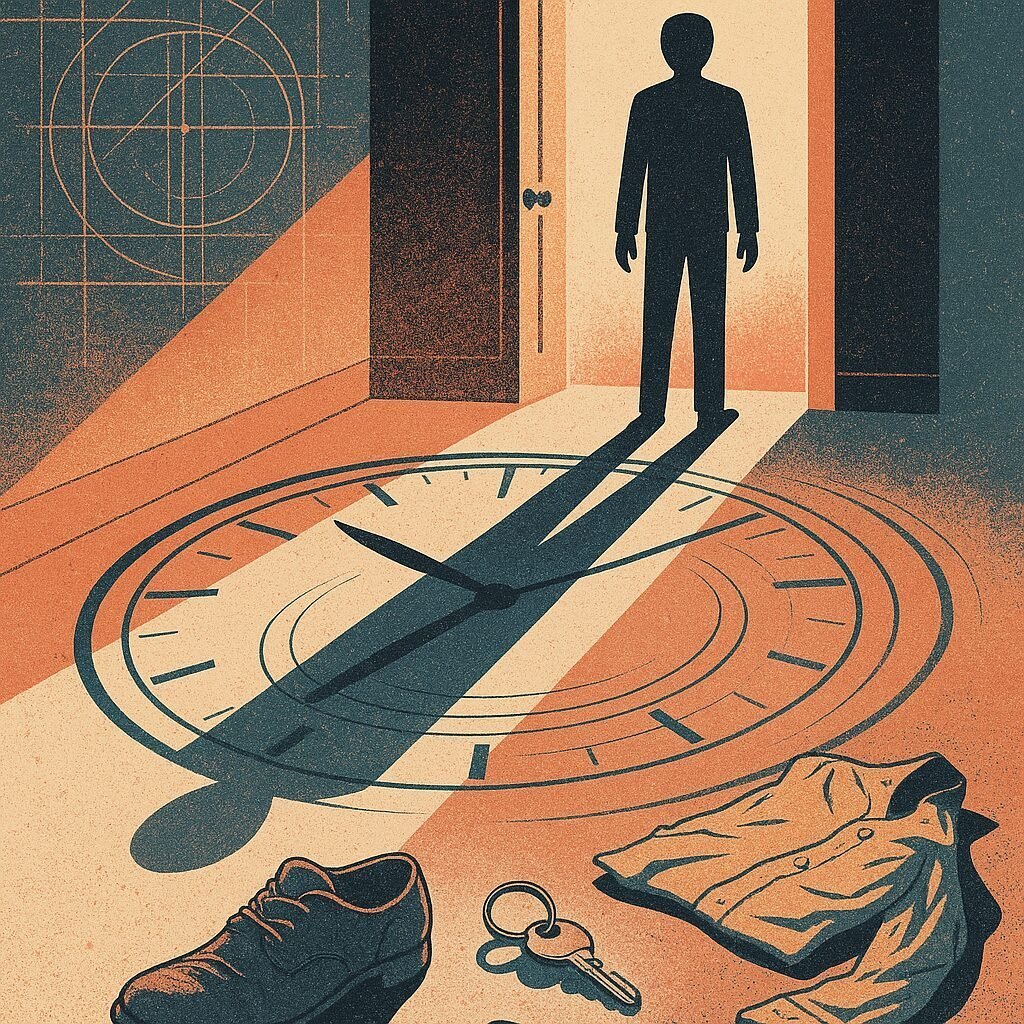
The honest answer, the one nobody wants to give you, is: it depends on whether the instrument is calibrated. Before you can act on the feeling, you have to know whether the feeling is information or noise. Because feelings of safety and danger are not the same thing as safety and danger. They are readings on a meter. And meters can be wrong.
I learned this in my late twenties, the hard way, after something happened to me on a street in a city I loved. The details aren’t the point. The aftermath is. For months afterward I noticed I was having fear responses that did not match my politics, my friendships, or anything I actually believed about other people. My danger-detection system was firing at the wrong stimulus. It had, in the technical sense, gotten broken. The signal coming out of the alarm did not correspond to the thing in front of me.
I remember the moment I clocked it. It wasn’t with shame. I realized I started to feel unsafe around groups of black men– which is strange, cause, uh, I certainly have a history of feeling very safe around ’em, if ya catch my drift. So, I wasn’t really ashamed of being afraid, it was more like: huh, that’s interesting. Kinda weirdly racist, bro. Yeah, way weird. We should probably do something about that.
What I did was force myself to walk up and down Georgia Avenue after dark. Alone. Repeatedly. I would tell myself: it’s getting dark out, just walk. You’re going to feel unsafe the whole time. Nothing is going to happen. The point is not to feel safe. The point is to put the alarm system in front of the actual stimulus, over and over, until it remembered how to read it.
Underneath this is a principle I have not let go of since. Safety is not real. There is no such state. There is only calculated risk assessment, conducted with whatever quality of instrument you currently have. The feeling of safety is not evidence of safety; people die in their sleep. The feeling of danger is not evidence of danger; people refuse to leave their apartments for years over a threat that has long since passed. What exists is risk, all the way down, and our job is to assess it as accurately as we can — which means, first of all, making sure the meter works.
So when I feel unsafe I have two possibilities to choose between. One: I am actually in danger, in which case the feeling is useful and I should act on it. Two: the part of me that detects danger is broken, in which case I should fix it, because I want my danger brain working properly. Both possibilities are worth taking seriously. Neither one is “trust the feeling.”
This is the part of the essay where I usually lose the wellness crowd, so let me make the bridge explicit.
Every Mysore room I have ever taught in contains a student who has just refused a pose because it “feels wrong.” Sometimes they are right. Sometimes the body is sending a real signal — there’s a sharp pain, a structure being loaded badly, a previous injury speaking up. In those cases the alarm is doing its job and we listen.
I need you to know I think it’s essential that students have agency and be able to opt out, modify, or change at any time. They’re allowed to change their mind. It’s essential. That being said– feelings aren’t facts.
No, just as often — more often, honestly — the alarm is mis-firing. The facts aren’t factsin’. The pose is unfamiliar, the breath is short, the heart is up, and the system that is supposed to distinguish “I am about to be hurt” from “I am being asked to do something new” cannot tell the difference. It hits the panic button on both. The student steps out. And then, because they trusted the feeling as if it were the fact, they conclude the pose is dangerous for them. The meter’s malfunction becomes a permanent piece of self-knowledge.
The alarm is not an oracle. It is a piece of hardware. It can be broken, it can be miscalibrated, it can be perfectly accurate. Your job is to know which.
Here is where Mysore practice turns out to be doing something unusual in the wider landscape of how human beings handle fear. Repeated deliberate exposure to the same sequence of stimuli, day after day, year after year, is the exact protocol you would design if you wanted to find out which of your fears were useful signals and which were broken noise. Every morning you walk into the room and you put your body in front of the same set of postures. Some of them will feel fine. Some will feel terrible. Over months and years, the ones that consistently signal real harm get respected and modified. The ones that signal alarm without ever actually producing harm get re-categorized, slowly, as noise. You learn your meter. You learn where it tells the truth and where it lies.
This is not “pushing through pain.” It is the opposite of that, actually. Pushing through pain treats every signal as noise. What I’m describing treats every signal as worth interrogating — but not worth obeying without examination. That distinction is everything. The student who pushes through every signal will eventually hurt themselves badly. The student who obeys every signal will never find out what they are actually capable of, and worse, will mistake the limits of their alarm system for the limits of their body.
The instrument needs calibration. Calibration requires data. Data requires repeated exposure. There is no shortcut.
I think about Georgia Avenue often. I think about how easy it would have been to let that fear settle in and call itself wisdom — to spend the rest of my life believing the alarm because the alarm was loud. To organize my life around avoidance and then, eventually, to mistake the avoidance for safety.
I am glad I didn’t. Not because the walks made me feel safe — they didn’t, not at first — but because they gave me my meter back. And I would rather have a working meter than a comfortable feeling, every time.
So the next time something feels too much — a pose, a conversation, a street, a decision — try the two-option frame. Either you are actually in danger, and the feeling is doing its job. Or the part of you that detects danger needs repair, and avoiding the stimulus is the one thing that guarantees it never gets fixed.
Both options are worth knowing. Only one of them is worth living inside.