
Ozempic may have revealed the brain’s hidden “craving center”
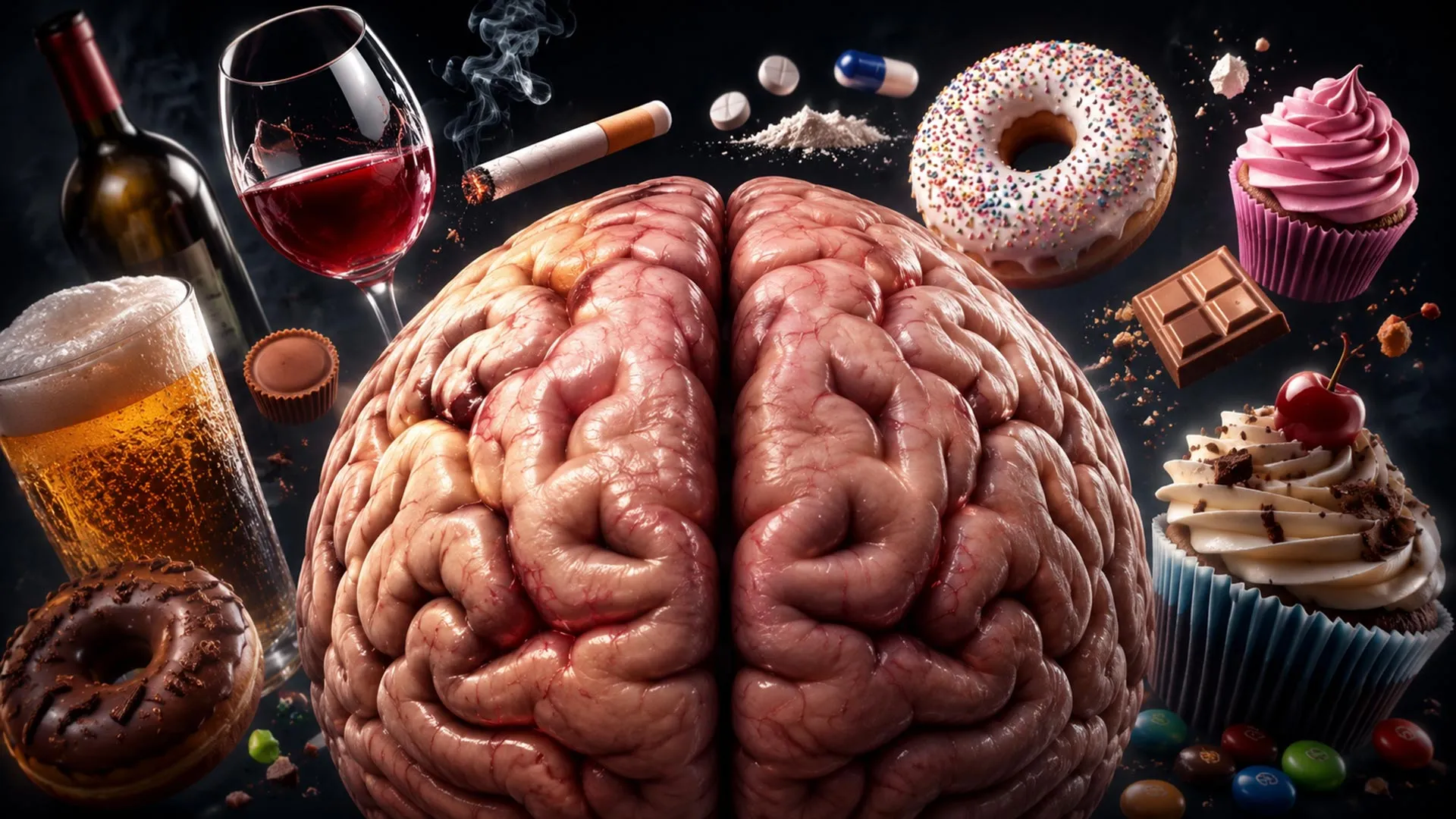 sciencedaily.comOzempic may have revealed the brain’s hidden “craving center”New research suggests GLP-1 agonists like Ozempic reduce cravings for food, alcohol, and drugs not by acting on the classic dopamine reward circuit but through the lateral septum, a brain region dense with GLP-1 receptors. The lateral septum appears to be where the brain links memory and place with✦ Read ad free and get the full MichaelFilter · $5.50
Part of the MichaelFilter
Members read the whole piece — the writeup, the pull-lines, and the full transcript. Unlock access for $5.50.
Unlock the full reading · $5.50 →New research suggests GLP-1 agonists like Ozempic reduce cravings for food, alcohol, and drugs not by acting on the classic dopamine reward circuit but through the lateral septum, a brain region dense with GLP-1 receptors. The lateral septum appears to be where the brain links memory and place with reward value, effectively serving as a 'craving center' that shapes conscious wanting and communicates with dopamine systems.
Teaching:
• Frame Ashtanga's repetition and tristana as direct training for the lateral septum: same place, same time, same sequence rewires what the mind flags as rewarding
• Use this to explain why students crave sugar or scrolling less after a few months of consistent practice, without moralizing about willpower
• Cue attention to breath and drishti as a way to interrupt the memory-to-craving pipeline rather than white-knuckling restraint
• In coaching, reframe cravings as location-based signals so students can redesign environments instead of fighting urges
Writing seeds:
• Essay: 'The Craving Center and the Mat' - how daily practice may be a low-tech intervention on the same circuit Ozempic targets
• Shala Daily post on why the same time and same place ritual of Mysore practice is neurologically load-bearing, not just tradition
• Longform for michaeljoelhall.com on addiction, appetite, and vairagya - what yoga philosophy got right about the mechanics of wanting
• ashtanga.tech piece connecting satiety, interoception, and the functional case for practicing before eating
Idea map:
• Systems literacy: cravings are not character flaws but outputs of a specific neural subsystem that can be observed and retrained
• Practice as method: Ashtanga's fixed sequence and place cells overlap - the room becomes part of the intervention
• Embodiment: what pharma reaches via receptors, breath and posture can reach via attention and repeated context
• Attention: the lateral septum's role in 'thinking about rewards' maps onto classical yoga's diagnosis of citta vrtti
Source: https://www.sciencedaily.com/releases/2026/08/260811011138.htm
Teaching:
• Frame Ashtanga's repetition and tristana as direct training for the lateral septum: same place, same time, same sequence rewires what the mind flags as rewarding
• Use this to explain why students crave sugar or scrolling less after a few months of consistent practice, without moralizing about willpower
• Cue attention to breath and drishti as a way to interrupt the memory-to-craving pipeline rather than white-knuckling restraint
• In coaching, reframe cravings as location-based signals so students can redesign environments instead of fighting urges
Writing seeds:
• Essay: 'The Craving Center and the Mat' - how daily practice may be a low-tech intervention on the same circuit Ozempic targets
• Shala Daily post on why the same time and same place ritual of Mysore practice is neurologically load-bearing, not just tradition
• Longform for michaeljoelhall.com on addiction, appetite, and vairagya - what yoga philosophy got right about the mechanics of wanting
• ashtanga.tech piece connecting satiety, interoception, and the functional case for practicing before eating
Idea map:
• Systems literacy: cravings are not character flaws but outputs of a specific neural subsystem that can be observed and retrained
• Practice as method: Ashtanga's fixed sequence and place cells overlap - the room becomes part of the intervention
• Embodiment: what pharma reaches via receptors, breath and posture can reach via attention and repeated context
• Attention: the lateral septum's role in 'thinking about rewards' maps onto classical yoga's diagnosis of citta vrtti
Source: https://www.sciencedaily.com/releases/2026/08/260811011138.htm
Notes from the field
No notes yet · members & customers welcome
- No notes yet. Be the first to leave one.
Join MichaelFilter
Michael Joel Hall’s daily reading — the field journal, critical-thinking cards, and synthesis — as a membership.
$5.50/month · cancel anytime
Join — $5.50/mo →Secure checkout on theyoga.club. A yearly option ($55) is available there too.