
END OF AN ERA: DUKEM Ethiopian Closing after almost 30 Years on U Street next month.
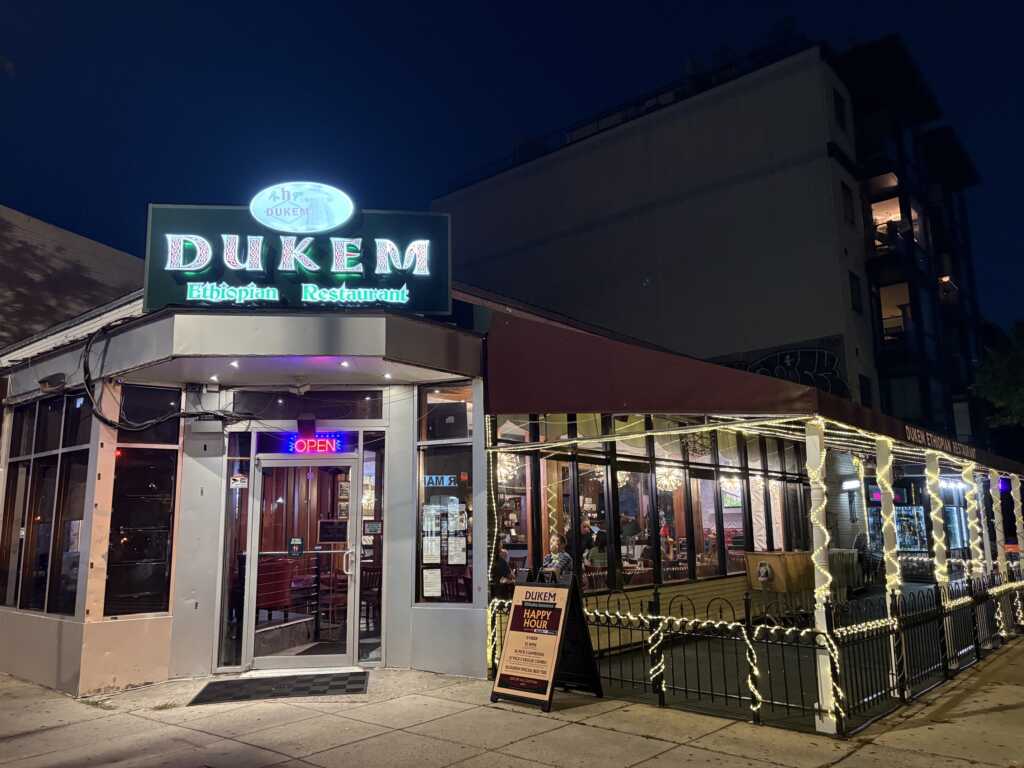 popville.comEND OF AN ERA: DUKEM Ethiopian Closing after almost 30 Years on U Street next month.Dukem Ethiopian Restaurant on U Street NW in Washington, D.C. is closing permanently after nearly 30 years, with final service on November 7. The closure marks the end of a longstanding community institution in a neighborhood that has undergone significant transformation over the past three decades.✦ Read ad free and get the full MichaelFilter · $5.50
Part of the MichaelFilter
Members read the whole piece — the writeup, the pull-lines, and the full transcript. Unlock access for $5.50.
Unlock the full reading · $5.50 →Dukem Ethiopian Restaurant on U Street NW in Washington, D.C. is closing permanently after nearly 30 years, with final service on November 7. The closure marks the end of a longstanding community institution in a neighborhood that has undergone significant transformation over the past three decades.
Teaching:
• Use the lifecycle of neighborhood institutions as a metaphor for practice sustainability: what conditions allow a practice to endure for decades versus what forces entropy
• Explore communal eating (Ethiopian food culture, shared platters) as embodied systems literacy — how we organize around nourishment mirrors how we organize attention in the Shala
• Cue transitions and closures in practice sequences as dignified completions rather than failures: every asana ends, every era ends, every exhale ends
• Frame the Shala as a third place that holds memory and ritual across years — what makes a practice space durable against gentrification of attention
Writing seeds:
• Essay: 'What Closes When a Shala Closes' — on the invisible infrastructure of practice spaces, using Dukem as analog for yoga studios that anchor neighborhoods then vanish
• Shala Daily post: 'Practice as Place' — how showing up to the same room, same time, same sequence builds the kind of institutional memory a 30-year restaurant holds
• Short piece: 'The Economics of Showing Up' — what it costs to keep a practice space (or restaurant, or any third place) alive in a city optimized for turnover
• Post: 'Gentrification and the Attention Economy' — how neighborhoods and practices both face pressure to become something other than what sustained them
Idea map:
• Systems literacy: a 30-year restaurant is a legible system — supply chains, staff rhythms, customer rituals — and its closure reveals which variables were load-bearing
• Practice as method: the repetition that made Dukem a landmark is the same repetition that makes Ashtanga a method — durability through constancy, not novelty
• Embodiment: communal eating and communal practice both require bodies in space over time; both are vulnerable to the same economic and cultural pressures that favor the virtual and transactional
• Attention: a neighborhood institution trains collective attention (where we go, what we return to); its loss is a loss of shared focus, like a Shala closing mid-series
Source: https://www.popville.com/2026/10/dukem-ethiopian-closing-dc-u-street/
Teaching:
• Use the lifecycle of neighborhood institutions as a metaphor for practice sustainability: what conditions allow a practice to endure for decades versus what forces entropy
• Explore communal eating (Ethiopian food culture, shared platters) as embodied systems literacy — how we organize around nourishment mirrors how we organize attention in the Shala
• Cue transitions and closures in practice sequences as dignified completions rather than failures: every asana ends, every era ends, every exhale ends
• Frame the Shala as a third place that holds memory and ritual across years — what makes a practice space durable against gentrification of attention
Writing seeds:
• Essay: 'What Closes When a Shala Closes' — on the invisible infrastructure of practice spaces, using Dukem as analog for yoga studios that anchor neighborhoods then vanish
• Shala Daily post: 'Practice as Place' — how showing up to the same room, same time, same sequence builds the kind of institutional memory a 30-year restaurant holds
• Short piece: 'The Economics of Showing Up' — what it costs to keep a practice space (or restaurant, or any third place) alive in a city optimized for turnover
• Post: 'Gentrification and the Attention Economy' — how neighborhoods and practices both face pressure to become something other than what sustained them
Idea map:
• Systems literacy: a 30-year restaurant is a legible system — supply chains, staff rhythms, customer rituals — and its closure reveals which variables were load-bearing
• Practice as method: the repetition that made Dukem a landmark is the same repetition that makes Ashtanga a method — durability through constancy, not novelty
• Embodiment: communal eating and communal practice both require bodies in space over time; both are vulnerable to the same economic and cultural pressures that favor the virtual and transactional
• Attention: a neighborhood institution trains collective attention (where we go, what we return to); its loss is a loss of shared focus, like a Shala closing mid-series
Source: https://www.popville.com/2026/10/dukem-ethiopian-closing-dc-u-street/
Notes from the field
No notes yet · members & customers welcome
- No notes yet. Be the first to leave one.
Join MichaelFilter
Michael Joel Hall’s daily reading — the field journal, critical-thinking cards, and synthesis — as a membership.
$5.50/month · cancel anytime
Join — $5.50/mo →Secure checkout on theyoga.club. A yearly option ($55) is available there too.